When it is one straw too many for trucking — Chandra Mohan Sinnandavar
OCTOBER 8 — Last week, I had an unpleasant surprise at a petrol station.
Driving home to Klang from Kuala Lumpur, my Myvi was already on its last bar of fuel.
I stopped to refuel, only to realise that I had left my IC behind.
Without it, I could not access the subsidised petrol price and had to pay the full price.
Fifty ringgit barely brought the gauge to half a tank.
It was painful, but I understood the purpose of the constraint and its value to the country.
However, managing fuel quotas for transportation, particularly trucking, needs a different approach.
Trucks are not simply vehicles consuming diesel.
They are productive assets that move our economy.
Almost everything we use has travelled on a truck at some point, including food, construction materials, factory inputs, machinery, containers from ports and products being sent for export.
Without trucks, the supply chain stops.
Fixed diesel quotas already exist under the Subsidised Diesel Control System, or SKDS.
The industry’s concern now is the possibility of a vehicle-level arrangement where the quota allocated to one truck cannot be shared with another truck in the same company.
The industry’s concern is not simply about having a quota.
Operators understand why subsidised diesel must be controlled.
The bigger question is whether a rigid truck-by-truck, non-shareable quota is the right way to achieve that objective.
If the purpose is to prevent leakage, diversion and resale of subsidised diesel, then the control mechanism should focus on identifying misuse.
It should not unintentionally restrict the legitimate movement of goods.
A transport company does not operate every truck in the same way.
Its fleet may contain trucks of different ages, capacities, specifications and fuel efficiencies.
Some may be more suitable for certain customers, cargo or routes.
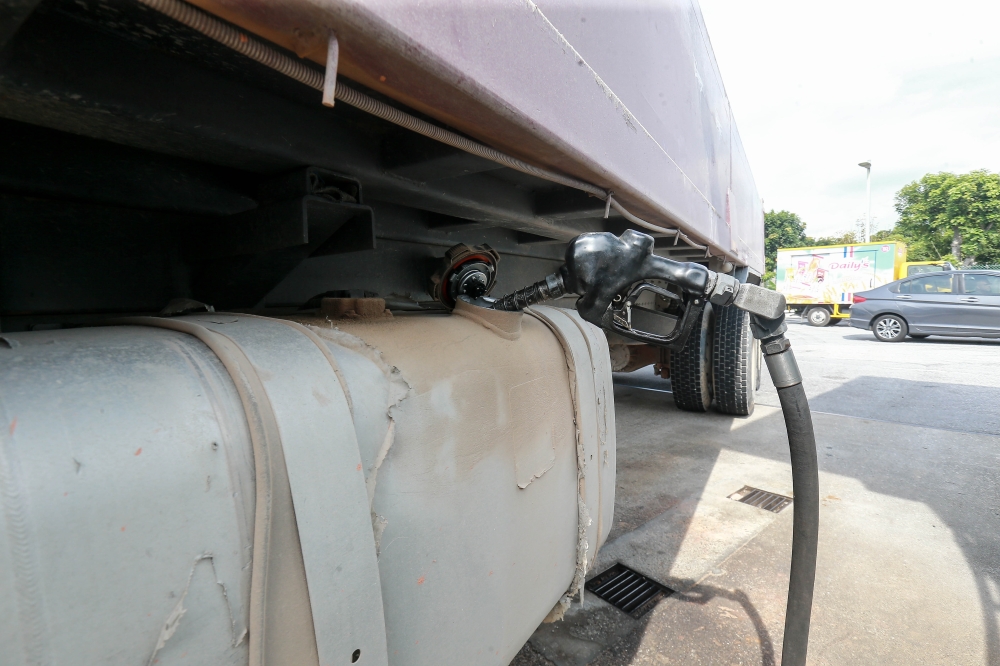
The author argues that rigid, non-transferable diesel quotas for individual lorries could disrupt Malaysia’s supply chains by preventing transport operators from allocating subsidised fuel according to their fleets’ operational needs. — Picture by Sayuti Zainudin
One truck may be heavily utilised in a particular month while another may travel much less.
It is not the same as my wife and me using our respective ICs to fill the same family car after one of us has reached a personal fuel limit.
Trucking is a far more complex business, and trucks cannot simply be switched according to which vehicle has diesel quota remaining.
If a heavily utilised truck reaches its quota while another truck in the same company still has unused quota, what should the operator do?
Park the productive truck until the following month?
Move the job to another truck simply because it still has subsidised diesel available, even when that vehicle may not be suitable for the job?
That does not make operational sense.
There can still be strong controls.
One mechanism could be to verify the total kilometres travelled by a company’s fleet over a certain period, perhaps quarterly.
This would provide a reasonable ballpark figure for the operator’s fuel requirements.
Total kilometres travelled, fuel consumed, and the types of trucks operated would give the authorities a better picture of whether subsidised diesel is being used for legitimate operations.
Trucking also operates in one of the most visible and heavily regulated parts of the supply chain.
Trucks operate on public roads and must comply with requirements involving vehicle condition, inspections, permits, driver licensing, road safety, loading and other operating rules.
They are also subject to enforcement by different government agencies and authorities.
The concern is the cumulative effect.
One regulation by itself may appear reasonable.
Another requirement may also look manageable.
But when more and more operational restrictions are added, their combined effect can make it increasingly difficult and expensive for truckers to operate.
We should therefore be mindful about adding another operational constraint through a non-shareable diesel quota.
The planned third Port Klang terminal on Carey Island will strengthen the country’s future port and logistics capacity.
But bigger ports alone will not make Malaysia a stronger logistics hub.
A supply chain is only as strong as its weakest link.
Our logistics ambitions must therefore go hand in hand by making it easier, not harder, for SME trucking operators to do business efficiently.
Control the subsidy and prevent misuse.
But legitimate diesel consumption should be recognised for what it is, and any new operational requirements should be designed so that they do not unnecessarily constrain legitimate trucking activity.
* This is the personal opinion of the writer or publication and does not necessarily represent the views of Malay Mail.
KioskNews shows a cleaned-up reading view extracted from the publisher’s page — the original always lives on their site, not ours.