Trump eyes China after brief Manila stop, seeking chemistry with Xi amid fresh AI strains
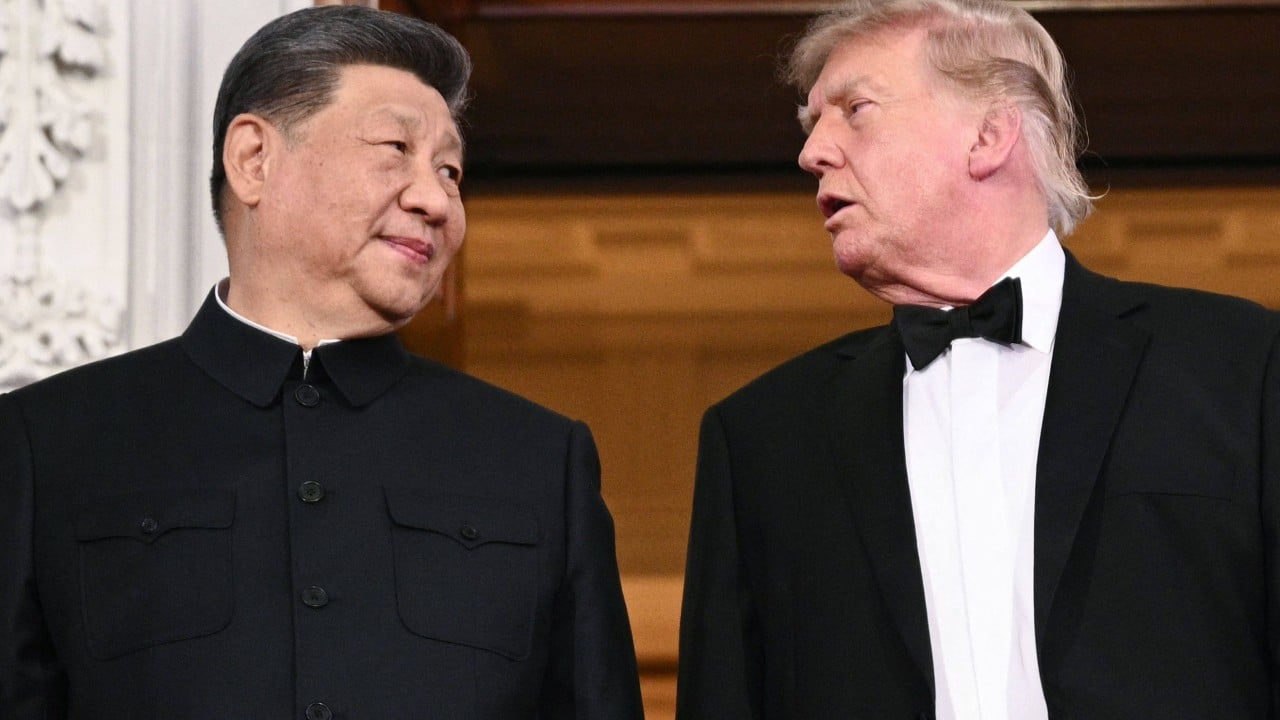
Barely hours after arriving in Manila on Tuesday, US President Donald Trump was already looking ahead to his meeting with Chinese President Xi Jinping in Shenzhen. “We have some very important things to discuss,” he said.
Trump also appeared to be anticipating the reception awaiting him in the southern Chinese tech hub. “I hear we’re going to have quite a landing. It’s going to be a beautiful thing,” he said.
First up, however, was a series of engagements around the Association of Southeast Asian Nations summit in the Philippine capital, setting the tone for his bilateral with Xi later in the week.
These included his first Quad Security Dialogue meeting in two years and a joint statement concluding trade negotiations with Thailand, which is expected to eliminate tariffs on American goods and commit Bangkok to buying an extra US$2.6 billion of US agricultural products annually, as Washington seeks new markets beyond China.
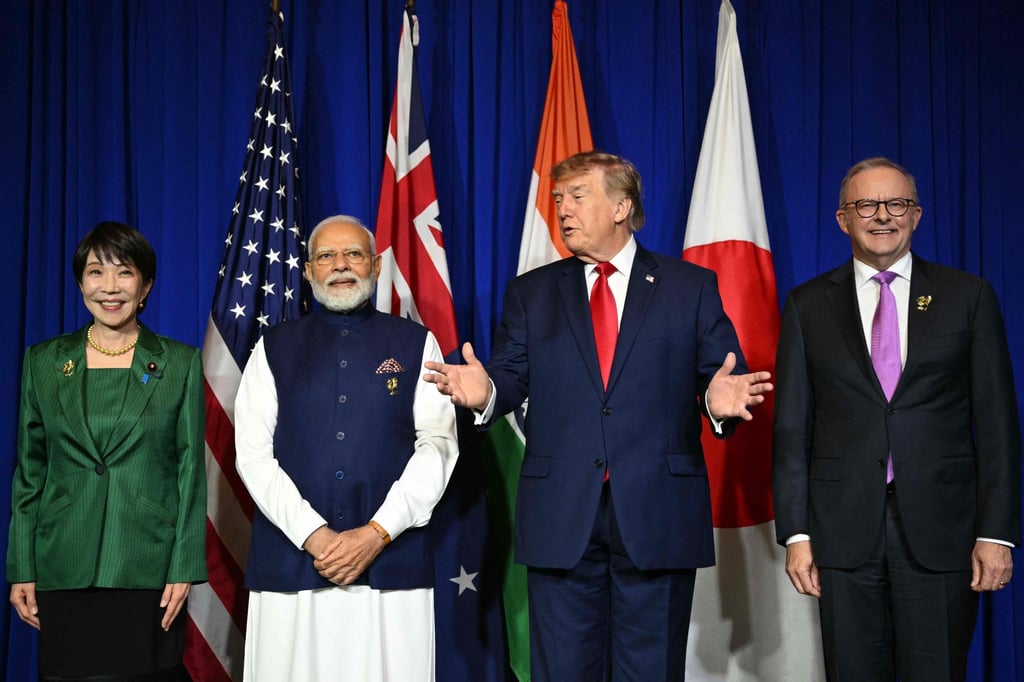
At the meeting of the Quad – an informal four-nation strategic grouping widely viewed as a counterweight to China’s influence in the Indo-Pacific – Trump praised his relationships with fellow members Japan, Australia and India, describing their leaders as “friends of mine”. Cooperation on critical minerals, rare earths and artificial intelligence (AI) featured prominently in the talks.
Later, in remarks at the US-Asean reception, Trump said there was “no better partner on Earth” than Washington – “from energy to technology, to security and far beyond”.
The talks with Xi on the Apec margins will mark their third bilateral encounter this year. Trump also remains open to a one-on-one with Putin and has said he wants to enlist the Chinese and Russian leaders in efforts to end the war in Iran.
Trump also expects the Taiwan issue to feature in his talks with Xi. Asked whether he would raise the matter, Trump suggested the Chinese leader would bring it up himself.
“I’m sure he’ll raise it. I won’t have to raise it. He’s going to raise it,” he said.
28:14
Live: US president Donald Trump attends Asean-US summit
Sun Chenghao, a fellow with Tsinghua University’s Centre for International Security and Strategy, said he hoped the two leaders would make progress on AI safety and crisis communication, while “clearly laying out their bottom lines” on sensitive issues such as Taiwan, as “Trump may have stronger momentum to seek diplomatic wins” after the midterm rout.
However, Sun conceded that “congressional pushes to tighten tech restrictions could narrow his room for negotiations”.
Speaking to reporters in Manila, Trump also floated the possibility of meeting North Korean leader Kim Jong-un. Asked whether this might happen in Shenzhen, Trump said: “We would like to. Yeah, we’ll see what happens”, suggesting that any such encounter would depend on Xi. “I am the guest of President Xi.”
Following on from his state visit to Beijing in May, the visit will also mark the first time across Trump’s two non-consecutive presidential terms that he has travelled to the same country twice in a single calendar year. Unlike six months ago, however, the Shenzhen trip is not a state visit.
“It is significant given it’s the third time the two leaders are coming together. The venue is important because it’s just not hosting the bilateral but also the larger Apec,” Farwa Aamer of the Asia Society Policy Institute said.
“That brings a host of strained bilateral ties including with Japan all on one platform in Shenzhen. Trade, AI and export controls will dominate the US-China agenda but with new US chip export controls, expect a tough bargain when the two leaders meet.”
Denis Simon of the Quincy Institute said that for Trump, Shenzhen’s symbolism was double-edged – a chance to recognise China’s economic achievements and explore commercial deals, but also a reminder that US efforts to curb its technological rise had failed to prevent formidable Chinese competitors from emerging.
“China is no longer simply seeking access to American markets and technology; it is increasingly seeking recognition as a technological power in its own right,” he said.
The reception accorded to Trump will be closely watched.
“Trump rolled out the red carpet for Xi [in September] … but again we didn’t get any substantial results for the United States from that warm reception,” Aamer said. “The devil will be in the details regardless of how warmly or grandly Trump is or isn’t received in Shenzhen.”
00:59
Trump says he might meet North Korean leader Kim Jong-un in China
The last time a sitting US president travelled to China for a multilateral event was in 2016 when Barack Obama went to Hangzhou for the Group of 20 summit.
When Air Force One touched down in Beijing on May 13, China’s vice-president Han Zheng, foreign vice-minister Ma Zhaoxu and top envoy to Washington Xie Feng were on the tarmac.
This is Trump’s first overseas trip since the midterm drubbing suffered by his Republican Party earlier this month. Political observers widely expect him to turn greater attention to foreign affairs – where he retains more latitude – as he heads into a lame-duck session facing a Democratic-controlled Congress.
Travelling with Trump are his Secretary of State Marco Rubio, newly appointed White House Chief of Staff Stephen Miller, Treasury Secretary Scott Bessent, trade envoy Jamieson Greer and Commerce Secretary Howard Lutnick.
02:53
US midterm elections: What the results mean for mainland China, Taiwan and foreign policy
Technology tensions with China are already surfacing. The Nvidia controversy centred on former CEO Jensen Huang has become an especially sensitive issue for Washington, involving allegations that advanced US chips were diverted to Chinese interests through Singapore-based Megaspeed International.
At the centre of the dispute are Bessent and Lutnick, who have differed over the handling of the case, including the timing of restrictions on Megaspeed. Bessent has publicly called for closer scrutiny of Nvidia’s compliance with export controls, while Lutnick has faced questions over his department’s handling of the restrictions.
Asked about the competing views of his two senior officials ahead of the China visit, Trump sought to play down the differences. “They’ve handled that very well. It’s two opinions. It’s two lines of thought. They’ve handled it very well,” he said.
Just two days before Trump’s arrival in Shenzhen, the US Commerce Department introduced new measures to restrict Chinese companies from accessing advanced American AI chips through data centres in Southeast Asia.
Beijing condemned the rules as running counter to common understandings between the two countries. “China will do what is necessary to firmly safeguard its legitimate and lawful rights and interests,” foreign ministry spokesman Guo Jiakun said on Tuesday.
02:29
Why Jensen Huang’s resignation may not be final
One of the biggest items on the agenda in Shenzhen is likely to be rare earths, an area in which China’s dominance gives it considerable leverage. In Manila, Trump sought to project confidence that the US could overcome that dependence.
“We are making rare earths at a level that we’ve never made before,” he said at the Quad meeting. “We’re moving at a pace that nobody believes is possible.”
AI will be another major focus. Trump said the four Quad partners wanted to ensure that the future of the technology was “dominated by nations that share our values and our common interests”.
Additional reporting by Alyssa Chen, Orange Wang, Fan Chen, Dewey Sim, Cao Jiaxuan and Amber Wang
KioskNews shows a cleaned-up reading view extracted from the publisher’s page — the original always lives on their site, not ours.