Chinese carmakers gear up European production to sidestep tariffs, import quota
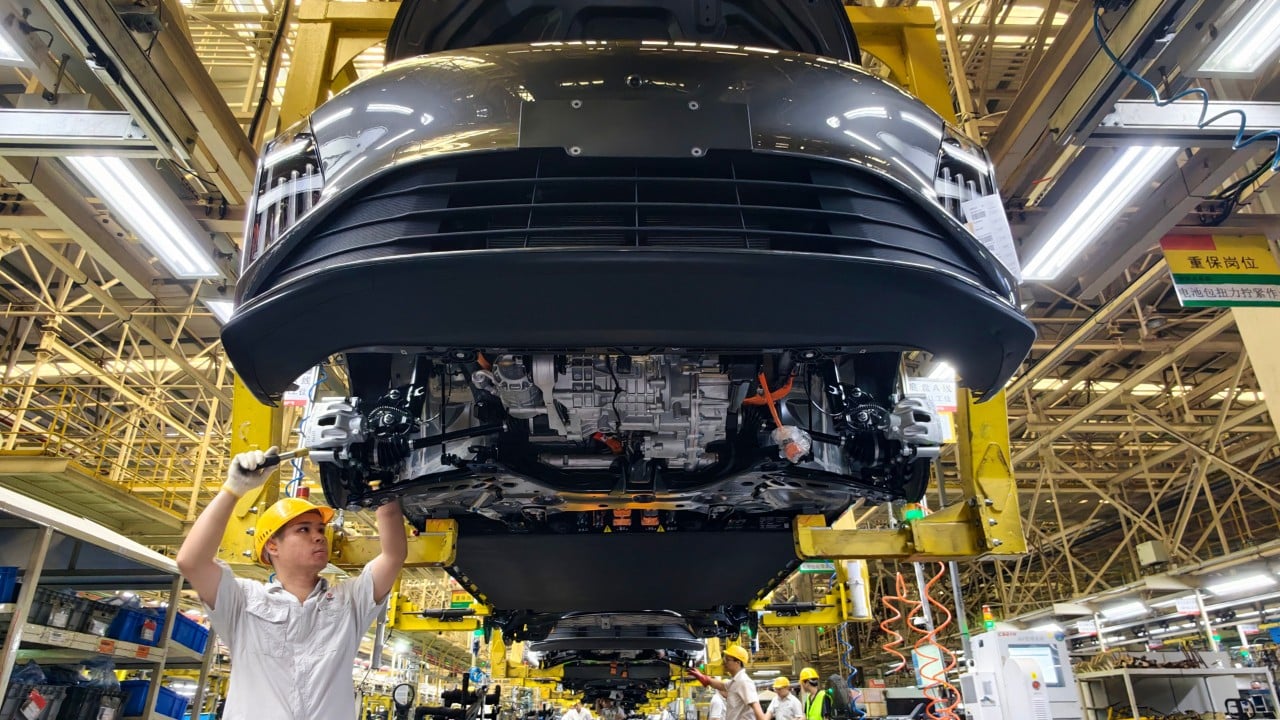
Chinese carmakers, facing a European Union import quota targeting their hybrid electric vehicles (EVs), are gearing up for more local production to reinforce their go-global drive.
They plan to either splash out billions of yuan to set up their own factories or tap international marques’ idle plants to build their vehicles, looking to sustain a sales boom in one of the world’s major automotive markets.
“Global growth shifts from exporting vehicles to Europe to producing them locally, from price-led market share gains to margin-led positioning, and from a single export channel to a multimarket footprint,” Morgan Stanley analysts said in a research note issued last week after Beijing and Brussels agreed on an import quota for Chinese-made hybrid vehicles.
“Such a development would favour Chinese EV leaders with the scale, balance sheets and European manufacturing plans already in motion to pivot quickly.”
On October 9, China and the EU reached an “understanding” on trade that would see Brussels impose a quota on imports of Chinese-made hybrid vehicles from next year. The European Commission was likely to grant an initial annual quota of 350,000 units, and would increase it by 6 per cent a year over the following four years, Bloomberg reported.
Analysts said idle plants in Europe could be highly sought after by Chinese carmakers looking to localise production to sidestep the import quota on hybrid cars and high tariffs imposed on pure EVs.
The EU currently subjects Chinese-made pure electric cars to tariffs ranging from 17.8 per cent to 45.3 per cent.
Our plans for local production in Europe are largely set
On October 12, Zhao Fei, president of state-owned Changan Automobile, told a news conference during the Paris Motor Show that it would be able to produce 180,000 units in the EU in 2028 through a tie-up with a local partner, and would increase that annual production capacity to 300,000 cars in 2030.
“Our plans for local production in Europe are largely set,” Zhao said. “We are in active discussions with our partner and expect to announce the details before the end of this year.”
BYD, the world’s largest EV manufacturer, was considering building factories in France and Spain, executive vice-president Stella Li told Bloomberg on October 12.
The Shenzhen-based company announced early this year that its plant in Hungary would begin operations in the fourth quarter of this year.
“Chinese carmakers have been cautious on setting up their own factories in Europe because of concerns about costs and regulatory hurdles,” said Qian Kang, the owner of a vehicle circuit board factory in Zhejiang province. “They are now seeking to create joint-venture factories or enlist local contract manufacturers to make their cars in Europe, where demand for their products is rising quickly.”
SCMP Plus is a new premium news platform that gives you an
all-inclusive edge to stay ahead on China news.
To access our exclusive content you’ll need to subscribe.
Already a subscriber?
LOG IN
Two years ago, Chery Automobile said it would build cars with Spanish partner Ebro at a former Nissan factory in Barcelona, and expected to begin deliveries at the end of this year or in the first quarter of 2027.
In early May, Dutch-based multinational Stellantis said it had deepened its strategic partnership with Chinese EV maker Leapmotor, aiming to add an EV production line at a Spanish factory previously earmarked for petrol-powered Opel vehicles. Stellantis owns a 21 per cent stake in Leapmotor.
In July, Geely Auto, China’s second-largest carmaker, signed a deal with Ford Motor to use the American company’s redundant capacity in Spain to build its EVs.
China shipped 452,000 hybrid cars to the EU in the first half of this year, according to data from the European Automobile Manufacturers’ Association.
JPMorgan said in a report released last week that the quota could “deal a serious blow to Chinese carmakers” as it estimated that the country’s exports of hybrid vehicles to the EU could top 800,000 units this year.
Chinese EV makers, buoyed by government subsidies and consumers’ willingness to embrace new technologies, have leapfrogged their European and American counterparts in developing smart pure electric and hybrid cars, sparking European fears about exports of excess production to the EU.
The EV issue “is something that China needs to be aware of because it will create more and more restrictions and will create more and more friction between the two economies,” said Carlo Diego D’Andrea, vice-president of the European Union Chamber of Commerce in China and chairman of its Shanghai chapter.
“Some European car plants may be closed, and some of them may be restructured in order to optimise the workflow,” he said.
D’Andrea added that negotiations on China’s EV exports were at a crucial stage as Beijing and Brussels attempted to find common ground to stabilise trade relations.
KioskNews shows a cleaned-up reading view extracted from the publisher’s page — the original always lives on their site, not ours.