Turkish filmmaker dedicates IFFI’s Gandhi Medal to Palestine, calls for ‘rebirth of humanity’
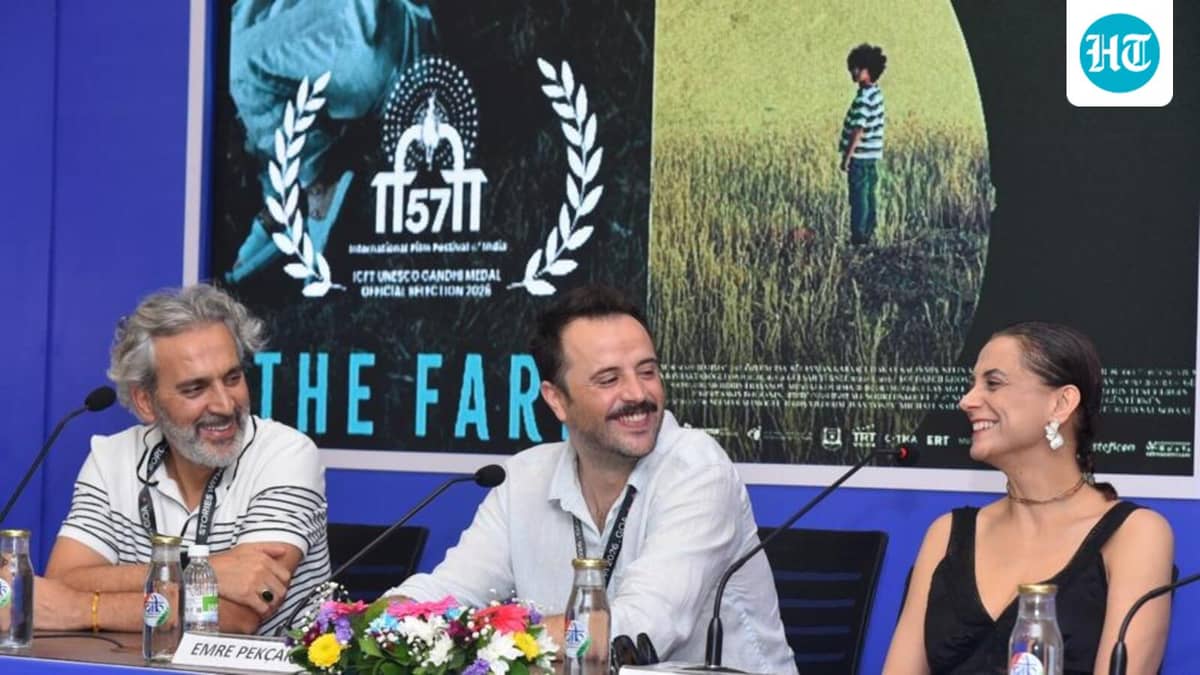
A Turkish filmmaker turned the closing ceremony of the International Film Festival of India (IFFI) in Goa into a moment of reflection on Palestine, dedicating his ICFT-UNESCO Gandhi Medal to “the rebirth of humanity we lost in Palestine” and the children of Gaza. Faysal Soysal, whose film Rahma won the award, delivered his message through a friend, calling for leaders in the spirit of Mahatma Gandhi to speak up against oppression and champion peace.
Soysal, who was not present at the ceremony, conveyed his acceptance message through his friend and cinematographer Emre Pekçakır. His film Rahma was selected from among 10 shortlisted films competing for the medal, which recognises works that reflect the ideals espoused by Mahatma Gandhi.
“Throughout history humanity has survived its darkest times because good people united with hope and faith to resist oppression. Yet over the past three years in Gaza the world has never felt so helpless in the face of a genocide unfolding right before our eyes where children are destroyed by starvation and hospitals by bombs,” Soysal said.
“Despite politicians choosing silence out of fear and self interest, people of conscience are out in the streets and refuse to be silenced. Today we need leaders like Gandhi to call humanity back to shared justice, freedom and universal peace,” he added.
“Every child breathing in the world today grows with the spirit of the honourable resistance in Palestine and all free people of the world deeply feel its presence. That is why I dedicate this UNESCO Gandhi medal to the rebirth of humanity we lost in Palestine and especially to the Children of Gaza who are still alive and who have not lost hope in us and to their future,” he said.
Rahma follows a couple who are unable to conceive despite undergoing multiple surgeries and failed in-vitro fertilisation (IVF) attempts. The woman’s journey takes an unexpected turn when she meets Rahma, a nine-year-old Syrian orphan living on the margins of society.
Meryem, the woman, is initially wary of adoption because of her own traumatic childhood with a stepmother. But as an emotional and mystical bond develops between her and the child, she begins to question her original intentions and discovers new possibilities.
The jury described Rahma as a “highly accomplished work with delicate direction, creating an emotional film with empathy. A human story with remarkable sensibility, exceptional performance by the actors particularly actress Deniz and the young non professional Nagam Virach, whose interpretation is noteworthy.”
“Motherhood is not just about giving life but about saving it,” the jury said.
Ten Indian and international fiction feature films competed for the prestigious ICFT-UNESCO Gandhi Medal at the 57th International Film Festival of India (IFFI). The shortlisted films explored themes of peace, tolerance, empathy, social justice and intercultural dialogue, in keeping with the festival’s overarching theme, ‘Stories Without Borders’.
The award was instituted at the 46th edition of IFFI in collaboration with the International Council for Film, Television and Audiovisual Communication (CICT-ICFT), Paris, under the aegis of UNESCO. It recognises films that reflect Gandhi’s ideals of non-violence, tolerance, intercultural understanding and a culture of peace.
The four-member international jury was headed by Prof. (Dr.) Ahmed Bedjaoui of Algeria, a university professor, filmmaker, producer and film critic. The other members were Maria Cristina Iglesias of Argentina and France, former head of programme at UNESCO’s Cultural Sector; Georges Dupont of Luxembourg, former director-general of CICT-ICFT; and Manouj Kadaamh of India, an internationally acclaimed filmmaker and ICFT member.
India was represented by three films in the competition. Kabir Sir ka Akhri Lesson (Kabir Sir), directed by Sarfaraz Alam and starring Vinay Pathak, explores the challenges faced by veteran educators in the age of technology and had its world premiere at the festival. Scroll, directed by Kannan S, examines smartphone addiction through the unsettling experiences of a young man who uses an app-based game to control his screen time. Sev Micchar, the debut feature of Muskan Asthana, explores family tensions, rivalry and reconciliation through the story of a shopkeeper facing financial and personal challenges.
KioskNews shows a cleaned-up reading view extracted from the publisher’s page — the original always lives on their site, not ours.