From satellite links to passport-free crossings: How this Japanese tech firm builds on its Singapore partnership
A motorcyclist pulls up to an automated lane at Woodlands Checkpoint, scans a QR code and rides through the entry barrier. He then looks into a camera, and the exit barrier lifts. Just like that, he has cleared immigration, with no need to scan a fingerprint or show a passport.
It may seem like a small convenience, but at the busiest land crossing in the world, every second counts. For the thousands of motorcyclists who commute between Singapore and Malaysia, even small delays quickly add up, especially when the weather turns.
Since its launch at Woodlands Checkpoint on March 31, 2026, face recognition has been implemented for motorcyclists’ immigration clearance at both of Singapore’s land checkpoints. Building on the QR code clearance introduced earlier, it has allowed faster and more seamless immigration clearance.
Behind the technology is Japanese information and communications company NEC Asia Pacific (APAC), which worked closely with the Immigration and Checkpoints Authority on the rollout. It marks the latest chapter in NEC’s partnership with Singapore, one stretching back nearly half a century, from linking the country to the world to helping build trusted digital identities.
Digital identity is easy to overlook, yet much of modern life rests on it. Crossing a border, logging in to a government service or proving eligibility for a transaction all depend on being able to show, securely, that you are who you say you are.
NEC supplies the technology behind such moments, so that people, businesses and governments can deal with one another safely and seamlessly. In Singapore, NEC has long worked with the authorities on identity and border management – yet the relationship goes back further.
A partnership that began in 1970
NEC’s story here began with a different kind of connection: linking Singapore to the rest of the world via satellite. In August 1970, NEC, then known as Nippon Electric Company, won the contract to build Singapore’s first satellite earth station on Sentosa, including its tower, antenna dish and communications equipment. When the station went into operation on Aug 8, 1971, its first live telecasts included news from Japan’s NHK, the Australian Broadcasting Commission and the British Broadcasting Corporation.
By then, NEC already had more than 70 years of history behind it. It was founded in 1899 as Japan’s first joint venture with a foreign company, by Kunihiko Iwadare, who had worked under Thomas Edison in the United States.
NEC established a permanent presence in Singapore in 1977, and has since grown into NEC APAC, the group’s regional headquarters and its base for supporting customers and driving innovation across South-east Asia. Today, NEC has about 110,000 employees worldwide, working across AI, security and communications technology.
“For nearly five decades, NEC has grown alongside Singapore,” says Takayuki Inaba, chief executive officer and president of NEC APAC. “Long before AI became today’s headline, NEC was helping connect Singapore to the world through telecommunications infrastructure, from satellite communications to today’s submarine cable networks, while also supporting national technology platforms such as digital identity. Over the years, our focus has expanded from enabling connectivity and infrastructure to co-creating digital solutions.”
From that single dish on Sentosa, NEC’s work here has made Singapore one of the company’s flagship references for digital identity.
Biometrics solutions have been exported to the rest of South-east Asia to make everyday interactions more secure and convenient such as in the Philippines, where opening a bank account or withdrawing cash can be done without a card.
In Vietnam, NEC provided its Automated Biometric Identification System for the National Population Database and National ID project, helping to lay a trusted foundation for the country’s digital identity system.

Face recognition* is one of NEC APAC’s best-known strengths, part of a wider portfolio that spans digital identity, cybersecurity, financial solutions, managed services, digital services and AI.
PHOTO: NEC APAC
Sunny Ho, head of regional sales and delivery at NEC APAC, leads one of the teams making these applications of biometric technology possible. The Singaporean, who has been with the company for more than 14 years, oversees the design and delivery of NEC’s biometric projects for governments and banks across South-east Asian markets beyond Singapore.
Ho says every project starts with the client rather than the technology: understanding their existing systems and how they operate. Only then does the team design a solution, combining core biometric technology from NEC’s Japan team with the Singapore team’s know-how in regional solution design and delivery. The two sides work closely together from start to finish.
“It’s rewarding to work on projects where expertise from Japan and Singapore comes together to solve real-world challenges,” says Ho. “Seeing technology improve security and convenience for millions of people across the region makes the work meaningful.”
Built on co-creation
Looking ahead, the team plans to expand its use of AI. According to Ho, the technology already improves the accuracy, speed and reliability of biometric matching, with machine learning helping systems recognise people across different settings and image conditions while reducing false matches. The aim now is to use it to drive deeper design innovation, and help customers streamline how they process data and monitor operations.
“Singapore’s stability, pro-innovation environment, strong digital infrastructure and position as a gateway to South-east Asia have made it a strategic hub for NEC’s ASEAN business for decades,” says Inaba.
“From Singapore, we combine Japanese technological expertise with local talent, research capabilities and partnerships to co-create solutions for customers across the region. By bringing together global innovation and local insight, we are creating what’s ahead for our customers and communities, reflecting the evolution of the Singapore-Japan relationship from technology transfer to technology co-creation.”
Innovation in action
Developed jointly by teams in Singapore and Japan, the two solutions are now being used in other markets
Fever checks in airports
In 2020, during the Covid-19 pandemic, NEC Laboratories Asia Pacific, then NEC Laboratories Singapore, responded to a tender from Hawaii’s airports for a safer way to screen arriving travellers. The system paired thermal cameras with NEC’s face recognition to spot travellers with a raised temperature in a moving crowd without staff at screening points, meaning fewer officers and less exposure risk for frontline staff.
Timing every factory motion
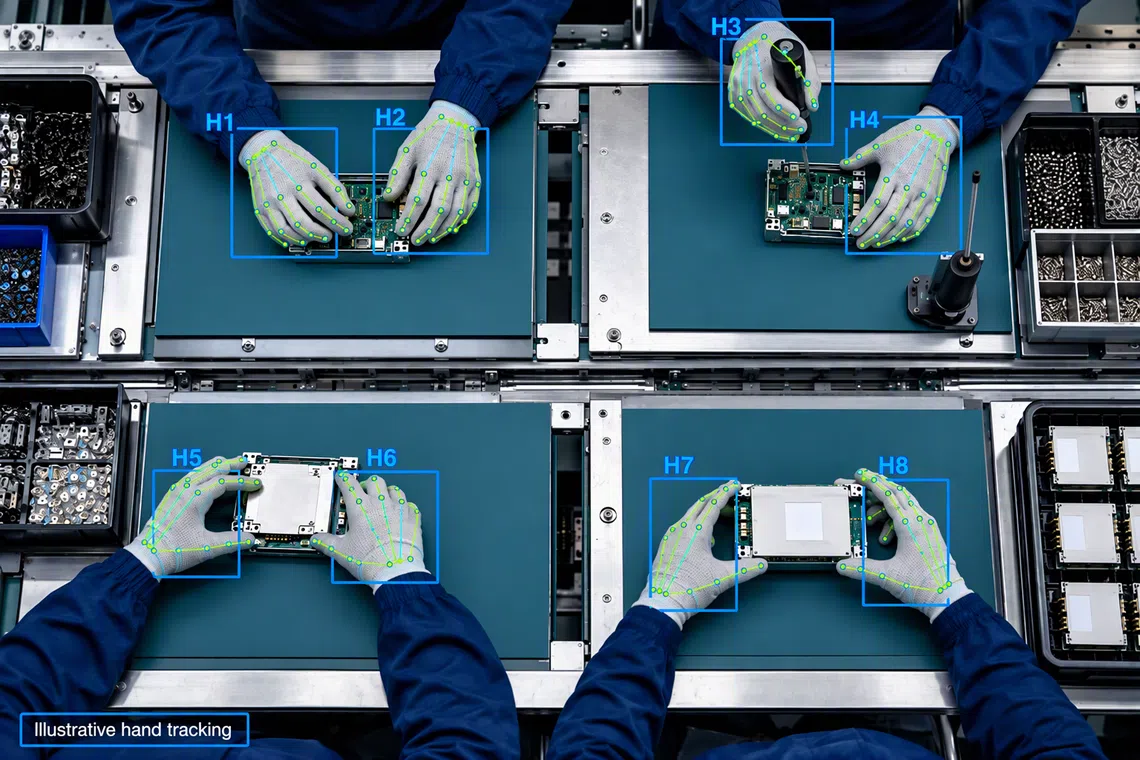
NEC’s Cycle Time Estimation uses computer vision to help manufacturers find where processes slow down.
PHOTO: NEC APAC
Cycle Time Estimation uses overhead cameras and computer vision to follow workers’ hand movements and time each repetitive task, showing manufacturers where processes slow and productivity can improve. The Singapore-born idea has since been passed to NEC’s Japan team to be developed into a commercial product.
* NEC ranked No.1 several times as the world’s most accurate face recognition technology in vendor tests conducted by the US National Institute of Standards and Technology (NIST). Results shown from NIST do not constitute an endorsement of any particular system, product, service or company by the US government.
KioskNews shows a cleaned-up reading view extracted from the publisher’s page — the original always lives on their site, not ours.