BOOK REVIEW: Caryn Dolley: The unbearable weight of the untouchables
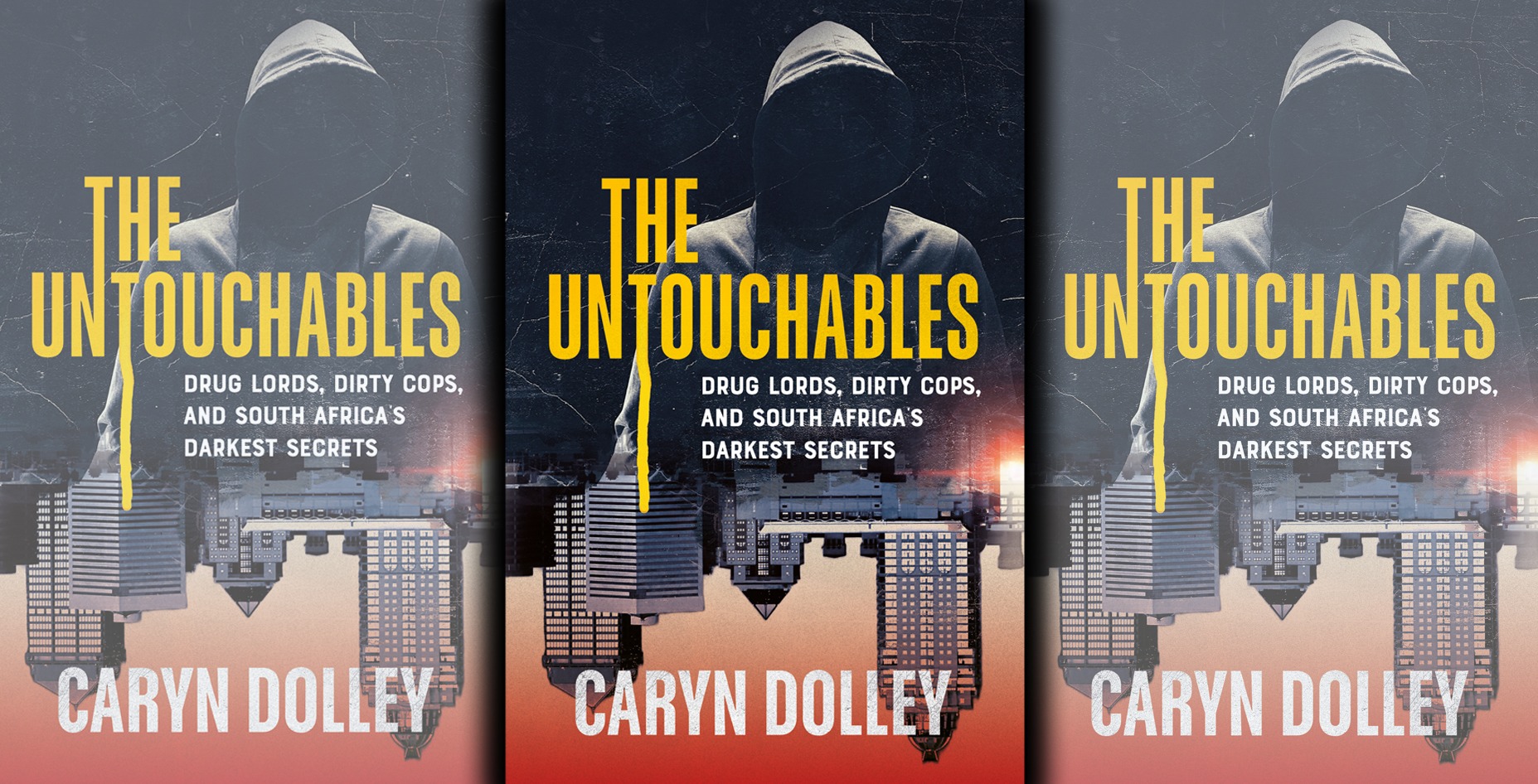
If Caryn Dolley had asked me whether she should publish The Untouchables, I’d have advised her not to.
Not because it is poorly researched, recklessly argued or unconvincing. Quite the opposite. I would have urged caution because the book is explosive. It exposes the myriad connections between international drug traffickers, Cape Town gangsters, rogue intelligence operatives, police officers, government officials, businesspeople and politicians. Many of those implicated in this world are not going to like what Dolley has written. They’re also dangerous.
As a criminologist and historian who has spent years working among Cape Town gangsters and who has written several books on crime, including Gang Town, I have some understanding of the risks she’s taking.
South Africa – and Cape Town in particular – is an extremely perilous place at this level, with the drug trade at its core. Murders pile up with numbing regularity, while those who order them frequently remain several careful steps removed from the gunmen.
Dolley knows this landscape better than any other journalist. She is, without question, the finest and bravest crime reporter working in South Africa today. She walks where few journalists dare to go and keeps walking long after most would sensibly have turned back.
Early in the book she writes: “Digging into organised crime in South Africa is unnerving and dangerous.” This is not dramatic throat-clearing. It is a plain statement of fact. She describes being warned, watched and photographed and living with the suspicion that people she investigates are, in turn, investigating her. At one point she records her “distinct impression” that she is being watched – and has been watched for some time.
Dolley has an elephantine memory for facts. She stores names, meetings, killings, allegations and apparently incidental moments, sometimes for years, before recognising how they fit into the enormous puzzle of national and transnational crime.
A murdered gangster in Cape Town, a fugitive Serbian assassin, a shipment intercepted in Australia, a corrupt firearms licence, a politically connected businessman and an Indian drug trafficker may initially appear unrelated. Dolley patiently follows the threads until the shape of the web becomes visible.
Her central proposition is that South Africa’s “underworld” is not really under anything. It operates around and among us, woven into legitimate business, policing, politics and everyday life. As she observes, criminality plays out “blended into legal activity and our everyday lives”. We notice it only when violence tears away the disguise.
We too often imagine organised crime as something conducted by tattooed men in shadowy rooms. Dolley shows us a different and more disturbing picture. “Traffickers come in every disguise,” she writes. “The purported investigator. The pious businessperson. The slick politician.”
Running through the book is Dolley’s fascinated tracking of KwaZulu-Natal police commissioner Nhlanhla Mkhwanazi, the policeman whose extraordinary public allegations detonated what she describes as a seismic national scandal.
Mkhwanazi alleged that a drug-trafficking cartel had penetrated South Africa’s criminal justice system, politics and private security. Among those he implicated – and who deny wrongdoing – is then police minister Senzo Mchunu. Dolley watches with something approaching astonishment as themes she’s pursued for more than two decades suddenly burst into the open at the highest levels of the state.
The cartel Mkhwanazi identifies is known as the Big Five. Its name may evoke South Africa’s most celebrated animals, but the reality Dolley describes is altogether more predatory: a conglomeration of criminals, fixers and allegedly compromised officials able to influence investigations, protect selected suspects and turn parts of the state against others.
Mkhwanazi’s claims remain allegations and Dolley is careful to say so. But they fit with disturbing precision into the architecture she has painstakingly mapped across her reporting and previous books. His intervention is not a digression from her story. It’s the moment when much of that story appears to erupt into public view.
The book reads at times like a detective’s case file or a prosecutor’s docket. Names and dates accumulate. Allegations intersect with denials; court records collide with intelligence claims; one murder opens a path to another, then another. Dolley moves between the Cape Flats and Gauteng, India and Kenya, Serbia and Australia, mapping trafficking routes and the human alliances that sustain them.
If the book has a fault, it’s that it can be bewilderingly complex. The cast is vast and the chronology loops backwards and forwards. Yet this complexity is partly the point.
Dolley has too much to tell and the criminal networks she investigates do not arrange themselves into a neat narrative for the reader’s convenience. They’re deliberately opaque, fragmented and layered. Confusion is one of the protections behind which powerful criminals shelter.
Dolley acknowledges that The Untouchables is “detail-dense”, and it is. But those details are the evidence. Remove too many of them and the connections begin to look speculative. Keep them, and the reader starts to grasp the scale of the structure she’s describing.
Reading the book, I found myself thinking that Dolley would make a damn fine member of the legal profession. She has a prosecutor’s instinct for sequences, contradictions and corroboration. She understands the difference between what is known, what is alleged and what can be proved. She carefully records denials and repeatedly reminds us when claims remain untested.
But as a journalist, she’s able to do much more. She is analytical, provocative and incisive, but can also be very funny. She writes beautifully, even when describing terrible things.
Of the murdered underworld figure Cyril Beeka, for example, she writes: “Beeka ran with feral packs – stepping on tails, stomping on paws – and teeth were inevitably bared at him.” Then the bullets arrive.
What gives the book its emotional force is the relentless human cost behind the architecture of crime. Dolley has visited too many murder scenes and funerals, including the funerals of children. She writes of images of bodies “catalogued in the crevices of my mind”.
The murder of police detective Charl Kinnear illustrates how assassination can destroy not only a person but also the possibility of justice.
Kinnear had intimate knowledge of investigations into police officers allegedly facilitating firearms licences for criminals. Dolley’s conclusion is devastatingly concise: “Killing Kinnear meant killing investigations into police officers who were allegedly arming the very criminals they were meant to stop.”
This is what makes The Untouchables so frightening: not simply the power of criminal syndicates, but their apparent ability to penetrate or neutralise the institutions intended to stop them. Dolley quotes allegations that the 28s gang had infiltrated policing and threatened Western Cape prosecutors. She documents investigators obstructed, evidence disappearing, cases collapsing and witnesses or central figures being murdered.
The title poses the book’s most troubling question. How do people accused of such grave crimes remain untouchable? Some have protection. Some have money. Some possess compromising information. Others have cultivated relationships with police officers, intelligence operatives or politicians.
And when these protections fail, inconvenient people can be eliminated, taking part of the truth with them.
Dolley’s bleakest summation may also be her most powerful: “The country’s freedom is cut with narcotics.” The huge profits generated by drugs do not remain in the underworld. They seep upwards into businesses, state institutions and political structures, buying silence, influence and impunity. As Dolley puts it, trafficking depends upon corruption – upon a captured state – in order to thrive.
The Untouchables is courageous investigative journalism of the highest order. It’s also a warning. South Africans cannot continue to treat gang killings, drug trafficking, police corruption and political criminality as separate problems. They are strands of the same blood-soaked system.
I still think publishing it is dangerous. But also I’m very glad Caryn Dolley dared to. This stuff needs to be known. DM
KioskNews shows a cleaned-up reading view extracted from the publisher’s page — the original always lives on their site, not ours.