‘SNL’ Just Exposed Its Most Troubling Double Standard With Shane Gillis' Episode

Amanda M. Castro is a Network TV writer at Collider and a New York–based journalist whose work has appeared in Newsweek, where she is an Associate Editor, and The U.S. Sun, where she previously served as a Senior Consumer Reporter.
She specializes in network television coverage, delivering sharp, thoughtful analysis of long-running procedural hits and ambitious new dramas across broadcast TV. At Collider, Amanda explores character arcs, storytelling trends, and the cultural impact of network series that keep audiences tuning in week after week.
Born and raised in Puerto Rico, Amanda is bilingual and holds a degree in Communication, Film, and Media Studies from the University of New Haven.
For years, television has produced some truly remarkable moments of unexpected disasters during live broadcasts. However, the most memorable moments on Saturday Night Live don't get the same attention. Shane Gillis learned that when, during his third hosting gig on Saturday, October 10, he let slip an F-word on air during a skit, the audience reacted with discontent, and he apologized well before the show ended. Yet the episode’s more troubling moment wasn’t a slip of the tongue. It was a deliberate joke about women that made their bodies the punchline and treated men’s responsibility for their own behavior as an unreasonable demand.
Gillis’s accidental swearing was a genuine broadcast blunder, and he acknowledged it. His opening monologue, however, raised a different question about what SNL considers acceptable comedy. When a comedian can accidentally utter a forbidden word on live television and feel compelled to apologize, but can deliberately describe women in degrading sexual terms for a national audience, the priorities start to look questionable. The issue isn’t that the show aired an offensive joke; it is more so that the joke’s framing shows how easily misogyny can pass as humor, even on a program that knows exactly how to recognize a mistake when it hears one.
Shane Gillis’ ‘SNL’ Monologue Made Women the Punchline
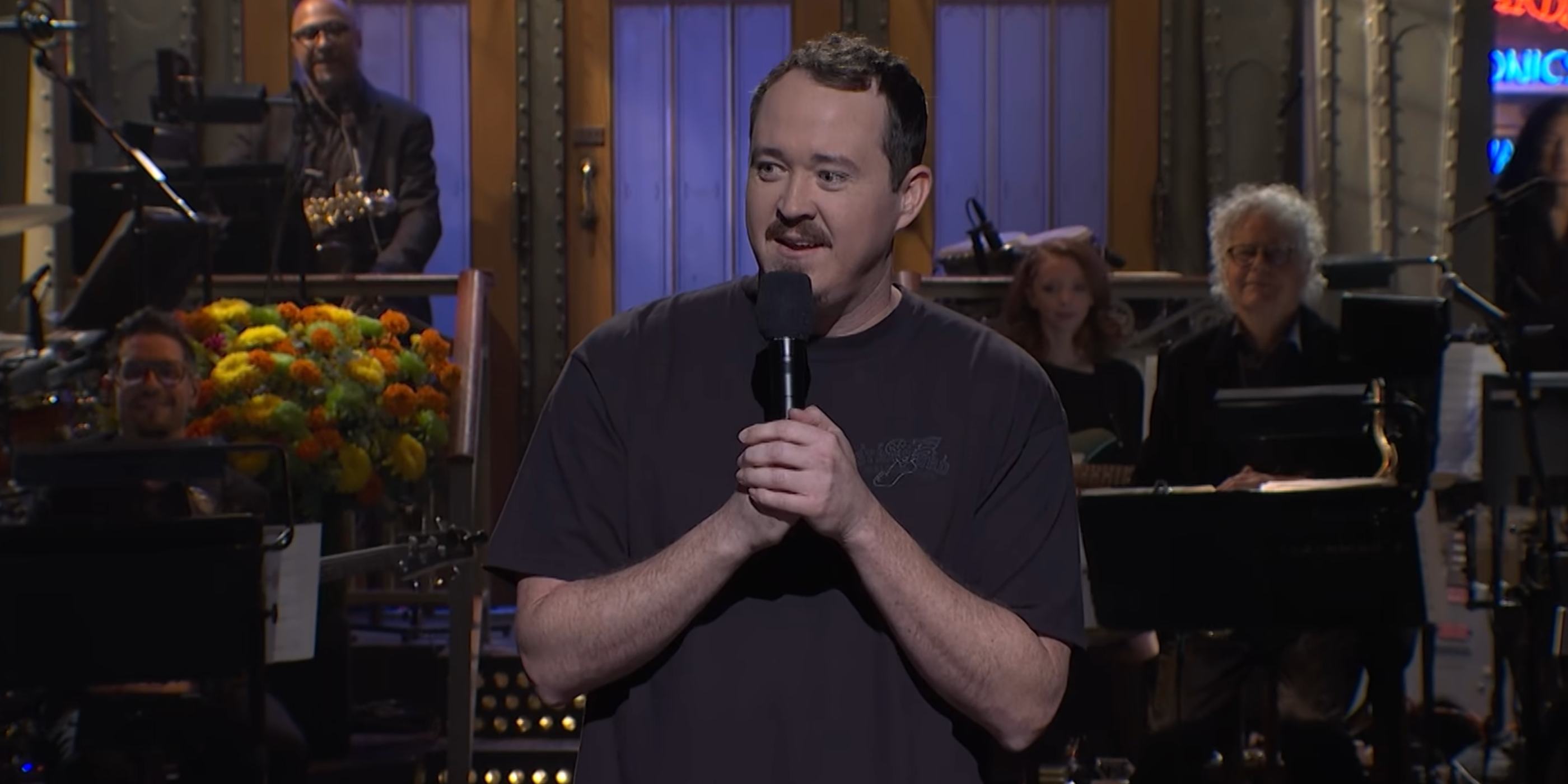
Gillis built much of his opening monologue around self-deprecation, discussing his weight, thinning hair, and discomfort in the gym, an approach that is familiar territory for stand-up comedians: Make yourself the target, exaggerate your insecurities, and invite the audience to laugh at the absurdity of your own behavior — but that framing became considerably less convincing when Gillis turned his attention to women exercising.
After describing his return to the gym, the comedian remarked that women now dress “like whores,” then offered a graphic description of their shorts before complaining that men weren’t allowed to look. The sequence was presented as an observation about modern gym culture, with Gillis’s supposed discomfort providing the comedic setup. Yet the joke depended on something beyond his own awkwardness: women were dressed inappropriately, and men were being unfairly restricted from looking at them.
There’s a difference between making fun of a man who feels uncomfortable around other people at the gym and suggesting that women are responsible for managing his gaze. Women have no obligation to dress according to strangers’ expectations of what is appropriate, nor does wearing fitted workout clothes constitute an invitation for sexual scrutiny. Gillis could have built a joke around his own embarrassment without turning women’s bodies into evidence of their supposed moral shortcomings.
The backlash, including criticism from Schitt’s Creek co-creator and star Dan Levy, reflected that distinction. Levy argued that women wearing short shorts doesn’t make them whores; calling them that is what makes the speaker misogynistic. His response cut through the premise of Gillis’s joke because the problem wasn’t that a man noticed what women wore, but rather that he used their clothing to justify degrading them, then treated the expectation of basic respect as the absurd part.
‘SNL’ Apologized for Shane Gillis’ F-Bomb, Not His Misogyny

The episode’s most revealing contrast came during a sketch inspired by Dr. Seuss’s Green Eggs and Ham. Gillis played the son of a man refusing to eat the titular dish, interrupting Sam-I-Am’s increasingly desperate efforts to change his mind. During the exchange, Gillis accidentally swore, caught himself, and tried to recover as the audience reacted.
The cast incorporated the slip into the sketch, with Mikey Day’s character eventually throwing Gillis’s character out for saying a bad word. Gillis accepted the joke at his expense, and he later addressed the incident during the show’s closing remarks, apologizing for what had happened earlier. The version of the sketch subsequently published online also censored the profanity.
None of that is especially surprising. SNL airs on broadcast television, where profanity raises different considerations than material that might appear in a stand-up special or on a podcast. An accidental expletive during a live sketch is an identifiable mistake, and Gillis’s response acknowledged it as one. The contrast, however, is harder to ignore when you consider the monologue alongside the sketch. Gillis’s accidental profanity prompted an apology, a comedic acknowledgment, and censorship in the online version. His remarks about women, meanwhile, were part of the material he had deliberately chosen to perform.
Of course, this doesn't mean SNL must ban every joke that offends someone; comedians need leeway to facilitate audience engagement with uncomfortable things, enlighten their audience, and make them laugh about taboo issues. However, just because a comedian intends a joke to provoke thought does not mean it makes sense as a joke. With this in mind, the episode ended up being monumental in raising a pertinent question in the comedy world: If the boundary of bad language is so clearly established that one can hear an unlawful word on air, how come a joke about a woman turning into a gratuitous sex object is received the way it is?
The Cornell Seven Allegations Show Why Misogyny Isn’t a Harmless Joke

The broader conversation surrounding Gillis’s monologue makes the question more pressing. The allegations involving seven former Cornell fraternity members have drawn attention to the ways women’s experiences of sexual violence are discussed, minimized, and sometimes treated as matters for public debate rather than serious allegations requiring investigation.
In a civil lawsuit, a woman identified as Jane Doe alleged that she was drugged and sexually assaulted by fraternity members at a house in October 2024. The allegations have prompted renewed scrutiny of the university’s handling of the case and the response to sexual assault claims. They remain distinct from Gillis’s comedy, and the monologue should not be treated as equivalent to the alleged conduct at Cornell, nor is there a basis for suggesting that one caused the other. In this respect, the relevant connection is the social milieu in which women's lived experiences and boundaries are subordinated to men's needs. When women are often portrayed as responsible for men’s reactions to their bodies, there is no longer any emphasis on men’s choices, but rather on what women “should do” to avoid “provoking” male behavior. A joke about workout clothing is not a case of sexual abuse, but it can also reinforce frames of mind that make it easier to disregard women’s protest as overreacting.
This is why Levy’s response deserves more attention than any celebrity's comment about a comedy act. He put forth the claim that media objectification leads to certain perceptions and behavior by men in relation to women, and called upon men to combat such perceptions instead of allowing them to go unnoticed. His main point was that the culture surrounding women is everyone’s responsibility, and men have a role in challenging the attitudes that reduce women to objects.
Levy’s intervention also offered a useful counterpoint to the familiar defense that a joke should be judged solely by whether its performer intended to cause harm. Intent matters, but it doesn’t settle what a joke actually does. Gillis’s monologue invited the audience to laugh at the idea that women dress provocatively and then expect men not to look. Levy challenged that premise by shifting the focus back to the people doing the looking and the language used to describe women.
Gillis’ history with SNL is already complicated: The show hired him as a cast member in 2019 before firing him following the resurfacing of podcast clips containing racist and homophobic remarks. His subsequent returns as a host have kept the conversation around his comedy alive, but his latest appearance has raised a different question about the material the show is willing to put on its stage. The answer isn’t to pretend that accidental profanity and misogynistic humor are identical offenses, but one was an acknowledged mistake during a live performance while the other was a deliberate comedic choice. SNL cannot control every word a host says during a live broadcast, and it shouldn’t be expected to eliminate every joke that generates controversy, but the show can be more discerning about the assumptions its comedy asks audiences to accept. A joke that exposes a man’s insecurity is one thing, but a joke that makes women responsible for that insecurity is another.
Gillis apologized for saying a bad word. Great, one would suppose, but what his episode exposed was a more troubling double standard that says that mainstream television can recognize a bad word in an instant while allowing the objectification of women to pass as entertainment. The problem at hand is that the wrong people keep being asked to carry the punchline.
Saturday Night Live airs Saturdays at 11:30 p.m. EST on NBC and streams the next day on Peacock.
KioskNews shows a cleaned-up reading view extracted from the publisher’s page — the original always lives on their site, not ours.