Robot dog ran a marathon on one charge and lived to publish the paper
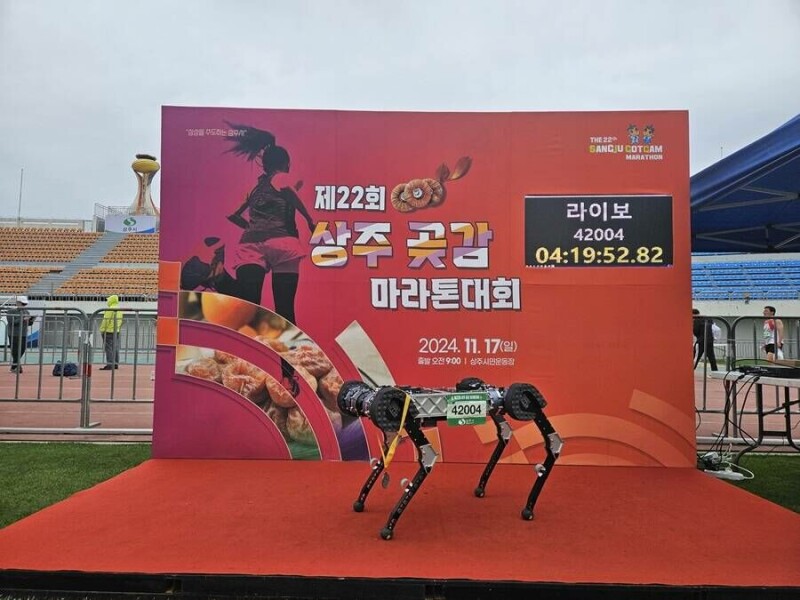
Two years later, creators explain how lightweight hardware and reinforcement learning helped it go the distance
South Korean researchers have published details of how their four-legged robot completed a marathon on a single battery charge – nearly two years after it crossed the finish line.
RAIBO2 covered the 42.195 km (26.2 mile) course of the Sangju Dried Persimmon Marathon in November 2024 in 4 hours, 19 minutes, and 52 seconds. As The Register reported at the time, its developers described it as the first quadruped robot to complete a full marathon at an official event.
The new paper published in Nature this week explains how the team at the Korea Advanced Institute of Science and Technology (KAIST), led by associate professor Jemin Hwangbo, squeezed more than three times the range per battery charge from RAIBO2 than recent comparable quadrupeds.
REG AD
Humans remain quicker. Kenya's Sabastian Sawe set the official world record of 1 hour, 59 minutes, and 30 seconds at the London Marathon in April, becoming the first person to break two hours in a competitive marathon.
REG AD
Wheels are more efficient on smooth ground, but legs allow robots to cross stairs, rubble, slopes, and other uneven terrain. That makes quadrupeds potentially useful in mountainous areas and disaster zones. Robot dogs have already been deployed to help with the nuclear clean-up at the UK's Sellafield facility, while military applications are considerably less cuddly.
The trade-off is range. The researchers say recent quadrupeds generally manage about 20 km per charge because their joints expend energy supporting the machine's weight, while repeated contact between foot and ground introduces further losses.
Hwangbo's team combined lightweight mechanical hardware, low-loss motor-driving circuitry, and an energy-optimized locomotion policy trained through reinforcement learning. RAIBO2 completed the course at an average speed of 2.64 metres per second, negotiating 286 m of elevation change and slopes reaching 18.4 degrees.

RAIBO2 consumed 1,280 watt-hours from a battery with 2,016 Wh of capacity. Its total cost of transport – the energy required to move a given weight over a given distance – was 0.25, compared with the researchers' human benchmark of 0.37. They say it is the first quadruped robot to beat that figure.
The researchers said: "Compared with existing quadrupeds, RAIBO2 offers more than three times the travel range per battery charge. This breakthrough in energy efficiency paves the way for extended outdoor applications in which prolonged battery life is critical."
The efficiency record does not make RAIBO2 autonomous, however. Stairs or mountainous terrain might require variations in the energy loss models and constrained robot postures, and require a more environment-aware strategy. "In addition, our study assumes human operation, yet autonomous navigation requires planners that can identify energy-optimal paths based on global map understanding. The loss models developed in this study provide a valuable foundation for addressing these challenges," the paper said.
The researchers believe their work could extend the range of future legged robots. Whether those machines spend the extra mileage inspecting disaster zones, carrying deliveries, or chasing humans is a matter for whoever buys them. ®
KioskNews shows a cleaned-up reading view extracted from the publisher’s page — the original always lives on their site, not ours.