UNC claims of authority to manage armistice clash with failure to stop North’s mine-laying
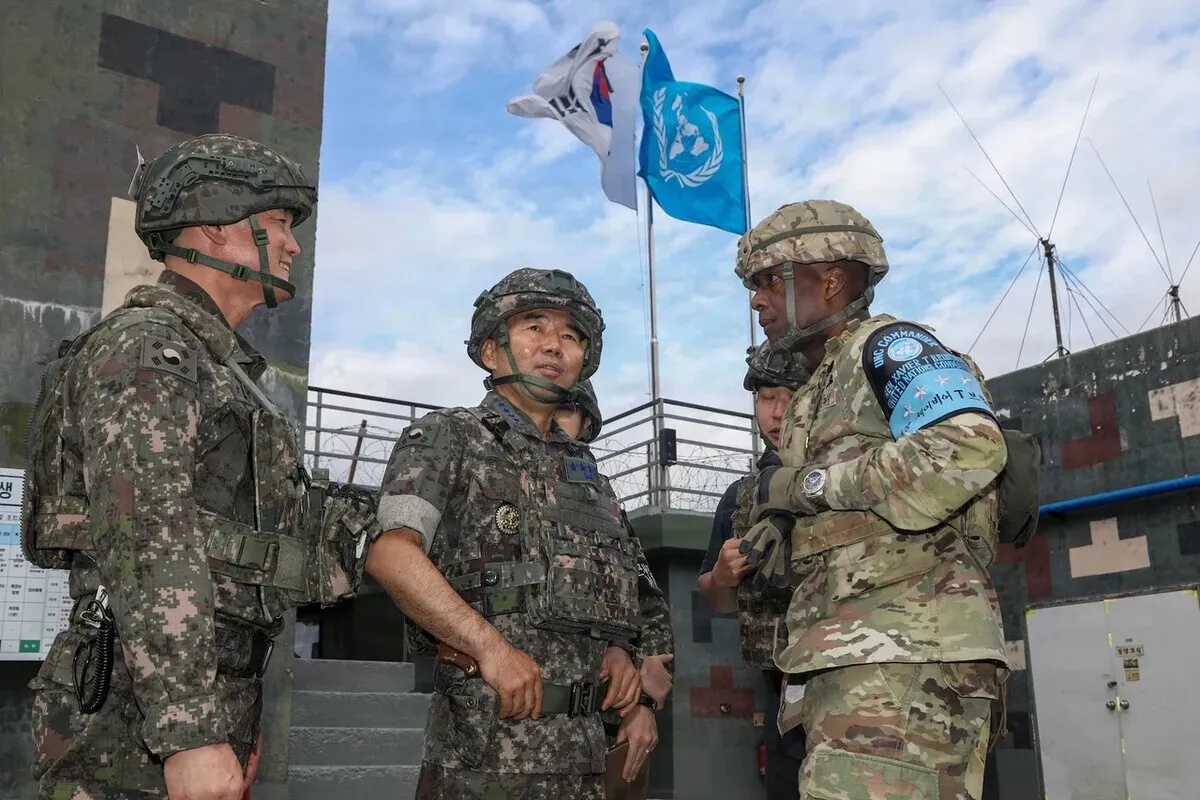
Gen. Jin Yong-sung (center), the chairman of South Korea’s Joint Chiefs of Staff, and Gen. Xavier Brunson, the commander of US Forces Korea, the UN Command, and the ROK-US Combined Forces Command, visit a guard post on the eastern front of the Demilitarized Zone to review the operational situation on Sept. 9, 2026. (courtesy Joint Chiefs)
US Forces Korea Commander Gen. Xavier T. Brunson made a series of sensitive remarks on Korean Peninsula security during a three-day visit to the US last week, weighing in on issues including the transfer of wartime operational control, or OPCON, and the deployment of a multi-domain task force aimed at countering China and Russia.
Brunson was in Washington to attend the annual meeting of the Association of the United States Army, which he is a member of as a four-star American general. Given his invitation to serve as a panelist for a formal discussion, his attendance was an official engagement.
On Oct. 12, he took part in a session at the event on “Decisive Landpower: Deterrence and Partner Integration against the Pacing Threat.”
Previous USFK commanders have attended the meeting but not every year, with their appearances shaped by factors such as recent security issues, the US Army’s agenda and whether an invitation was extended. Panelists are reportedly selected each year in consultation with the US Army Chief of Staff and other related bodies.
At a seminar on Wednesday in Washington hosted by the think tank Gold Institute for International Strategy, Brunson stressed a condition-based transfer of OPCON. He hinted at his underlying skepticism over the transfer by saying changing plans mean changing conditions, including North Korea’s growing military threat, adding the need for “new standards” to meet.
Most USFK commanders, including Brunson, have opposed the transfer. The post is held by a four-star US Army general and those in the role sought to retain the framework of the bilateral Combined Forces Command (CFC), the only structure outside the US where the doctrine for full-scale conventional war remains fully intact.
Military sources said a major factor behind this is the US Army’s desire to keep the position for a four-star general. If American troop levels in South Korea are cut and the latter regains OPCON, the role of USFK commander would be scaled back and potentially lead to a downgrade in the position’s rank from four-star general to three-star lieutenant general.
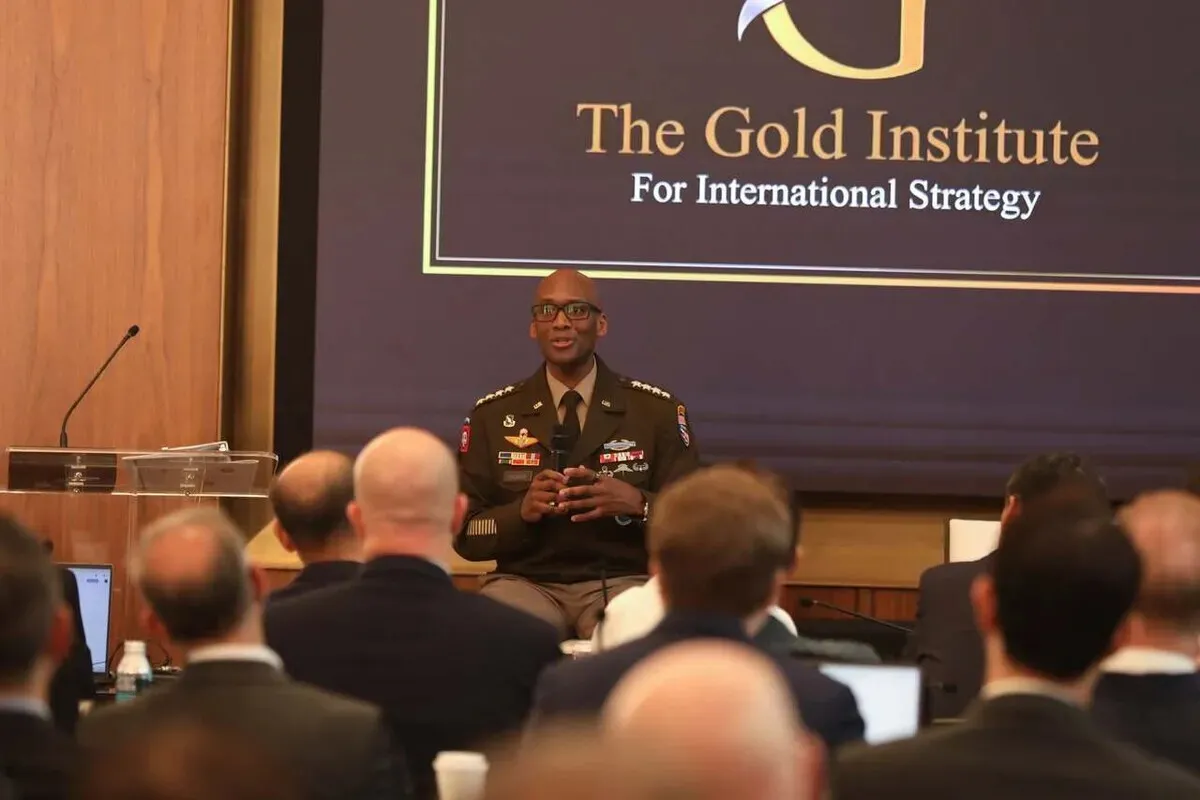
Gen. Xavier Brunson, the commander of US Forces Korea, speaks at the Indo-Pacific Regional Summit held in Washington, DC, on Oct. 14, 2026, by the Gold Institute for International Strategy. (Yonhap)
Brunson wears three hats in leading not only the USFK but also the CFC and the United Nations Command (UNC). Depending on the situation, he selects which hat to use for his role; in Washington, he wore that of USFK commander.
When Brunson returns to Camp Humphreys in Pyeongtaek, Gyeonggi Province, where the USFK is headquartered, he plays the role of UNC chief. As the entity that fought the Korean War and signed the armistice, the command holds the authority and responsibility for enforcing the ceasefire agreement.
Yet the UNC appears to be emphasizing its role in managing the armistice while downplaying its actual responsibilities, as reflected in its response to the Sept. 21 land mine explosion in the Demilitarized Zone (DMZ). Since last year, the command has repeatedly asserted the armistice grants it control over the portion of the DMZ south of the Military Demarcation Line (MDL).
In January, UNC officials told reporters at the National Assembly that Seoul would violate the armistice if it authorized civilian access to the DMZ without the command’s approval. Under the armistice, the officials added, the UNC commander holds jurisdiction over the DMZ south of the MDL, stressing that this authority had remained unchanged for more than 70 years.
While the UNC has long asserted exclusive jurisdiction over the DMZ, it has responded tepidly to North Korea’s efforts to fortify its side of the border.
On June 24, it denied comments by the Ministry of National Defense in Seoul, which said in regular briefings on June 22-23 that Pyongyang’s military activities within the DMZ were a “clear violation” of the armistice.
At the time, the UNC said on its website that “recent North Korean (DPRK) construction activities — including fencing and road repairs — do not constitute violations of the 1953 Armistice Agreement, provided they remain north of the Military Demarcation Line (MDL) and do not introduce heavy weaponry.”
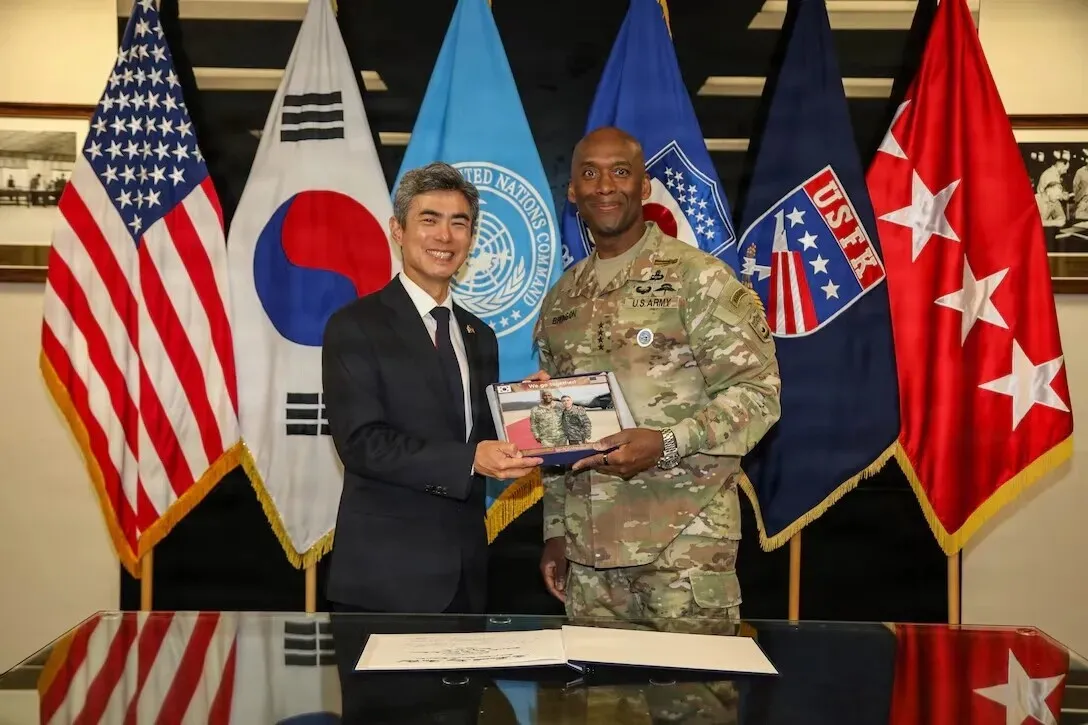
South Korean Defense Minister Kang Shin-chul presents a framed photograph to US Army Gen. Xavier T. Brunson, commander of United Nations Command, ROK-US Combined Forces Command and US Forces Korea, at USFK headquarters at Camp Humphreys, South Korea, on Oct. 2, 2026.
It also said the North’s laying of mines was not a violation, adding, “Emplacing mines defensively on the northern side is permitted.”
Unification Minister Chung Dong-young on Oct. 7 mentioned the UNC’s comments at an audit of his ministry by the National Assembly’s Foreign Affairs and Unification Committee at the Inter-Korean Relations Management Bureau in Seoul.
“Our government has consistently raised concerns over North Korea’s barbed-wire fences, tactical roads and mines, actions that effectively render the armistice null and void,” he said. “But the UNC considered these defensive measures and maintained a complacent attitude prior to [the mine explosion].”
Only after three South Korean soldiers were injured in the Sept. 21 explosion, the UNC shifted its stance following a joint on-site investigation with the Joint Chiefs of Staff, calling the incident a violation of the armistice.
It’s up to Brunson to dispel concerns that there is a mismatch between the command’s responsibilities for managing the armistice and the authority it wields.
KioskNews shows a cleaned-up reading view extracted from the publisher’s page — the original always lives on their site, not ours.