Taxman uses chats, Excel sheets to dispute property sale value; ITAT quashes addition
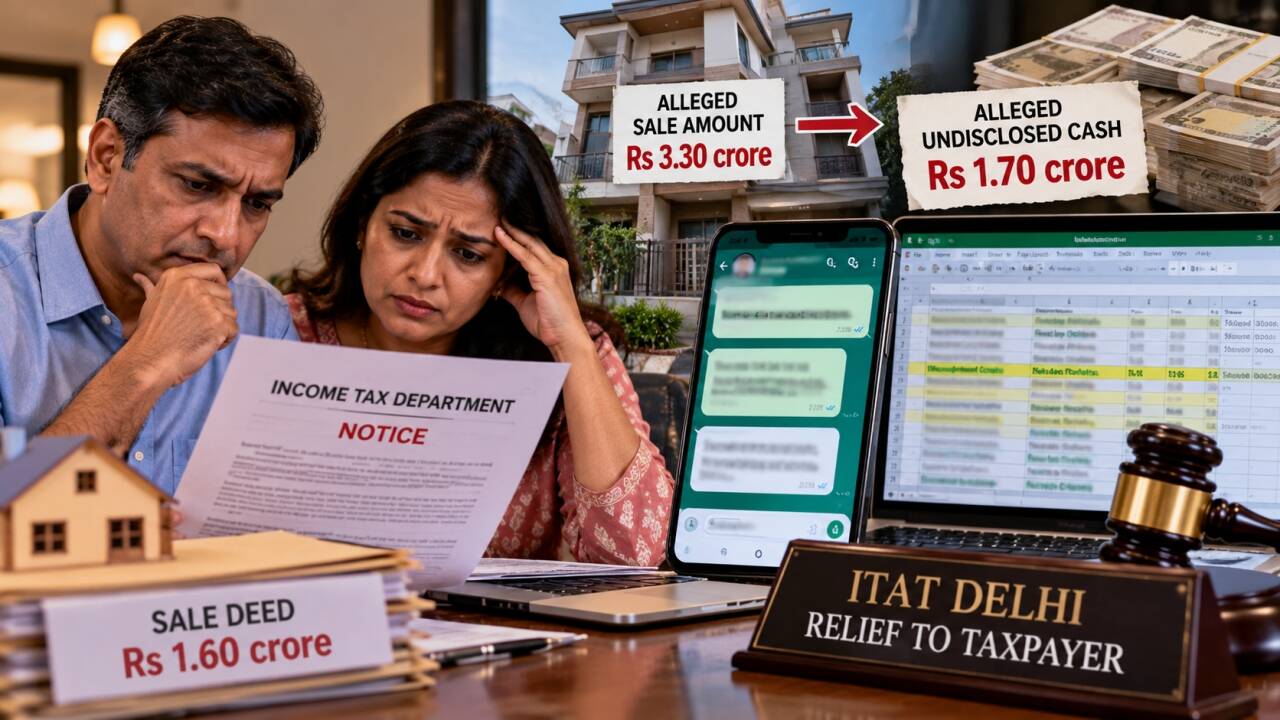

The AO treated the alleged amount as undisclosed cash receipts and made an addition under Section 69A. (Image for representative purpose only)
Property related transactions can sometimes be complicated. Recording the same in your income tax return is equally important. But what if the Income Tax Department sends you a notice for unexplained cash receipts, believing that you have received a part of the payment for property sale in cash.In one such case, the tax department relied on WhatsApp messages and Excel spreadsheets to reach the conclusion that the property had been sold for an amount higher than the one disclosed. The assessee finally won the case in Income Tax Appellate Tribunal (ITAT), Delhi.
What the case is about
The dispute concerned a man and his wife, who jointly owned a property in Delhi before selling it.The Income Tax Department alleged that the buyers had paid an additional amount in cash beyond the sale consideration documented in the registered conveyance deed.Also Read | Man sold his house and bought a Rs 1.10 crore flat jointly with wife; income tax department denies Rs 55.48 lakh capital gains exemption for half the amount, but ITAT Mumbai gives full reliefThe assessing officer calculated the total transaction value at around Rs 3.30 crore, whereas the registered sale deed recorded a consideration of Rs 1.60 crore. The department regarded the difference of Rs 1.70 crore as cash received by the sellers but not disclosed in the documents.The case arose from a search conducted in 2021, involving a group of companies. According to the tax department, an Excel workbook titled “BOSS -DEC 18 onwards”, handwritten diary entries and other seized material pointed to cash payments allegedly made to the man in connection with a property in Delhi, jointly owned by him and his wife.
The department alleged that Rs 1.70 crore had been paid in cash by the group owner in connection with the property transaction to the husband and wife. Its case included entries for Rs 1.55 crore and a further Rs 15 lakh. It also relied on handwritten records and WhatsApp conversations involving several people.The Assessing Officer (AO) also drew on WhatsApp conversations that mentioned payments of Rs 50 lakh, Rs 50 lakh, Rs 20 lakh, Rs 5 lakh and Rs 30 lakh.
These amounts added up to Rs 1.55 crore.The AO treated the alleged amount as undisclosed cash receipts and made an addition under Section 69A read with Section 115BBE of the Income Tax Act. The Commissioner of Income Tax (Appeals) subsequently sustained an addition of Rs 1,16,25,000 out of the Rs 1.70 crore assessed, giving part relief.However the man appealed in ITAT.Also Read | He inherited land from mother, redeveloped home & received Rs 75 lakh from builder; taxman denied capital gains exemption, but ITAT Delhi gives relief, ruling multiple floors can qualify as one house
Why did the taxpayer win relief?
The man’s representative disputed the reliance on the seized material and argued that he had not been given a proper opportunity to cross-examine the people whose statements and communications were used against him.He also challenged the legality of the proceedings under Section 153C, including the recording of a consolidated satisfaction note covering seven assessment years.The taxpayer further argued that the alleged cash consideration related to a property sold through a registered conveyance deed dated October 31, 2019, falling in assessment year 2020-21, rather than the assessment year under appeal, 2019-20.The tribunal found that the WhatsApp conversations relied upon by the tax authorities largely contained monetary figures but did not clearly establish what the payments were for or the purpose behind them.“The WhatsApp chats and seized documents merely referred to certain figures and alleged transactions but did not conclusively establish that the assessee had received unaccounted cash,” CA Avinash Kumar Rao, Partner at Mohindra & Associates told ET.CA Suresh Surana said the assessing officer had also not adequately examined the people connected with the alleged payments. The taxpayer was not given a proper opportunity to cross-examine them.Also Read | Man had Rs 2 crore bank deposit and didn’t file ITR, faced Rs 2.51 crore tax addition; ITAT Chennai quashes reassessment after Income Tax Department missed 6-year deadline by 5 daysThe tribunal also noted that the Income Tax Department had not summoned a man despite relying substantially on his statement and documents recovered from him to support its allegations.The tribunal observed that if the department intended to rely on the chats and related material as evidence of cash consideration, “it was essential for the assessing officer to have examined these persons on oath and also give the assessee an opportunity to cross-examine these persons.”It explained that WhatsApp messages and supporting documents needed to be properly tested rather than treated as conclusive proof. As the order put it, “the inferences drawn cannot be considered to be conclusively based on relevant and admissible evidence, but become more of suspicious circumstance” if the necessary examination and opportunity to challenge the evidence are missing.The Income Tax Department had also relied on a common satisfaction note covering seven assessment years.
However, it had not identified relevant incriminating material for every assessment year included in the note.Surana explains that the ITAT held that the department was required to demonstrate a clear link between the material seized during the search and the income relating to each individual assessment year before initiating proceedings under Section 153C.On these grounds, the tribunal allowed both the quantum appeal and the consequential penalty appeal.
Its final direction was explicit: “The impugned assessment and penalty stands quashed.”The order was pronounced on September 9, 2026.It’s important to note that the decision turned on the evidentiary shortcomings and legal defects identified by the tribunal; it should not be read as a finding that the alleged cash payments definitely did not occur.Also Read | Woman declared Rs 67.4 lakh ancestral jewellery in her ITR which led to additions by tax department; ITAT Mumbai deleted it on basis of old records, but rejected her Rs 12 lakh HUF brokerage claim
Significance of ruling
The decision reiterates a fundamental principle of tax law: even strong suspicion cannot take the place of conclusive evidence.
The Income Tax Department can examine WhatsApp conversations, Excel spreadsheets and handwritten records, but simply finding such material does not automatically prove that a taxpayer earned undisclosed income.CA Avinash Kumar Rao advises taxpayers facing allegations based on third-party statements or conversations to obtain copies of the material cited against them and assess its context and relevance. They should also ask for an opportunity to cross-examine the individuals concerned. Such requests are preferably made in writing while the assessment proceedings are underway.The ruling also underlines that procedural safeguards prescribed under the Income-tax Act must be followed rather than treated as formal requirements that can be overlooked.
KioskNews shows a cleaned-up reading view extracted from the publisher’s page — the original always lives on their site, not ours.