How food, people-to-people ties and an Indian international school helped Siglap get a park
SINGAPORE – Residents in Siglap have the Global Indian International School (GIIS) to thank for after waiting years for a park near their homes.
Revealing this on Sept 18, Law Minister Edwin Tong said Yarrow Park, which is in his Joo Chiat ward in the East Coast GRC, was carved from a cluster of five basketball courts which sat on premises previously leased by GIIS at Cheviot Hill.
The school, which is one of 12 under the Global Schools Group (GSG) banner, moved to its present location in Punggol in 2026.
Speaking at the campus, at an event to mark GSG’s 25th anniversary, Tong lauded GIIS for its contribution to the Joo Chiat community.
He told the audience, which included the High Commissioner of India to Singapore Shilpak Ambule and GSG chairman and co-founder Atul Temurnikar, that the school was quick to agree when asked to give up part of its premises for the park.
Tong, who is Second Minister for Home Affairs, said: “Siglap is a very tight estate with small roads built many years ago. There weren’t many public spaces.
“I moved the idea of a public space to Atul, and I said sheepishly, ‘Can we take a little bit of your school premises and turn it into a park for the community? Almost without hesitation, Atul said ‘Yes. How do we make this work?’”
The school then worked with NParks and the Singapore Land Authority in contributing to the park, which was officially opened in 2022.
Tong said: “You saw yourself as being part of Joo Chiat, part of the fabric of our community, and you were prepared to share what you had, so that a wider community could benefit, and indeed they have.
“In many ways, this story reflects the larger relationship between Singapore and India as well.”
He said close ties between the two nations go back more than 200 years. Singapore was once administered from Calcutta (now Kolkata) after Sir Stamford Raffles’ arrival in 1819.
Tong added: “After independence in 1965, India was one of the first to recognise the status of Singapore, which is why we celebrated 60 years of our diplomatic relations last year.
“It’s a very deep relationship that we have, bound by history and across many areas, from trade and investment to technology, skills, sustainability, connectivity, and defense.
“But to me, the relationship has been less about agreements between governments or numbers on a balance sheet or trading surplus or deficit. The relationship ultimately rests on people. It’s the most valuable commodity.”
In his speech, Tong praised the school’s academic achievements, noting that the students have done exceptionally well.
He said the classrooms in GIIS today bring together young people from more than 40 nationalities, a mix which mirrors what Singapore looks like.
“We share that same quality: to be outward looking, cosmopolitan, and welcoming of the world.
“Singapore has always drawn strength from people of different backgrounds coming together. We say multiculturalism, multi-ethnicity, diversity.
“There’s a strong quality about that,” he said, adding that while each group group brings something unique about themselves to the table, they still share a common identity.
Tong said he was in India in July, where he enjoyed the warmth of the people, the buzz and energy, and the deep history and culture.
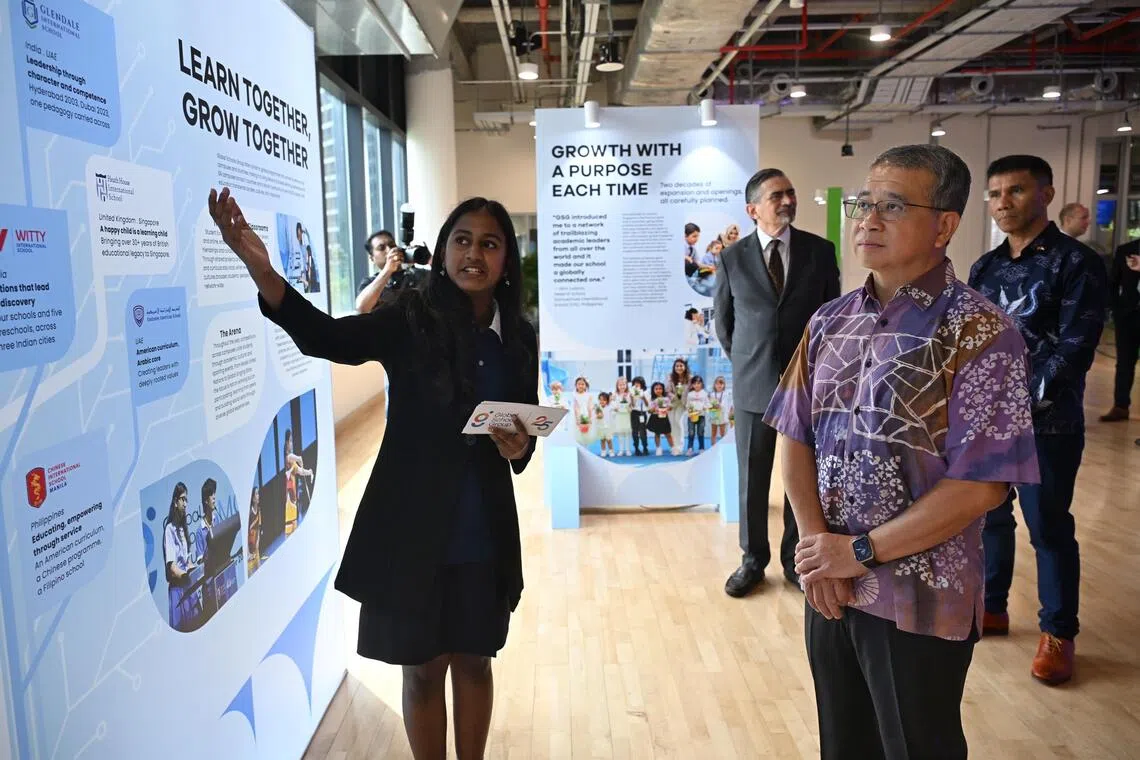
Law Minister Edwin Tong (right) touring the exhibits at the One World International School on Sept 18.
ST PHOTO: CHONG JUN LIANG
“And of course, there’s the food. I’m a typical Singaporean. People often ask whether I prefer North or South cuisine, and I say actually both because I’m Singaporean. As long as it’s food.”
He added: “Beyond the food, what makes the Singapore-India relationship special are the human connections.
“The Indian families who have made Singapore their home, the Singaporeans who live, work and do business in India, the students and professionals as well as entrepreneurs who move freely between our two countries, the friendships that have been built and nurtured over generations, and of course institutions like GSG.
“GSG has remained proud of its Indian heritage, but at the same time, you have become very much a part of Singapore.”
The group now operates 64 campuses across 11 countries. It has about 45,000 students in its schools.
In his speech, Temurnikar said that GSG started 25 years ago by planting a small seed in Mount Sophia.
“Today, we have grown a tree. Now this tree will shape the lives and will shape our future.
“It is our responsibility to ensure the branches reach even further and that its shade benefits generations of children who are yet to come,” he added.
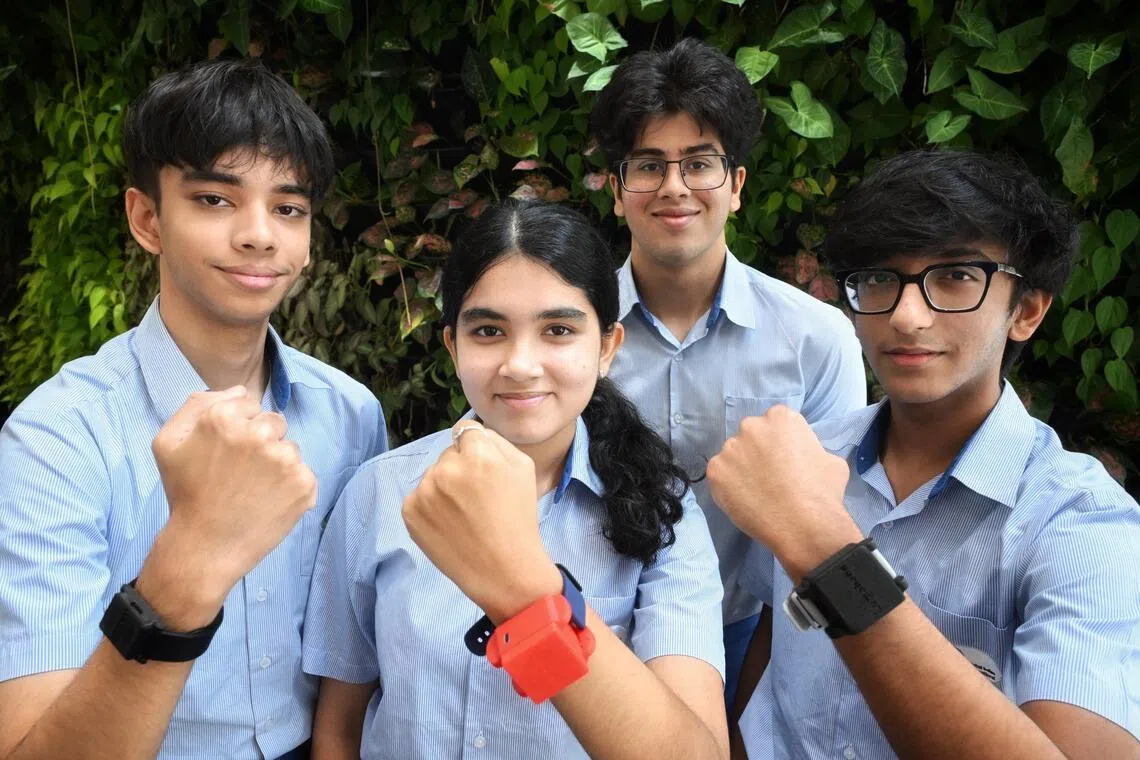
(From left) Iraj Gupta, Srishti Hariharan, Anuraag Vombatkere and Arnav Rai showing their lumabands at the One World International School on Sept 18.
ST PHOTO: CHONG JUN LIANG
At the event, Tong was given a tour of exhibits at the school -- from achievements by students and alumni, to special projects being championed by the students.
They include a project by 15 students called LumaBand, an AI-powered wristband for the elderly that will alert five contacts via SMS when it detects a fall by the wearer.
Student Iraj Gupta, 17, said the idea was developed when his 70-year-old female relative suffered a fall.
Teammate Anuraag Vombatkere, 17, said the idea is for the elderly person to receive timely assistance.
Anuraag said: “Given Singapore’s growing elderly population, we thought it would be great for an elderly to receive immediate help in any emergency.”
KioskNews shows a cleaned-up reading view extracted from the publisher’s page — the original always lives on their site, not ours.