‘Almost all’ Fed policymakers say hikes are likely
“Almost all” participants of the US Federal Reserve’s interest rate-setting meeting last month thought that further rate hikes would be necessary to fight stubbornly high inflation, minutes of the meeting showed on Wednesday.
The minutes, released after a customary three-week lag, showed that according to almost all policymakers’ baseline outlooks for inflation and the labor market, further rate hikes “would likely be appropriate” to bring prices back under control.
The 12-member Federal Open Market Committee voted 10-2 to hold rates at a target range of 3.75 to 4.00 percent, citing the need for more data in the fight against inflation, after having hiked for the first time in three years at its previous meeting in September.
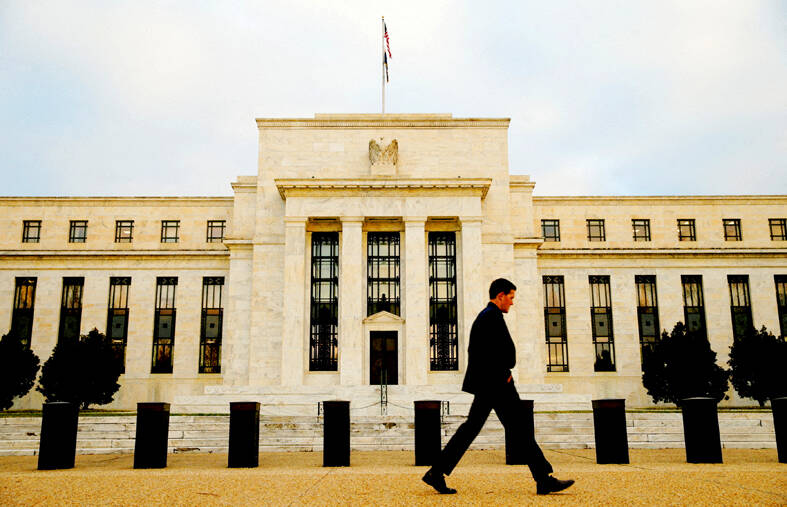
A man walks past the US Federal Reserve in Washington on Dec. 16 last year.
Photo: Reuters
Two voting members, Lisa Cook and Beth Hammack, had dissented in favor of an immediate 25-basis-point hike
Inflation in the US, on a downward trajectory since hitting a peak during the COVID-19 pandemic, has reignited in the past year.
The massive investments in infrastructure to support the artificial intelligence (AI) buildout, as well as tariff policies and the war in Iran have led to increased prices.
The personal consumption expenditures price index inflation, the Fed’s preferred gauge, hit 3.6 percent in September, far above the central bank’s 2 percent target.
At last month’s meeting, participants “acknowledged that inflation remained elevated.”
“Most remarked that inflation pressures in the economy were broad-based,” indicating they saw price increases as having spread beyond skyrocketing energy prices into other sectors.
Still, 10 of the committee’s 12 voting members called for rates to be held steady.
“These participants cited the need to assess the durability of AI-related investment demand, the evolution of financing conditions, the transmission of the September rate increase to the economy, or geopolitical developments,” the minutes said.
Those who dissented from the majority decision in calling for a 25-basis-point hike said they saw inflation as “too high” and “saw few signs of it abating.”
“They judged that the current policy stance was not sufficiently restrictive, and a few of them warned that further delay risked allowing high inflation to become entrenched or necessitating a larger and more disruptive tightening later,” the minutes said.
Speaking to US broadcaster CNBC on Wednesday morning, before the minutes were released, Fed Governor Chris Waller said he was “very, very concerned” about inflation and now saw the need for a 50-basis-point hike at the Fed’s meeting next month.
“If you really want to get it down, you’ve got to start taking more aggressive actions,” Waller said.
KioskNews shows a cleaned-up reading view extracted from the publisher’s page — the original always lives on their site, not ours.