Calligraphy against freedom of abstraction: Alex Shnaiderman opens first solo exhibition

‘The moment a painting feels too stable, my instinct is to destabilize it, to disrupt the harmony and spark a new dynamic,” said Alex Shnaiderman.
When visitors come to her studio on Allenby Street in Tel Aviv, she sometimes carries paintings into the building’s dojo, a bare room where she also practices Aikido.
“I suddenly perceive them in an entirely new light,” she said. Inside the painting, she explained, “it is very insular.” Stepping back to observe the works from a broader perspective, she said, allows them to evolve.
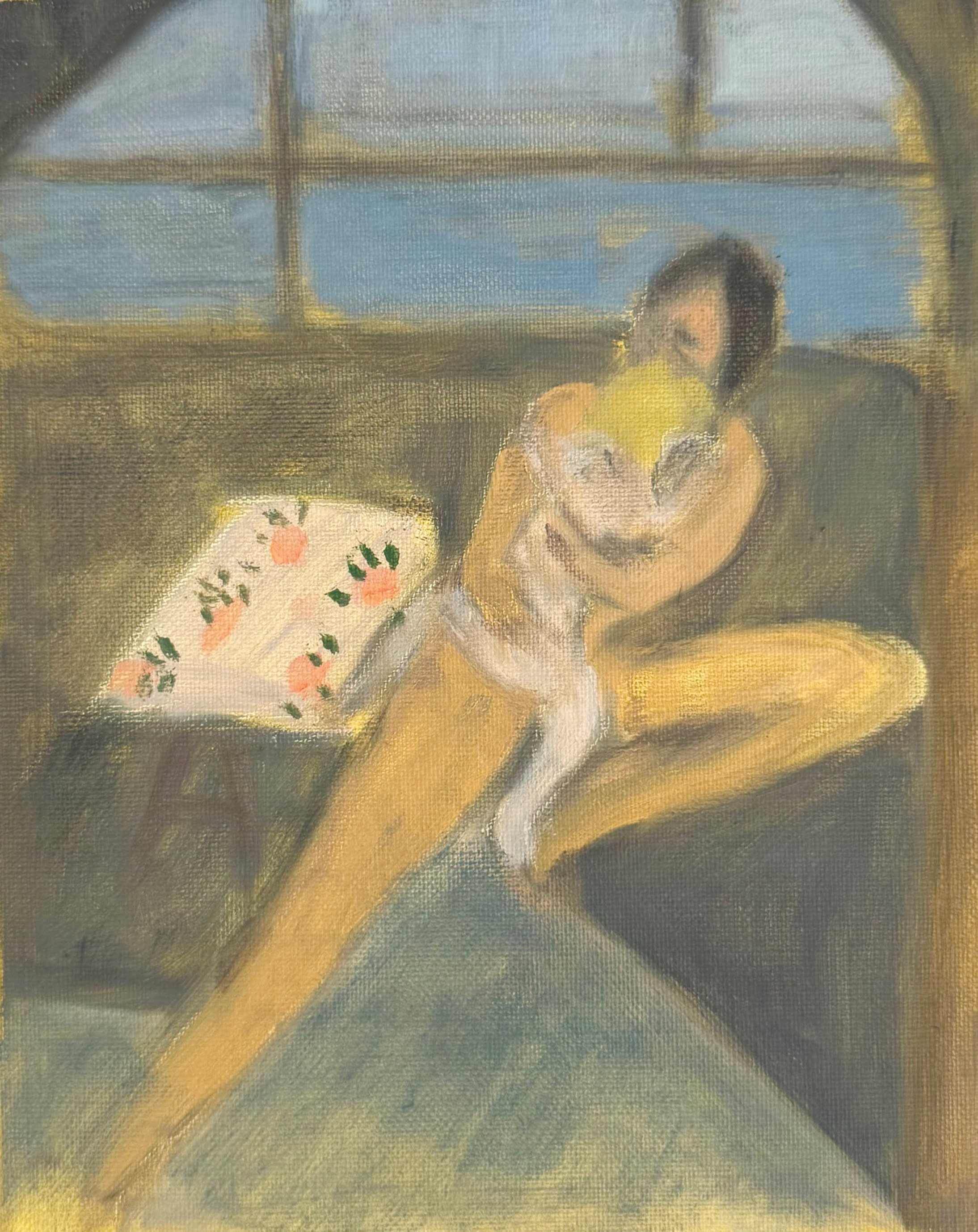
Blue and Green, her first solo exhibition, opened on November 19 at Rothschild Fine Art in Tel Aviv, with Naama Arad as curatorial adviser. All the works are oil on linen. Shnaiderman waited until she felt she had enough work to make a coherent exhibition.
“I wanted to feel that a critical mass of work speaking a cohesive language had accumulated.” She is in no hurry. “I am still at the beginning of my journey; I have been painting for 15 or 17 years, which is relatively young for a painter.”
The exhibition was originally scheduled to open in April. The war with Iran pushed it back, and Shnaiderman, her partner, Alexander Gad, and their two young daughters waited it out in their building on Allenby Street.
The building has no bomb shelter, so they stayed in an interior room that felt relatively secure. It was unsettling, particularly with young children. Yet the postponement had an unexpected benefit.
“It gave me time to further crystallize the body of work, and several strong pieces emerged during those months, fueled by the sheer intensity in the air,” she said.
Rules first
The paintings look loose. The life behind them is strict. “That tension around freedom is a constant internal dialogue for me,” Shnaiderman said, “between the cultural heritage I come from and my disciplined practices.”
Her martial arts take her to Japan frequently. For many years she has also practiced Japanese calligraphy, an art form that demands absolute precision. “It requires years of rigorous practice to internalize the technique before you can begin to release it.”
She began painting in a similarly disciplined way, with observational work and landscapes, but her curiosity has gradually pulled her toward a freer realm.
Japanese martial arts have a name for this progression: Shu-Ha-Ri, the three stages of mastery. In the first, Shu, the student follows the master. In the second, Ha, the student begins to question. In the third, Ri, the student leaves the rules behind.
“In Japan, of course, that process spans 20 years,” she said. “It is certainly not a month-long course. It is a 20-year commitment.” She places herself in the middle stage, questioning what she has learned and gravitating toward greater abstraction.
The influence of Japanese culture is less about imagery than composition. Shnaiderman is particularly interested in Ma, the negative space. “Japanese art accords deep respect to the expanses where seemingly nothing is happening.”
Years of calligraphy, in which the angles, proportions, and placement of characters are paramount, have given her an internal sense of spatial measurement. That awareness remains present even when she paints with complete abandon, generating a quiet tension within the composition.
Paint, scrape, paint again
The surfaces of the paintings can look thin and delicate, but they contain numerous layers. Shnaiderman might begin with one composition, paint a completely different one over it, then scrape or wipe away the paint.
“When I erase, the underlying elements resurface, generating an unplanned dynamic that fascinates me,” she said. “At that point, the dialogue is genuinely between me and the painting itself, rather than me imposing a predetermined agenda onto the canvas.”
She often leaves faces indistinct. “I feel no compulsion to exhaust the details. What matters to me is the overarching atmosphere and the subtle tension generated between the forms or the colors.”
Once the painting works for her, she leaves it alone, even if it might seem unresolved to someone else.
Some canvases remain open for two or three years. She returns to them. “Sometimes I end up ruining them, though I do not really view it as ruining. It is more of an organic cycle. The moment you touch a canvas again, it opens up anew, like unlocking a door, and something entirely different is born.”
Her completed paintings also remain part of the process. She hangs them at home and looks at them from time to time, using them as visual references for subsequent work and trying to understand how something unexpected emerged.
Eventually, however, she lets them go. “In my mind, once a piece is created, it has been released into the world.”
The anchor
Guy, an artist and photographer, has a studio on the roof of their building and photographs family life at home. Shnaiderman frequently uses his snapshots as starting points.
Their two daughters appear in the paintings, often in quiet domestic moments. Other works begin with a sketch, perhaps of a sculpture she admired in Florence. Once the initial reference is established, she puts it aside.
“I simply need that initial anchor to launch the process, and from there it unfolds and expands until something sufficiently compelling emerges,” she explained.
In Falling, the 180 by 220 centimeter canvas reproduced on the exhibition invitation, a figure in blue hangs against a large brown animal, a streak of yellow hair pressed to its neck, the animal’s head thrown back.
Behind them, the color dissolves into teal and gray haze, while a few green leaves curl along the bottom edge.
There is a physical intimacy to the scene, a sense of leaning and holding on.
Shnaiderman confirmed that touch is a recurring concern.
“There is a strong preoccupation with touch, with leaning, with forms being intertwined and bound up with one another.” Between figures, animals, and human beings, she said, “there is a palpable tether.”
The exhibition text reads these relationships through the family, describing figures holding on to animals, trees, or one another in an ongoing search for repair and renewed closeness.
It sees the landscapes as projections of the figures’ inner states, a blue and green geography recalling Italy, Greece, or Japan. It also draws a connection with Aikido, with its emphasis on flow and redirection rather than confrontation.
Shnaiderman herself is wary of a fixed interpretation: “I strive not to cling to the literal narrative.”
Hands keep returning in her paintings, she said, partly because she practices Aikido in the same building. In one sketch, a figure appears to have an extra finger. Shnaiderman counts them aloud: “One, two, three, four, five... yes, indeed.”
She still needs a photograph or a sketch to begin, but hopes eventually to dispense with external references altogether.
“I am searching for a visual language that requires no external anchor whatsoever, turning entirely inward to distill a new synthesis.”
She is drawn to the uncertainty of that process. “Whatever might unfold, wherever it leads, whatever is waiting to be born on the canvas. There is a pure joy of creation in that uncertainty.”
Between here and elsewhere
The exhibition title began with the palette. Shnaiderman wanted to name the show after the two dominant colors in her work.
When she mentioned the idea to Arad, the curatorial adviser thought of Amir Lev’s 1998 song “Blue and Green,” which she felt resonated with the paintings’ concerns with family, closeness, and independence.
Shnaiderman admires Lev’s songwriting. “Because the atmosphere in the studio can feel somewhat otherworldly, the song tethers me to the land,” she said. “It connects me to Israel, both the song and its lyrical content.”
There is another geography in her paintings. Born abroad, Shnaiderman said she carries another culture within her.
She spent years overseas, including studying for a master’s degree at the London School of Economics, and is drawn to Japanese culture, Italian frescoes and the landscapes of Greece, where she and her family travel frequently.
These places do not necessarily appear as identifiable settings. They become part of an internal landscape, a synthesis of impressions that surfaces on the canvas.
Viewers have found echoes of religious icons in her figures, and she recognizes connections to Christianity, the Byzantine era, and Russia. “All sorts of visual echoes surface, not always intentionally, but they are embedded within the work.”
Her artistic reference points include Israeli painters Liliane Klapisch, Lea Nikel, and Ori Reisman.
We discussed how artists can carry memories of another landscape and culture into their work while developing a deep attachment to the place where they live. Shnaiderman recognizes that tension: nostalgia for elsewhere alongside a deep love for this place.
This summer, at the Rijksmuseum in Amsterdam, she stood in front of Rembrandt’s The Jewish Bride. In the studio, she takes out her phone to show it, apologizing for doing so.
“His mastery of deep reds and browns captivated me completely.”
Those colors have begun appearing in her recent paintings, a welcome shift in a body of work named for blue and green.
Rothschild Fine Art, 2 Moshe Maor Street, Tel Aviv. The exhibition runs through December 12. Gallery hours: Tuesday to Thursday, 11 a.m. to 6 p.m.; Friday and Saturday, 10 a.m. to 2 p.m. www.rgfineart.com
KioskNews shows a cleaned-up reading view extracted from the publisher’s page — the original always lives on their site, not ours.