Raymond J. de Souza: Trump finds gangsterism doesn’t always end well
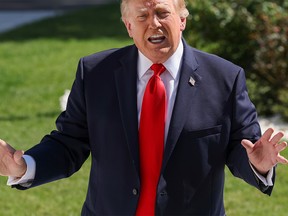
Over the summer, after President Donald Trump took the Gordie Howe bridge hostage at the behest of his billionaire benefactors, I wrote that gangsterism was a key part of the New York real estate world of the 1970s and 1980s. It was part of his formative experience. Trump was in New York last week and announced at the United Nations that it was also the animating spirit of his foreign policy.
Sign In or Create an Account
“To the victor belong the spoils,” he instructed the General Assembly, apropos of the oil “deal” he made with America’s now puppet regime in Venezuela. When gangsters take over a rival’s turf, they do not wind down the operation, much less hand it over to a new local thug. They take it over and claim the proceeds — the spoils, if you will.

Columnist Jesse Kline keeps you up to date with what’s happening in Israel and the effects of antisemitism on life here in Canada. Friday mornings.
By signing up you consent to receive the above newsletter from Postmedia Network Inc.
A welcome email is on its way. If you don't see it, please check your junk folder.
The next issue of Channel Israel will soon be in your inbox.
We encountered an issue signing you up. Please try again
Trump then returned to Washington to roll out the (literal) red carpet for Chinese President Xi Jinping. While Xi was waiting to deplane, he could observe uniformed American military personnel on their knees to clean the red carpet before his descent. He likely does not see such literal kowtowing even at home.
American presidents do not greet foreign leaders on the tarmac — not since the protocol was revised during the Kennedy administration. The sole exception is for visiting popes — Ronald Reagan and Bill Clinton respectively greeted John Paul II in Alaska (1984), Miami (1987), Denver (1993), Newark (1995) and St. Louis (1999); George W. Bush welcomed Benedict XVI in Washington (2008) as Barack Obama did for Francis (2015). But that’s it. No one else.
A papal visit to the United States while Trump is still president is unlikely, so perhaps Trump thought Xi the best he could do. Certainly, Trump speaks more favourably of Xi than he does of Pope Leo XIV, whom he subjected to a social media tirade earlier this year.
Only Vladimir Putin — red carpet in Alaska last summer — gets the adulation given to Xi, a sort of affection for gangster regimes by one who celebrates, as he did at the UN, the gangster ethic.
Gangsterism as the organizing principle of foreign policy is hardly new, but ancient. The phrase itself — to the victor belongs the spoils — arose in the context of naked American political patronage in the 19th century and, it must be conceded, has been applicable on occasion to American foreign policy, too.
Is this such an occasion? Gangsterism had been largely set aside after WWII; whatever “rules-based order” means, it means not gangsterism. Is the Trump administration now correct that the gangster-spoils principle is well suited to American interests and global order in 2026?
It did suit the administration on the Gordie Howe hostage-taking. Canada had to concede or the bridge wouldn’t open. But it also likely cost the Americans in the trade negotiations. Why would Canada make other concessions with a gangster who takes hostages?
As for hostage-taking, or extraction-by-law-enforcement if you prefer, in Venezuela, shed no tears for Nicolas Maduro, languishing in a New York jail. But the deal that Trump made with Venezuela will require massive private investment over the long term, and what company will be confident in an environment in which there are gangsters on both sides, in Caracas and in Washington?
Gangsterism did not play well in Greenland, in which NATO allies forced Trump to back down and accept an enhanced version of the same arrangements the U.S. has had since the 1950s.
Gangsterism is proving difficult in the Persian Gulf, where in the heady days after starting the war Trump announced that he wanted to “take the oil.” Despite an overwhelming imbalance in military power, not only can the U.S. not take the oil, but at enormous expense is struggling to re-establish the status quo antebellum — namely free and safe passage of all oil through the Strait of Hormuz.
The most pressing question is whether gangsterism is a good China policy. It would seem not, as China already defeated the Trump administration in last year’s initial round of the trade war. Constricting access to rare earths forced the Americans to back down, and as a kind gesture Beijing promised to buy more American soybeans. Those promises have not been quickly fulfilled, as the howls from Iowa farmers, paying over $6/gallon for diesel, attest.
Gangsterism is a foolish policy if the other fellow is stronger, or at least strong enough to inflict damage. And China certainly is at least that. The alternative of carefully constructing international alliances to constrain China is not the sort of work gangsters like to do, even though the more skilful ones recognize the need to do so.
One of the real achievements of the first Trump term was making clear that a new approach was needed to the strategic and moral threat of China. The challenge for the second term was to build a grand partnership of like-minded allies, liberal democracies and market economies, to force China to become a less aggressive international actor, to play by global economic rules. It would have been difficult, to be sure, for China is formidable. Instead, Trump chose to aggravate his allies and capitulate to the Chinese.
In his obsequious deference to Xi last week, Trump implicitly acknowledged that he had, as he is wont to say, few cards to play. If Trump had any cards, he would at least demand that China stop aiding Iran in its war effort against the U.S.
It is astonishing that in wartime, Trump could lavishly concede a singular honour on a country aiding his adversary. But Trump lost his trade war to Xi last year, and will lose the Iran war to Xi too, given that China will emerge stronger and America weaker in the aftermath.
It was mostly ceremonial in Washington last week, but the spoils were lovely enough. They belonged to Xi, and the victor had come to collect them.
National Post
Join the Conversation
This website uses cookies to personalize your content (including ads), and allows us to analyze our traffic. Read more about cookies here. By continuing to use our site, you agree to our Terms of Use and Privacy Policy.
KioskNews shows a cleaned-up reading view extracted from the publisher’s page — the original always lives on their site, not ours.