Toddler hides but peeks? Psychology says they're juggling 2 feelings at once
The answer may lie in the way young children approach unfamiliar social situations.
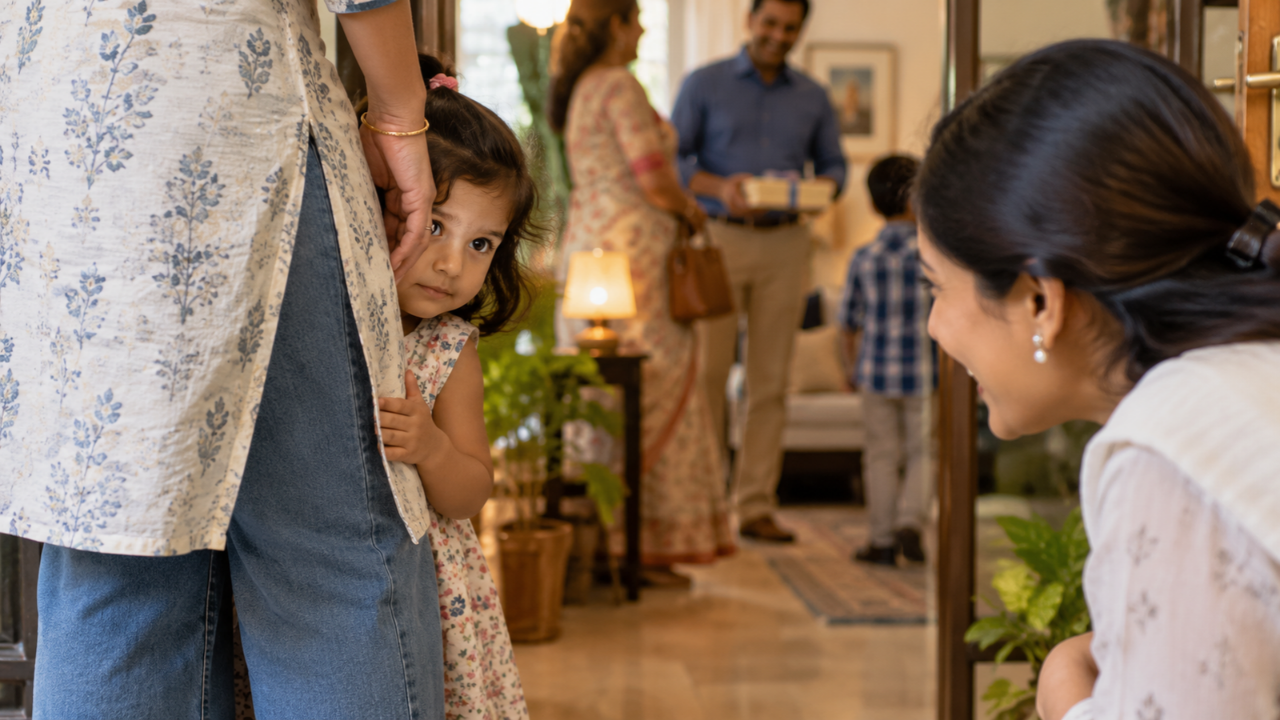
There is a familiar scene at family gatherings. The door opens, relatives arrive, and a toddler who was happily playing a moment ago suddenly moves behind a parent's legs. When someone bends down to say hello, the child turns away or clings a little tighter.
Yet, a few seconds later, the toddler peeks out to look at the visitor. The moment the guest tries to engage, the little face disappears again.To an adult, this behaviour can seem confusing. If the child is frightened of the visitor, why keep looking at them? And if curiosity is winning, why refuse to come out from behind the parent?
8 Oct 2026 | 14:25
What is the hardest part of raising a toddler that nobody prepared you for?
The answer may lie in the way young children approach unfamiliar social situations. A toddler can be curious about a new person while also feeling uncertain about interacting with them.
Hiding provides some distance, while peeking allows the child to observe without having to participate immediately.This does not mean every toddler who hides is experiencing the same emotions. However, developmental psychology offers a useful way to understand the behaviour: a child can want to explore something unfamiliar and still need time to feel comfortable enough to approach it.
Why toddlers may want to look but not interact
For a toddler, an unfamiliar visitor brings several new things to process at once: a different face, an unfamiliar voice, an unexpected greeting and the possibility of being picked up, touched or asked to perform a social ritual.
Even when the visitor is a familiar relative whom the child has met before, the setting or the person's behaviour may feel different from what the toddler expects.Research on behavioural inhibition examines how some infants and young children respond to unfamiliar people, environments and experiences with caution, hesitation or withdrawal. A review published in Annual Review of Psychology in 2005 described this temperament as a pattern of reacting warily to unfamiliar adults, peers and situations.
Parents do not need to manufacture enthusiasm or pretend every situation is completely comfortable.
For some children, an unfamiliar person prompts an immediate approach. Others take longer to observe before joining in. Neither reaction, by itself, tells parents everything about a child's personality or social development.The toddler hiding behind a parent may therefore be doing two things at once: keeping a comfortable distance and gathering information about the person who has entered the room.Peeking is not proof that the child is ready to interact. It may simply be a way to remain interested while controlling how close the interaction gets.
The parent becomes a point of reassurance
Notice what happens when the toddler peeks out. The child may look at the visitor, glance at the parent and then look back again. Sometimes, the child moves a little closer to the guest when the parent continues talking calmly. At other times, even a friendly greeting sends the toddler back behind the parent's legs.This is consistent with research on social referencing - a process in which young children use information from other people's expressions, voices and reactions to help interpret unfamiliar situations.A study published in Infant Behavior and Development in 1984 examined how 43 infants, aged approximately 19 and a half months, responded to an unfamiliar adult. The researchers observed how the children sought emotional cues from their mothers during the encounter. The findings linked social referencing and proximity-seeking with aspects of the infant's relationship with the caregiver.The study does not establish that every toddler who peeks from behind a parent's legs is consciously checking whether a guest is safe.
It does, however, provide context for why a parent's presence and reactions can matter when a child encounters someone unfamiliar.If the parent remains relaxed and allows the interaction to unfold gradually, the toddler can continue watching without being rushed into participating. If the parent becomes visibly tense or repeatedly insists that the child greet the visitor, the interaction may become more demanding.Parents do not need to manufacture enthusiasm or pretend every situation is completely comfortable. A calm, matter-of-fact response can help communicate that there is no immediate pressure to do anything.
Why some toddlers take longer to warm up
Children differ in temperament. Some are quick to approach new people, while others prefer to watch first, stay close to a familiar adult and join in only after they have had time to adjust.A2015 review and meta-analysis on inhibited temperament, published in Progress in Neurobiology, examined research on individual differences in children's responses to unfamiliar people, objects and experiences.
It discusses how these differences can emerge early in life and how they may relate to later outcomes.Importantly, being cautious around strangers is not the same as having an anxiety disorder. Nor does a toddler who takes time to warm up necessarily need to become more outgoing.A 2021 review in Biological Psychiatry noted that behavioural inhibition is a recognised risk factor for later social anxiety, but it also reported that nearly 60% of children identified as behaviourally inhibited did not go on to meet the criteria for social anxiety disorder.
Temperament is one part of a much larger developmental picture.For parents, the distinction matters. The aim is not to eliminate every moment of hesitation. It is to help a child gradually become comfortable with everyday social experiences while respecting their individual pace.
What parents can do when a toddler hides from guests
The next time a toddler retreats behind your legs at a family gathering, the instinct may be to coax them out, explain their behaviour to relatives or encourage them to say hello.
A more helpful approach may be to reduce the pressure and let the child decide when to engage.1. Let the child observe firstGive the toddler time to watch the visitor from a comfortable distance. There is no need to turn every family arrival into an immediate greeting exercise. Observing can be part of how a cautious child gets accustomed to a new situation.2. Avoid forcing physical affectionA relative may expect a hug, a kiss or to pick the child up. But a toddler who is hiding is already communicating some hesitation.
Do not insist on physical contact simply to avoid disappointing an adult.You can greet the visitor warmly yourself while allowing your child to remain beside you.3. Acknowledge the hesitation without labelling the childInstead of announcing, "My child is very shy" or "She is scared of everyone", try saying, "You can watch for a little while. You don't have to say hello straight away."This recognises the child's present discomfort without turning one reaction into a fixed identity.4. Make introductions low-pressureA visitor can sit nearby, talk to the adults or engage in an activity without immediately directing attention towards the toddler. Some children find it easier to join when they are not the centre of everyone's attention.A familiar toy, a shared picture book or an activity the child enjoys may also create an easier starting point for interaction.5. Notice small steps rather than demanding a dramatic changeA toddler might first watch from behind a parent, then stand beside them, accept a toy or eventually begin talking.
These are different levels of participation, and there is no need to hurry the progression.The American Academy of Pediatrics' parenting resource, My daughter is extremely shy and anxious around strangers. How can I help her?, recommends encouraging small social steps, modelling comfortable social behaviour and recognising a child's efforts.
Children can be allowed to maintain physical boundaries even when adults have good intentions.
When should parents pay closer attention?
Hiding behind a parent at a gathering, particularly around unfamiliar people, is not automatically a cause for concern. The broader pattern matters more than one incident.Parents can pay attention to whether the child gradually becomes more comfortable after some time, whether the behaviour occurs only in unfamiliar situations, and whether it interferes with ordinary activities or relationships.If the child experiences intense distress during most social encounters, remains extremely fearful despite repeated opportunities to become familiar with people, or has difficulty participating in everyday settings, parents can discuss these concerns with a paediatrician.
Persistent distress, rather than shyness alone, is an important reason to seek guidance.It is also worth remembering that a toddler's reluctance to approach someone should not be dismissed simply because the visitor is a relative. Children can be allowed to maintain physical boundaries even when adults have good intentions.
The takeaway for parents
When a toddler hides behind your legs but continues peeking at guests, the behaviour may reflect a mix of curiosity, uncertainty and a desire to stay close to someone familiar.
The child is not necessarily rejecting the visitor, nor is looking at them a guarantee that they are ready to interact.Sometimes, the most useful response is to stay nearby, keep the introduction relaxed and give the child room to decide what happens next.The goal is not to make every toddler the first to run towards a guest. It is to help them discover that they can approach unfamiliar people at a pace that feels manageable - without being pushed before they are ready.
KioskNews shows a cleaned-up reading view extracted from the publisher’s page — the original always lives on their site, not ours.