Agility’s new humanoid robot will stop, squat to avoid harming human coworkers
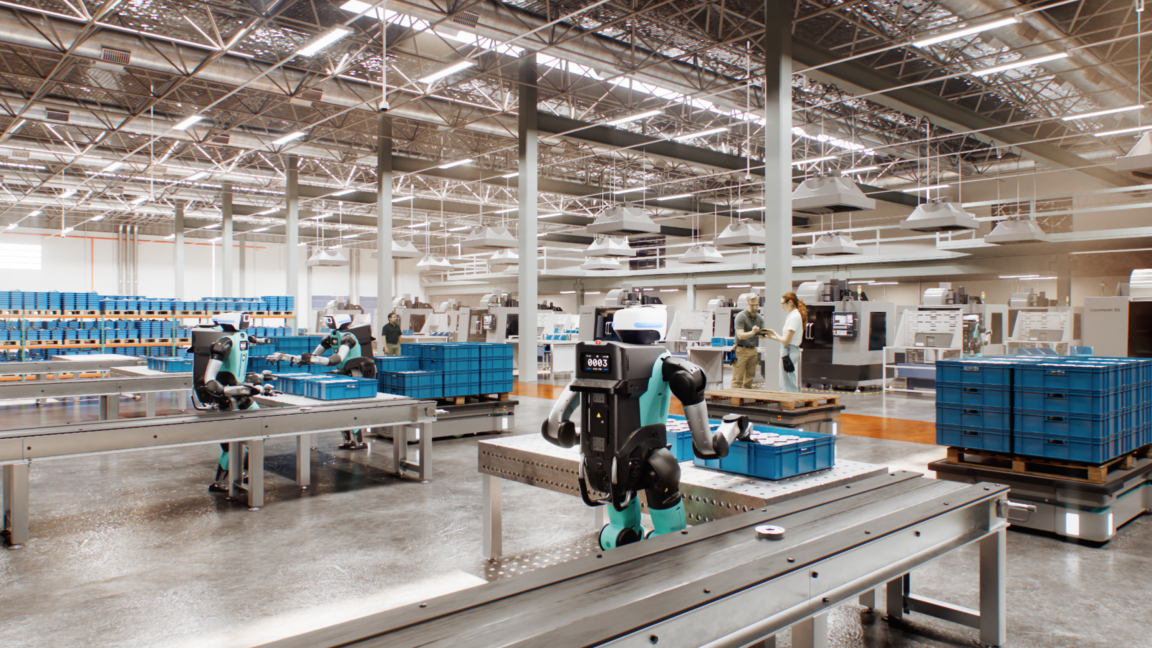
Agility Robotics has debuted its first humanoid robot engineered to work safely near humans without risking harm to flesh-and-blood coworkers. Such safety features could unlock many more opportunities to use such robots inside warehouses and automotive factories—all without requiring isolated robot work cells and physical separation barriers.
When Agility’s new Digit 5 robot detects a person at a distance, it can autonomously take precautions, like moving to avoid the person or standing still so the person can pass by without getting closer. If a person is getting into close proximity with Digit 5, the robot can even choose to squat and assume a seated position.
“The robot was designed with a complex safe motion system that can take a variety of different mitigations depending on exactly what sort of human presence is detected,” Pras Velagapudi, chief technology officer at Agility, told Ars.
Customers can expect to gain early access to the Digit 5 within the first half of 2027, with the robot becoming generally available by the end of that year, according to Agility’s announcement today. Agility has been retooling its RoboFab facility in Salem, Oregon, to produce its newest humanoid robot.
Agility’s leadership has consistently talked about safety as a crucial constraining factor in putting humanoid robots to work, despite being one of the humanoid robotics industry’s early movers. The robotics company, headquartered in Salem, became the first to deploy humanoid robots in full-time commercial operations at a GXO warehouse in Atlanta in 2024.
Since that time, earlier versions of the Digit robot have accumulated more than 65,000 hours working at warehouses and factories across North America. Clients that have piloted or deployed the Digit robots include GXO, Schaeffler, Amazon, and Toyota Motor Manufacturing Canada.
The competition to deploy humanoid robots has only intensified in recent years, with US and Chinese companies racing to scale up production and put the robots to work in a growing array of workplaces. But the safety issue has been a “blocker for everybody,” said Jonathan Hurst, cofounder of Agility Robotics and a robotics researcher at Oregon State University, in a previous interview with Ars.
The robotic safety hardware and software
The expected availability of the Digit 5 robot in 2027 provides a more “granular” approach to robotic safety around humans as opposed to simply turning the robot completely off and on again, Velagapudi told Ars. He also described Agility’s robot fleet management system as being able to interface with customers’ external workplace safety systems.
Digit 5 uses AI algorithms along with an onboard set of multimodal sensors to detect people in its proximity, Velagapudi said. Although he declined to reveal exactly what types of sensors the robot uses to monitor nearby humans, he described the array as consisting of “a few different types of vision-based sensors.”
Agility’s newest humanoid robot uses Nvidia’s Thor IGX hardware, which provides AI compute for robots and medical devices, along with integrating the Nvidia Halos for Robotics system that provides a software stack for robotics safety applications.
“Digit is equipped with this Thor IGX, and we’re one of the first adopters to be taking that through to a functionally safe application using that technology,” Velagapudi explained. “It’s really core to the compute of our product, and it’s part of the safety case that we’ve been putting together.”
Agility developed Digit 5’s safety features while also participating in a working group to develop an international safety standard for industrial mobile robots through the International Organization for Standardization (ISO). That standard, known as ISO 25785-1, is under committee review and will eventually be put to a vote by the international organization’s 89 voting nation members.
Unleashing the upgraded robot
Beyond being designed to operate safely around humans, Digit 5 also features an upgraded leg design compared to its predecessor that allows it to repeatedly lift up to 50 pound loads. Such capability makes the robot suitable to cover all single-person lift tasks as defined by the workplace safety regulations of the US Occupational Safety and Health Administration.
The new humanoid robot also has a battery capable of lasting 90 minutes on a single charge that can recharge in just nine minutes. That enables Digit 5 to perform more than 20 hours of work within a 24-hour period by spending most of its time operating rather than charging.
Compared to the older Digit 4 robot, Digit 5 stands taller, at 5 feet, 11 inches, and has the capability to reach heights of up to 7.2 feet, compared to Digit 4’s reach of 5.5 feet. That makes Digit 5 better able to reach the same shelves that average-size adults can reach.
Digit 5 also comes with a swappable gripper design that enables new hands or “end-effectors” to be quickly installed for various manipulation tasks. Combined with new AI-based skills, the swappable end-effectors allow Digit 5 to handle a wider variety of workplace tasks beyond just moving around totes filled with items.
The humanoid robot’s ability to work safely around people will allow it to help stack and package goods onto pallets and pause while a person swaps out the pallets, or safely move through aisles where people may also be working, Velagapudi said. In those scenarios, “it’s not really practical to constrain the robot within a physical safety cage,” he said.
Having a humanoid robot with such “cooperative safety” features enables the robotic workforce to get productive work done in the same space as humans while operating at a safe distance, Velagapudi said. Once this is proven in commercial deployments, it could lay the foundation for the next big step of enabling “collaborative safety,” where the humanoids work directly with humans in close proximity.

Jeremy Hsu is a reporter exploring a wide range of topics across deep tech and AI. He has previously written for New Scientist, Scientific American, IEEE Spectrum, Wired, Undark Magazine and MIT Tech Review, among many other publications, about topics such as deepfakes, data centers, drones, battery tech, robotics, and GPS jamming. He also has a Master of Arts in Journalism from NYU, and a bachelor's degree from University of Pennsylvania in History and Sociology of Science, with a minor in English.
KioskNews shows a cleaned-up reading view extracted from the publisher’s page — the original always lives on their site, not ours.