UNPACKING THE POLLS: Beyond coalitions, Joburg needs to rebuild trust and restore services
With coalition negotiations still unfolding following the local government elections, Johannesburg’s future remains uncertain. But as political parties negotiate behind closed doors, a bigger question looms over the country’s economic hub: what will it take to get Johannesburg working?
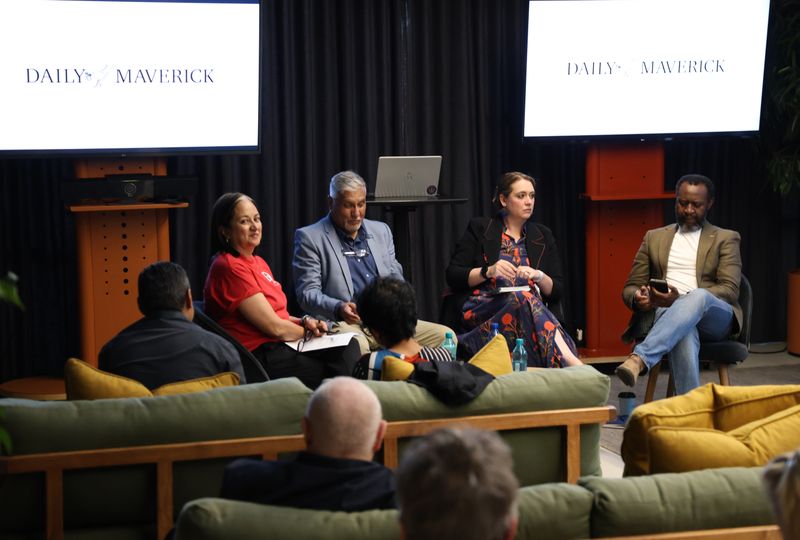
This was the question at the centre of a Daily Maverick discussion on Thursday evening, 19 November 2026, moderated by associate editor Ferial Haffajee. The panel brought together JoburgCAN director Julia Fish, Johannesburg Crisis Alliance coordinator Yunus Chamda and Wits University associate professor William Gumede to consider what lies ahead for the city.
Political uncertainty
For Haffajee, the political uncertainty was an obvious starting point. The Democratic Alliance’s failure to secure a majority in key metros was enough of a statement, with Helen Zille reportedly acknowledging the party’s electoral defeat in Johannesburg. Haffajee said the DA would have to consider its position in opposition, while the possibility of coalitions centred on the ANC, ActionSA and EFF had become part of the conversation.
Fish cautioned against viewing the election results as a problem. She argued that they reflected a population that felt increasingly unrepresented. Whatever coalition eventually emerges, it will have to reflect the diversity of political choices made by voters.
“Any form of coalition will be a mirror of what people wanted,” said Fish.

The challenge lies in ensuring that political diversity does not translate into another period of instability.
Fish described the prospect of a coalition excluding the parties with the most votes – the DA in the Joburg context or that of four other metros – as a “doughnut coalition”, warning that Johannesburg’s history of fragile political arrangements offered little reason for complacency.
However, some coalitions involving fewer parties have also proven unstable, with the panellists agreeing that smaller political arrangements are no guarantee of effective governance.
Fish pointed out the Government of National Unity as an example of different political parties finding a way to govern together despite ideological differences.

Chamda warned against allowing political egos to dictate the outcome of negotiations. The exclusion of a party that received the largest share of the vote raised questions about whether voters would feel adequately represented, he argued. Parties would need to put their differences aside and prioritise the interests of South Africans.
‘SA’s course has changed’
Gumede offered a more optimistic perspective, describing the election as a “historical moment for our [South African] democracy”. He argued that political support was increasingly crossing traditional racial, generational and social divides, creating an opportunity for a broader range of voices to influence government.
He pushed back against the bleak conclusion that Johannesburg was heading towards another political catastrophe. Much had changed, he said, including the strength of civil society and the growing expectation that political leaders would be held accountable.
“Whatever happens, I think we’ve just changed the course of our country,” he said.
Gumede also cautioned against taking public statements and leaked information, often fed to the media, at face value, adding that there could be “some method” behind the apparent hostility playing out during coalition negotiations.
He referred to ActionSA leader Herman Mashaba’s increasingly confrontational public stance towards the DA’s Helen Zille, suggesting that it could serve more than one strategic purpose.

Deteriorating services
But political negotiations are only one part of Johannesburg’s problem. For residents, the more immediate crisis is the city’s deteriorating services.
Haffajee described Johannesburg as effectively operating on “co-pilot”, pointing to worsening road conditions and mounting potholes as visible signs of municipal dysfunction.
“It’s like Kenny Kunene has left the building,” she joked about the former transport MMC.
Chamda said the contrast between suburbs and townships had become increasingly stark, with many communities left to organise and provide for themselves where government had failed. Food insecurity was among the most pressing concerns, while residents continued to demand basic services.
He argued that civic organisations would have an important role to play in holding the incoming administration accountable. The Johannesburg Crisis Alliance, he said, was prepared to scrutinise the new council.

The panellists returned repeatedly to the importance of accountability. Fish argued that communities needed to become more involved in local governance, including through practical interventions such as community food gardens and neighbourhood initiatives.
Gumede said this was a defining moment for civil society and the media to demand greater accountability, but that new approaches would be needed. Government, he argued, should not be understood to consist of politicians and public officials alone. It should involve citizens, businesses and civil society as active participants in shaping the state.
The discussion also touched on the growing tendency of wealthier residents to turn to private solutions for failing public services. While understandable, this risked deepening economic divisions and creating increasingly disconnected communities, where access to water, security and other necessities depended on what people could afford.
The future of Johannesburg will be determined by more than who occupies the mayor’s office. Coalition negotiations may decide the city’s immediate political leadership, but rebuilding public trust, restoring basic services and strengthening accountability will require a change in how the city is governed and who gets to shape its future. DM
KioskNews shows a cleaned-up reading view extracted from the publisher’s page — the original always lives on their site, not ours.