I thought of quitting chess, it was that hard: Savitha Shri
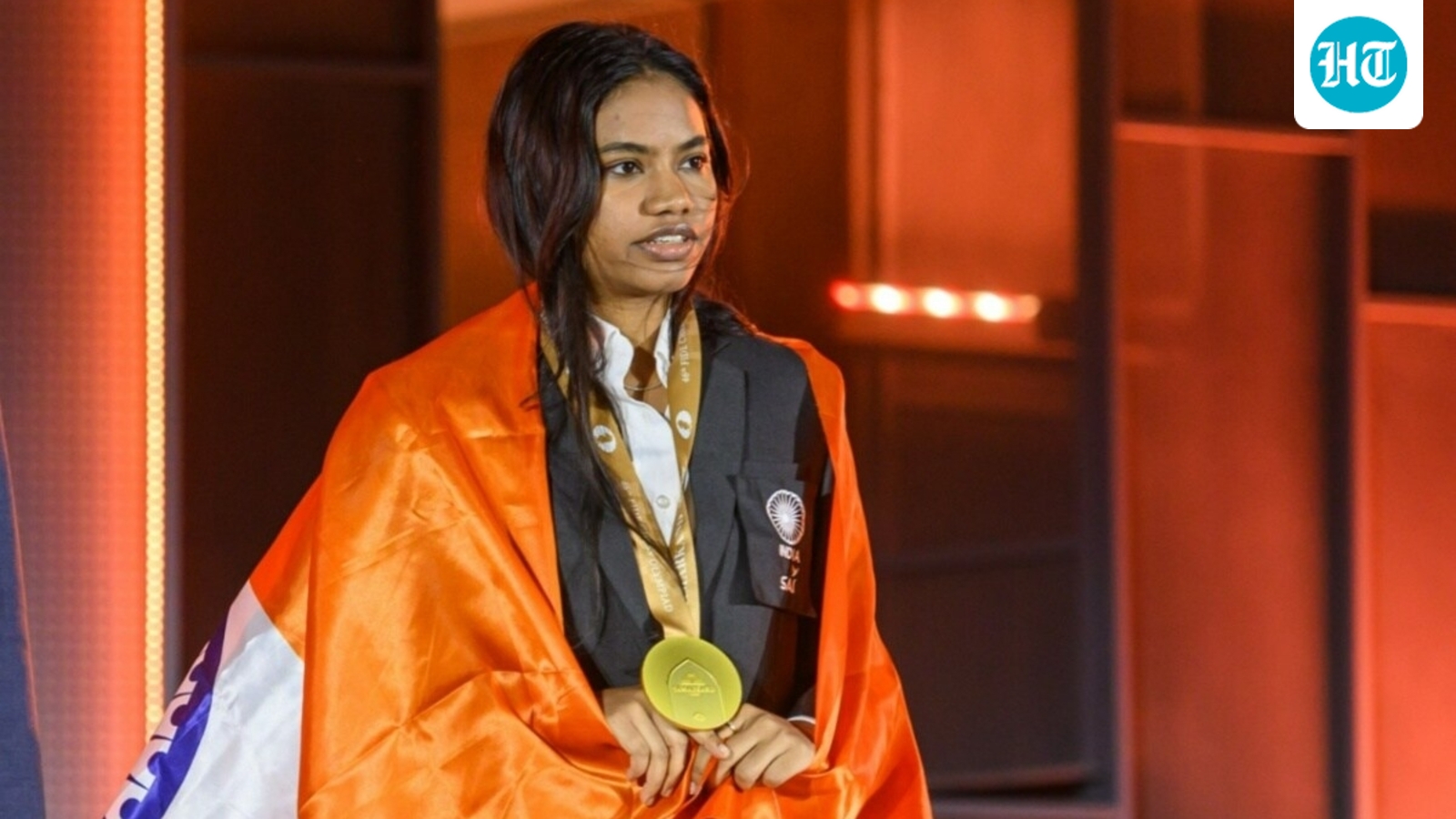
Shortly after the Indian Olympiad team was announced, 19-year-old Savitha Shri’s phone buzzed. It was a message from Judit Polgar. The Hungarian legend wrote – This is your chance.
Savitha turned those words into rocket fuel.
Playing her debut Olympiad, the international master from Chennai went unbeaten, scored 9/10 and won India’s only individual gold on Board 5 at the Fide Chess Olympiad in Samarkand. She won eight games and drew two, and helped the defending champions return with a bronze.
On most days, she was the last one standing, with the team’s fortunes pivoting on her game. Speaking to HT in an interview on Tuesday, Savitha said: “Throughout the tournament, I managed to swindle my opponents. Of course, it was also huge pressure. Most rounds, it was my games that went on after everyone else’s. Almost every day I was playing for five-six hours, so, it was very tiring as well. I’m happy I could help the team win bronze. That’s what’s important.”
After four wins in a row, Savitha was rested for the Round 5 match against Poland, which India went on to lose, the only one that the team lost in the entire tournament. “We lost to Poland last time too, but still won the gold. Both Vantika and I were on 3/3 when she was rested, and I played the fourth round instead. We were both in good form. Also, most of my opponents until then were not too strong,” says Savitha, who went on to score 7/7. “At that point, it was a tough call, and I too thought it was right for Vantika to play. Of course, now it’s pretty clear that I should have played that match. I was in great form. Who knows… anything could have happened.”
The final two rounds – against China and Georgia – had Savitha doing what it takes to get India on to the podium. She calls her “fighting ability” her strength. “China was the most difficult round for us. Matches usually come down to Board 3 and 4. Vantika (on Board 3) was playing extremely well, it’s unfortunate she lost.”
Vantika had an equal position with White before things went downhill.
The cameras caught a visibly shocked and disappointed Savitha, hands cupped over her mouth, glancing at Vantika’s board to discover her teammate was losing.
“Yeah, everybody was telling me about it,” Savita laughs, “I wish I was better at controlling my emotions. When I saw she was losing, I was kind of mad because I thought we both were winning and team would have a good chance to win gold. So, it was hard for me to suddenly see her losing.”
If Savitha lost her game too, India would have lost the match and been out of medal contention. She blundered a pawn in an equal position but went on to fight back and win against WGM Zhai Mo, taking India to a 2-2 draw against eventual champions, China, heading into the final round.
During the final round against Georgia, Savitha was “mad” at herself. She was objectively worse with Black but managed to equalise. “I was suffering from the position I had. But I had hope, since I had been defending well throughout the tournament. Once the Kazakh team drew, I started thinking that if I win and we win the match, we will win silver. I was not sure if we would win a bronze if the team drew because there were other teams too. I was a pawn up in a rook bishop endgame and I remember Humpy akka saying that she saw I was worse in the middlegame only to come back and find me a pawn up. Though the engine says it’s equal, from a human perspective it would have been mentally hard for my opponent because I had gone being from a pawn down to a pawn up.”
“My team was surprised and happy that I had defended the game but I was mad at myself for not pushing. But I controlled my emotions. Once our captain, Swayams (Mishra), shook my hand, I couldn’t control it anymore.”
For Savitha to get here – an Olympiad hero – has taken a lot of will, some self-loathing and thoughts of quitting chess. The past two years were rough. She was putting in the work, but there was little to show for it, her rating had dropped, sponsors had stopped backing her, tournament invitations had dried up and she found herself spiralling, questioning whether she should continue in the sport.
“I had thoughts of quitting chess. It was that hard. I lost whatever I had – sponsors, tournament invitations. It was difficult for me to process what had happened. My play wasn’t improving, I was losing a lot of rating and I wasn’t winning any tournaments. It’s this vicious cycle, because when your rating drops, your confidence also takes a hit when you play someone higher rated. So that was affecting my play. My parents were a huge support during that phase.”
What helped her climb out of the rut, she says, is a switch in mindset.
“At some point I stopped thinking about it. I stopped thinking about what people think of me or what was on social media. I just kept working hard and the results are finally here.”
In the open section, reigning world champion Gukesh, manning board 4, had a decent run. He finished with an individual silver. They both have known each other since they were kids. “We were competing and sometimes winning together in the same age category. So yeah, we sort of went through the early part of our career together. Of course, back then too, he was a lot stronger than I was. He would always have the answers really fast, during the endgame session we did together with Karsten Muller. During this Olympiad we got some time together, congratulated each other on the tournament we both were having and all of us played some card games together Of course, now he’s the world champion, a superstar. He’s always been kind and humble. I’m just happy for him.”
While Gukesh has a world title to defend in November, Savitha plans to play the World Junior Championship that month. She has GM norms to chase and rating climbs to focus on. Savitha gained 23 Elo points from this Olympiad and is now 2405 in the live ratings which moves her move up to world No 41 in the women’s rankings. “Getting the grandmaster title is one of my goals right now,” she says.
Savitha was away playing in Biel when she got to know she had made the Olympiad team. She called her parents right away and was thrilled to receive a text from Judit, whom she describes as an “idol”. Two years ago, Savitha together with six other Indian female players spent a fortnight in Budapest, training for eight hours a day at a camp run by Judit.
What weighed most on her mind when she was picked, was the player she was replacing – grandmaster Harika Dronavalli, a veteran of 10 Olympiads, who was part of the 2024 gold-medal winning team as well. Harika, mother to a young daughter, chose to sit this Olympiad out, presumably to make way for young names like Savitha.
“The Olympiad seemed like a huge chance. The one thing on my mind was whether I’ll be able to prove myself, because I was taking Harika akka’s place. I was in touch with her throughout the tournament. I was asking her for advice. She’s such a sweetheart. She was always there for me whenever I needed her. I’m really happy I could make her proud.”
The Indian women’s team had grandmasters Arjun Kalyan and Diptayan Ghosh helping them. On their way to the playing venue, Savitha would often turn to Arjun for a last-minute brush up on the move orders.
“Everyone in the team worked really hard. I harassed our seconds a lot and I don’t think we could have asked for a better captain than Swayams.”
For Savitha, who is studying marketing management at M.O.P Vaishnav College in Chennai, this Olympiad has been a defining moment. Her career may well come to be viewed in two parts – before and after Samarkand.
“I suppose this performance has brought me some recognition in the chess world. I want to keep proving myself. We’ll see how it goes. This is only the beginning.”
KioskNews shows a cleaned-up reading view extracted from the publisher’s page — the original always lives on their site, not ours.