New tripartite council formed to prepare healthcare workforce for the future
SINGAPORE - As job roles of healthcare workers continue to evolve amid new care models and technological advancements, a new tripartite council has been formed to equip the workforce for the future.
Its efforts will include redesigning healthcare roles; especially for nurses, pharmacists and allied health professionals, to support the shift in delivering more care in the community, away from the hospitals and clinics.
This is one of the three key focus areas of the newly-formed Healthcare Jobs, Skills, and Training Council, said Health Minister Ong Ye Kung on Nov 27 at the Healthcare Services Employees’ Union (HSEU) human resource forum.
An example of successful job redesign was patient care support roles across the public healthcare sector. Support staff are now able to take on more operational tasks under supervision such as wound dressing, performing electrocardiograms, and taking blood from patients.
The second focus area of the new council is to equip healthcare workers with skills for the future.
“As healthcare becomes more team-based and technology-enabled, healthcare workers will need new skills, including the ability to work across disciplines and make effective use of technologies such as AI”, Ong said.
This will require job and skills training to be directly linked to how care is to be delivered, “so that whatever they learn, they can apply in their jobs”, the Minister added.
Some workers might be impacted with the loss of their job roles when care models change or with disruption brought about by technology.
Ong said that the council will support workers through change, which is its third area of focus.
“If roles are affected negatively, we should identify the implications early, engage workers, and provide timely upskilling, reskilling, and career transitions.”
Nevertheless, he added that “overall, I would say that a great majority of healthcare workers will find their roles expanding”.
The council, established by the Ministry of Health (MOH) and HSEU under the National Trades Union Congress (NTUC), is co-chaired by Minister of State for Health Rahayu Mahzam and NTUC president K Thanaletchimi.
MOH and HSEU said in a joint statement release on Nov 27 that members of the council include senior leaders in the Government, public healthcare employers, and the union, although the full list of members has yet to be announced.
Ong, who is also Coordinating Minister for Social Policies, said at the forum that the healthcare system is undergoing a major transformation with the ageing population which had drastically changed the demand for healthcare services.
“Not only are there more patients, they are also more likely to develop chronic diseases and multiple medical conditions”, he said.
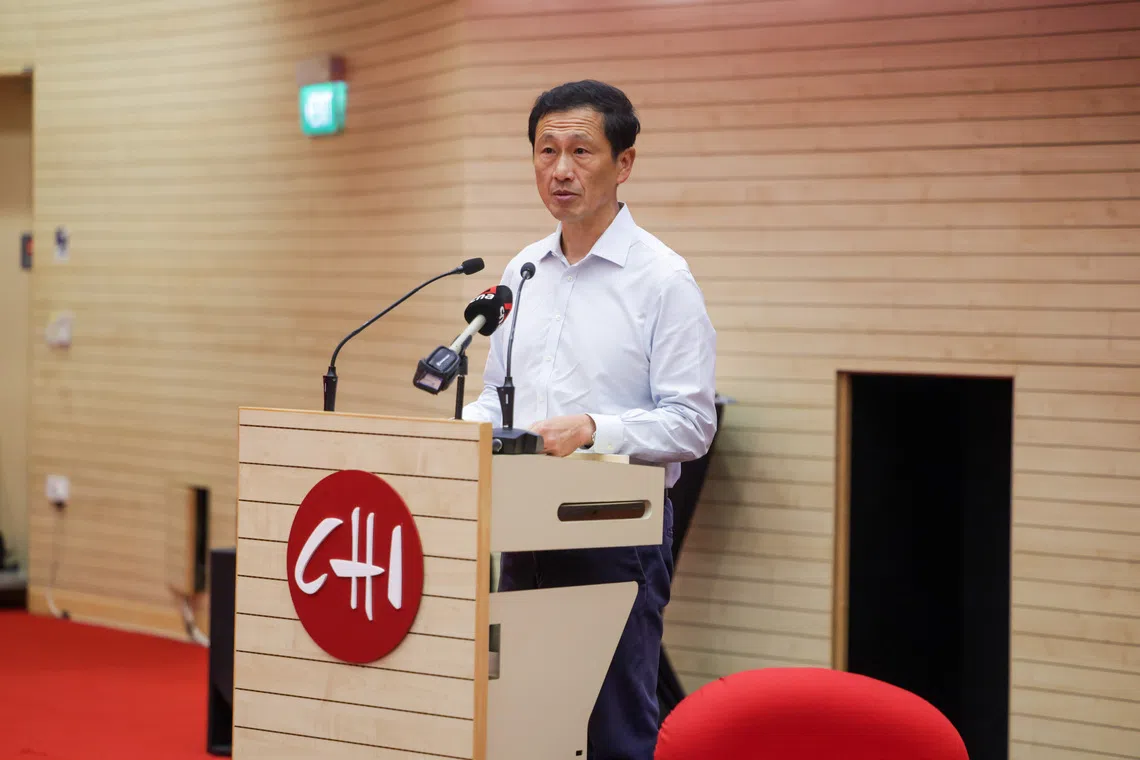
Health Minister Ong Ye Kung speaking at the Shaping the Workforce of Tomorrow Forum at the Centre for Healthcare Innovation on Nov 27.
PHOTO: LIANHE ZAOBAO
The solution to address this is not to simply build more hospitals and polyclinics, and hire more healthcare workers.
“We also need to change the way healthcare is delivered, moving from treatment to prevention, from focusing on sickness to emphasising health, from hospitals to the community and our residential areas”, he added.
Leveraging technology such as telemedicine and artificial intelligence (AI) has enabled healthcare to be delivered at home, instead of only in clinics. The time needed to complete tasks can also be greatly reduced from hours to minutes, Ong pointed out.
He said there is a need to evolve healthcare manpower and that “job responsibilities will change - more likely expand than contract, regulations will need to be updated, workers with new skills need to learn how to use new tools, and training pathways also need to be redesigned.”
Currently, nurses manning community health posts - neighbourhood spaces where residents can receive personalised health coaching and chronic disease management near their home - are able to support those with stable chronic conditions in between their visits to the doctors.
The minister said these nurses could possibly take on more roles safely, such as routine monitoring and assessments, providing appropriate health advice, and escalating health concerns to the doctor.
“He or she must be empowered and possess the competencies and clinical tools to carry out the required tasks, supported by clear care protocols, supervision and escalation pathways”, Ong said.
Henceforth, there is a need to go beyond matching demand and supply numbers for healthcare workers, to “understanding the tasks that need to be carried out, and ensuring healthcare workers have the mandate, tools and skills to accomplish them”.
The tripartite partners will develop the Council’s workplan at its first meeting in April 2027.
Thanaletchimi, who is also the president of HSEU, said the union’s role is to include workers’ voices into the transformation process from the start.
“Workers must have a voice in how their jobs are redesigned, and proper training and support must accompany every major change”, she added.
She emphasised that going forward, attracting and retaining healthcare workers will become more important.
“We must ensure that healthcare continues to offer meaningful jobs and sustainable careers that workers can see a future in”, she said.
KioskNews shows a cleaned-up reading view extracted from the publisher’s page — the original always lives on their site, not ours.