Hokuto apples perfect for Mid-Autumn gifting
SEASONAL ALTERNATIVE: While Lishan honey apples are usually harvested from late October until December, Hokuto apples are ready from mid-September, an official said
By Ou Su-mei and Esme Yeh / Staff reporters


The Taichung Agricultural Tourism Industry Development Association yesterday encouraged people to purchase Hokuto apples grown in Taichung’s Lishan (梨山) area, which it said are in season and ideal for a Mid-Autumn Festival giftbox.
The Lishan area is famous for its Megumi apple production, commonly known as Lishan honey apples in Taiwan.
Lishan honey apples convert starch into fructose for storage to protect themselves from frost damage in the alpine climate of the Lishan area.
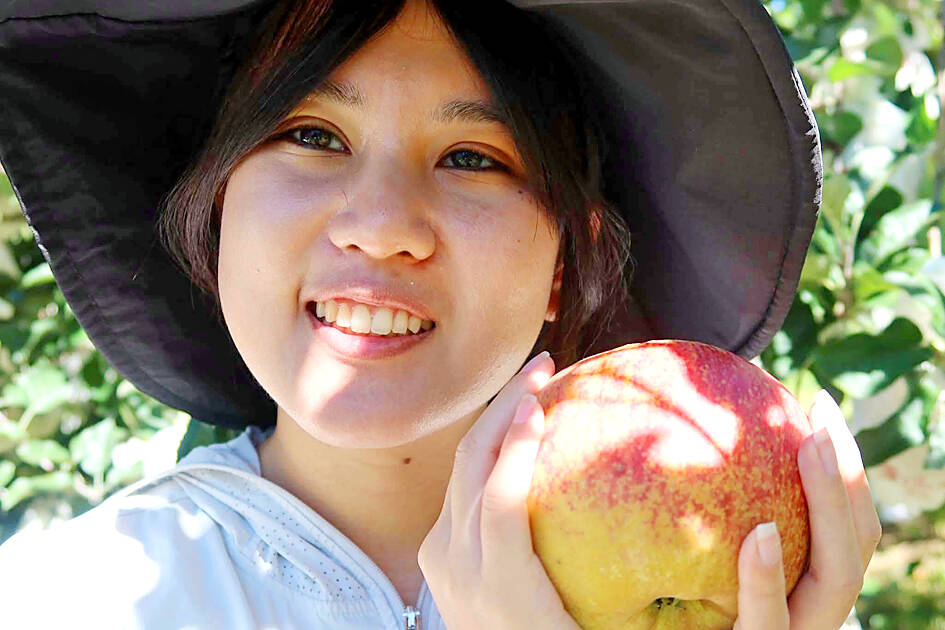
Taichung Agricultural Tourism Industry Development Association chairman Lo Ching-yu’s daughter Lo Fang-wen is pictured with a Hokuto apple in an undated photograph.
Photo courtesy of Lo
The fructose forms a translucent water core inside the apples, making them taste sweet and juicy with a crisp texture.
However, Lishan honey apples are usually harvested from late October until December and might not be available until next month.
While honey apples have a concentrated harvesting season, the Hokuto apples cultivated in the Lishan area are a good alternative, association chairman Lo Ching-yu (羅進玉) said yesterday.
The Hokuto apple is an heirloom variety that was introduced to Lishan for cultivation more than three decades ago, he said.
It is a hybrid of Mutsu and Fuji apples developed by Japan’s Aomori Apple Experiment Station in 1983, Lo said.
The Hokuto apple features large fruits, each weighing from 300g to 400g, he said.
Its flesh tastes smooth, juicy, sweet and tangy, with a strong aroma after ripening, Lo said, adding that some Hokuto apples also have water cores.
The Lishan area’s high altitudes and sharp day-night temperature changes are the key to the Hokuto apple’s exquisite flavor, he said.
The Hokuto apple’s harvesting period runs from mid-September to early-October, making it ideal for a giftbox during the Mid-Autumn Festival this week or the Double Ten National Day holiday next month, Lo said.
Separately, the Ministry of Agriculture (MOA) has collaborated with the Ministry of Sports to showcase Taiwanese agricultural products at the 20th Asian Games in Japan’s Nagoya over the weekend.
At a promotional fair held at Nagoya’s Meieki Parklet public plaza yesterday, Minister of Agriculture Chen Junne-jih (陳駿季) said consumers in Taiwan and Japan emphasize food safety and quality.
Taiwan continues to supply safe and high-quality agricultural and fishery products to Japan and has earned recognition from the Japanese market, he said.
To meet Japanese consumers’ strong demand for quality, freshness and safety, Taiwan will continue to improve its agricultural production, quality management and related techniques, Chen said.
Taiwan’s promotional efforts for its agricultural and fishery products in the Japanese market used to focus on the Kanto region, he said.
The MOA would actively assist Taiwan-grown produce in expanding into more local markets of Japan such as Nagoya, he added.
Nagoya Mayor Ichiro Hirosawa said that Taiwan’s specialty foods such as braised pork rice and fruit such as bananas, pineapples and mangoes are widely popular in Japan.
Japan in the past few years has promoted a “nighttime economy,” he said, adding that Taiwan’s rich experiences in night market culture and noctourism would be favorable for future bilateral exchanges.
Representative to Japan Lee Yi-yang (李逸洋) said that Taiwan and Japan have long been critical partners for each other and the partnership continues to deepen through culinary culture exchanges.
Taiwan’s annual pineapple exports to Japan amounted to 16,000 tonnes last year, a record high, he said.
Other agricultural or fishery products such as mangoes, bananas, dragon fruit, eels and Pacific saury are popular with Japanese consumers and have become familiar ingredients, Lee said.
KioskNews shows a cleaned-up reading view extracted from the publisher’s page — the original always lives on their site, not ours.