French schoolchildren have been treated like violent criminals – for telling the truth | Rokhaya Diallo
As a secondary school pupil in 1994, I took part in protests against a reform that would have allowed French employers to pay young people below the minimum wage. Our campaign was successful, but if we had had to face the terrifying police response unleashed on student protesters in France over recent weeks, I would have stayed at home.
A 14-year-old boy, Eden, suffered a fractured jaw and had teeth knocked out after a police teargas grenade struck him in the face. Sixteen-year-old Maël lost the sight in one eye allegedly after being struck by a shot from an LBD, a form of rubber-bullet launcher. Evan, 15, had his hand blown off in an explosion involving a police stun grenade. And in Dunkirk, a police SUV is alleged to have driven repeatedly at groups of secondary school pupils, as an officer could be heard saying: “Come closer, we’ll smash their fucking faces in.” Accounts from children left terrified by brutal treatment in police custody describe traumatic experiences with severe psychological and physical consequences.
France, the self-styled home of human rights, is now attracting the kind of international legal scrutiny you would expect if this were an authoritarian regime gone mad. The human rights organisation Ligue des droits de l’Homme has condemned the alarming “brutalisation of young people”, and the threat to their freedom of expression.
A UN special rapporteur has called on the French authorities to respect the physical safety of protesters. The UN human rights office says it is following incidents surrounding the protests in France “with concern”. Amnesty International has called for the suspension of rubber-bullet launchers at school protests, condemned the disproportionate use of force and reminded the authorities of their duty to protect children. The Swedish climate activist Greta Thunberg, whose activism increasingly encompasses struggles against oppression and state violence, travelled to France this week to support school pupils.
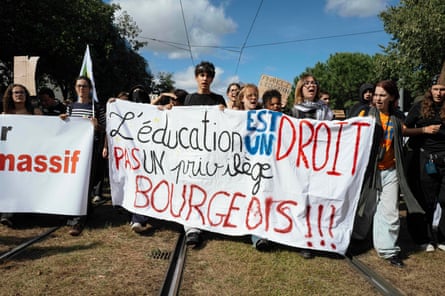
It is often argued that France is broke, and that crippling debt levels make the student demand for €10bn of investment to improve their learning conditions a non-starter. But even in our difficult fiscal position, public spending is a political choice: to reduce debt you can cut public spending or you can raise revenue.
Economists Élise Huillery and Romane Paris have come up with a credible proposal for investing an additional €11.8bn a year in education, funded through tax reform targeting large inheritances, raising €12.7bn in 2026 and increasing taxes only for the wealthiest 1% of heirs.
This would make money available to raise teachers’ pay, improve support for pupils, student grants and housing, and expand university places. But the debate about public spending does not invalidate the legitimate grievances of pupils, teachers and parents, which are not new. Nor does it justify a vicious law and order response.
Learning conditions in some of the most disadvantaged schools have been deteriorating to shockingly poor levels for a long time. I highlighted school conditions in France in the Guardian three years ago, arguing then that the state education system was among the most unequal in the developed world. The lack of resources assigned to such basic things as teaching vacancies has been glaringly apparent for years, with jobs in some districts sometimes left unfilled for months.
More than 20m teaching hours were lost in state secondary schools in 2024-25, equivalent to almost one in 10 lessons. More than 15m of those hours were lost because no replacement teachers were provided. Schools in designated priority education areas, which serve disadvantaged communities, have been particularly affected, according to France’s National Audit Office.
In Seine-Saint-Denis, the poorest part of mainland France, two-thirds of school doctor posts were vacant in 2023. As early as 2022, the Créteil education authority reported a shortfall of 60 school nurses and 20 social workers, with 90% of the unfilled posts in Seine-Saint-Denis. In 2025, 49 suicides were recorded among staff in the national education system. While these deaths cannot all be attributed to work, it is hard to avoid thinking of the severe deterioration in working conditions across the sector.
Then there are the schools that are physically falling apart: water that is unsafe to drink because of bacterial contamination, pupils reporting rats and cockroaches, filthy toilets, and in one case, a septic tank that overflows when it rains. There are power cuts, missing furniture and some classrooms are so poorly insulated that temperatures fall below 14C in winter and hit 40C during heatwaves.
after newsletter promotion
In Mayotte, where protests began, a secondary school built for 900 pupils is accommodating 2,300. The protests then spread to mainland France through a school in Créteil that began the academic year short of 13 teachers and other staff, as well as a deputy headteacher.
Another issue at the core of pupils’ anger is Parcoursup, the system through which school leavers apply for higher education. Seen as discriminatory, it left 126,000 applicants – many from disadvantaged backgrounds – without a place this year.
Rather than deal with this crisis as justified social protest based on legitimate demands, the government has invoked a doctrine set out in its Operational Guide to Urban Violence. It has treated school pupils as internal enemies to be neutralised. This sets up a coercive response, disregarding the possibility of resolving the conflict through constructive measures.
By 8 October, 6,877 people had been taken into police custody, about 80% of them children. On 1 October alone, police made 1,949 arrests, exceeding the highest single-day total recorded since 1961, says the historian Éric Anceau. According to the Syndicat de la magistrature, a French judges’ leftwing union, the numbers reflect a clear determination to crush the movement. So overwhelming has the police deployment been that teachers and parents have had to form human chains to protect children.
The police operations are also driven by a focus on arrests, which encourages forceful confrontations and fuels the escalation. This in turn draws more people into rioting. About 700 police officers and a number of teachers have been injured since the start of the unrest.
The sociologist Olivier Fillieule points out that policing protests requires an assessment of risk. If the swift break-up a blockade exposes teenagers to serious injury, you have to consider alternatives. Temporarily accepting a degree of disorder when immediate intervention risks creating more of it should remain a guiding principle of policing protests, Filleule says, noting that the French authorities know how to apply restraint when farmers stage blockades.
Yet while the police have opened internal investigations into 36 allegations of officer violence, the interior minister Laurent Nuñez said he had given the forces “no instructions to exercise restraint”. This is a shameful and contemptuous way to respond to young people’s healthy expression of dissent. Such violence towards citizens has no place in a democracy.
-
Rokhaya Diallo is a French journalist, film-maker, activist and Guardian Europe columnist
KioskNews shows a cleaned-up reading view extracted from the publisher’s page — the original always lives on their site, not ours.