The 6 Most Uplifting War Movies of All Time, Ranked

Jeremy has more than 2900 published articles on Collider to his name, and has been writing for the site since February 2022. He's an omnivore when it comes to his movie-watching diet, so will gladly watch and write about almost anything, from old Godzilla films to gangster flicks to samurai movies to classic musicals to the French New Wave to the MCU... well, maybe not the Disney+ shows.
His favorite directors include Martin Scorsese, Sergio Leone, Akira Kurosawa, Quentin Tarantino, Werner Herzog, John Woo, Bob Fosse, Fritz Lang, Guillermo del Toro, and Yoji Yamada. He's also very proud of the fact that he's seen every single Nicolas Cage movie released before 2022, even though doing so often felt like a tremendous waste of time. He's plagued by the question of whether or not The Room is genuinely terrible or some kind of accidental masterpiece, and has been for more than 12 years (and a similar number of viewings).
When he's not writing lists - and the occasional feature article - for Collider, he also likes to upload film reviews to his Letterboxd profile (username: Jeremy Urquhart) and Instagram account.
He has achieved his 2025 goal of reading all 13,467 novels written by Stephen King, and plans to spend the next year or two getting through the author's 82,756 short stories and 105,433 novellas.
Sign in to your Collider account
This is a difficult topic to tackle, because war movies don’t tend to be uplifting. Like, if you're after movies that'll make you feel good, or at least a little better about the state of the world, you're going to be better off seeking out those belonging to other genres, like certain coming-of-age movies, romance films, or some comedies, for hopefully obvious reasons.
With the war genre, plenty of these movies are anti-war, and so the likes of Grave of the Fireflies, Come and See, and All Quiet on the Western Front are about as far from inspiring and uplifting as movies get. But if you're after some great war movies that have uplifting qualities (even if you do have to take those uplifting parts with some inevitable heavy parts), the following ones might well end up scratching that admittedly unusual itch.
6 'The Great Dictator' (1940)
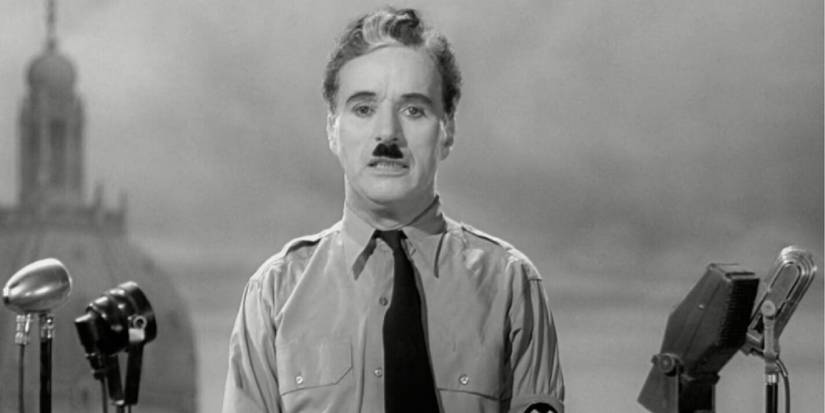
Charlie Chaplin was an exceptionally interesting figure during the 1930s and 1940s, since in the former decade, he held onto silent film as a whole medium for longer than most. If you look at 1931’s City Lights and 1936’s Modern Times, they're almost entirely silent, but the times kept changing, and then Chaplin finally shifted at the very start of the 1940s. In that decade’s first year, he ended up making a “talkie” and actually being ahead of the curve in the process, since The Great Dictator was one of the earliest movies that dealt with World War II, a conflict that had only just officially broken out in 1939.
The Great Dictator did strive to bring peace to a world that had gone a little beyond being “just” on the brink of war, and for its efforts there, it has to be admired.
It’s not explicitly a World War II movie, because the war itself – and its true destruction – either hadn’t happened or hadn’t been made apparent at that point in time. And maybe the ending (with a no-longer silent Chaplin giving one of the most memorable monologues in movie history) is a bit naïve, with the benefit of hindsight, but The Great Dictator did strive to bring peace to a world that had gone a little beyond being “just” on the brink of war, and for its efforts there, it has to be admired. Also, wars continue to be fought, so the climactic plea for peace retains a certain power when watched all these decades later.
5 'Master and Commander: The Far Side of the World' (2003)

Rightly considered one of the more underrated war movies in recent memory, Master and Commander: The Far Side of the World finds adventure, heroism, and hardships (though with the latter, not as much as some other war movies) all at once in a story set during the Napoleonic Wars. It’s incredibly well-written to keep all that balanced, not to mention have the whole movie feel entertaining despite some slower moments and a willingness to highlight some of the inevitable downtime that comes with warfare, and without too much of an emphasis on over-the-top action. The battle scenes are there, sure, and exciting, but they're not always the focus.
Master and Commander: The Far Side of the World also maintains a level of realism despite it being an adventure film, and you get a sense of how this sort of life could fluctuate between thrilling and challenging. It’s a bit like a less depressing and not as claustrophobic as Das Boot, which is somewhat interesting to compare to Master and Commander, since that one is also set largely at sea but feels much more intense and unnerving than it is necessarily exciting, because that one does lean far more into anti-war territory.
4 'Schindler's List' (1993)

Make no mistake: there is a heaviness to much of Schindler’s List, and so calling most of the movie uplifting in the traditional sense would be outright misleading. You have to take into account what is eventually built toward, though, because Schindler’s List is ultimately about an act of heroism that didn’t (and couldn’t) save everyone and solve everything, but it made a difference. And it was an act of good that occurred among numerous acts of violence and murder.
The idea that one person (and a lot of wealth, admittedly) can make a difference is the inspiring part. Schindler’s List does depict the horrors of the Holocaust while also showing what Oskar Schindler did to save more than 1000 Jewish lives, and that’s what’s celebrated, and that’s the part that makes Schindler’s List technically uplifting. It’s more bitter than sweet, if you look at the whole movie, though the ending is about heroism – even if limited – making a difference, and someone doing something great against all odds.
3 'Inglourious Basterds' (2009)
It does take place during World War II, but otherwise, Inglourious Basterds is a very different beast to Schindler’s List, since the latter is about doing what can be done against insurmountable evil, and the former is about possibly being able to actually conquer that evil. It’s ruining things a little to frame it in that way, but Quentin Tarantino and his willingness to play around with history is pretty well-known at this point, since he’s done it to some extent with most of his more recent (well, comparatively recent) movies, like Django Unchained and Once Upon a Time in Hollywood.
Striking the balance between tension/violence and moments that are surprisingly cheer-worthy is something that not many filmmakers could do and get away with, but hey, Quentin Tarantino is one of them. He makes rewritings of history work better than expected, and builds a lot of suspense throughout Inglourious Basterds while also making sure it’s entertaining. And, even if unrealistic, the fact that the characters here defy the odds of history is kind of inspiring and cathartic to see, when you think about it.
2 'Casablanca' (1942)

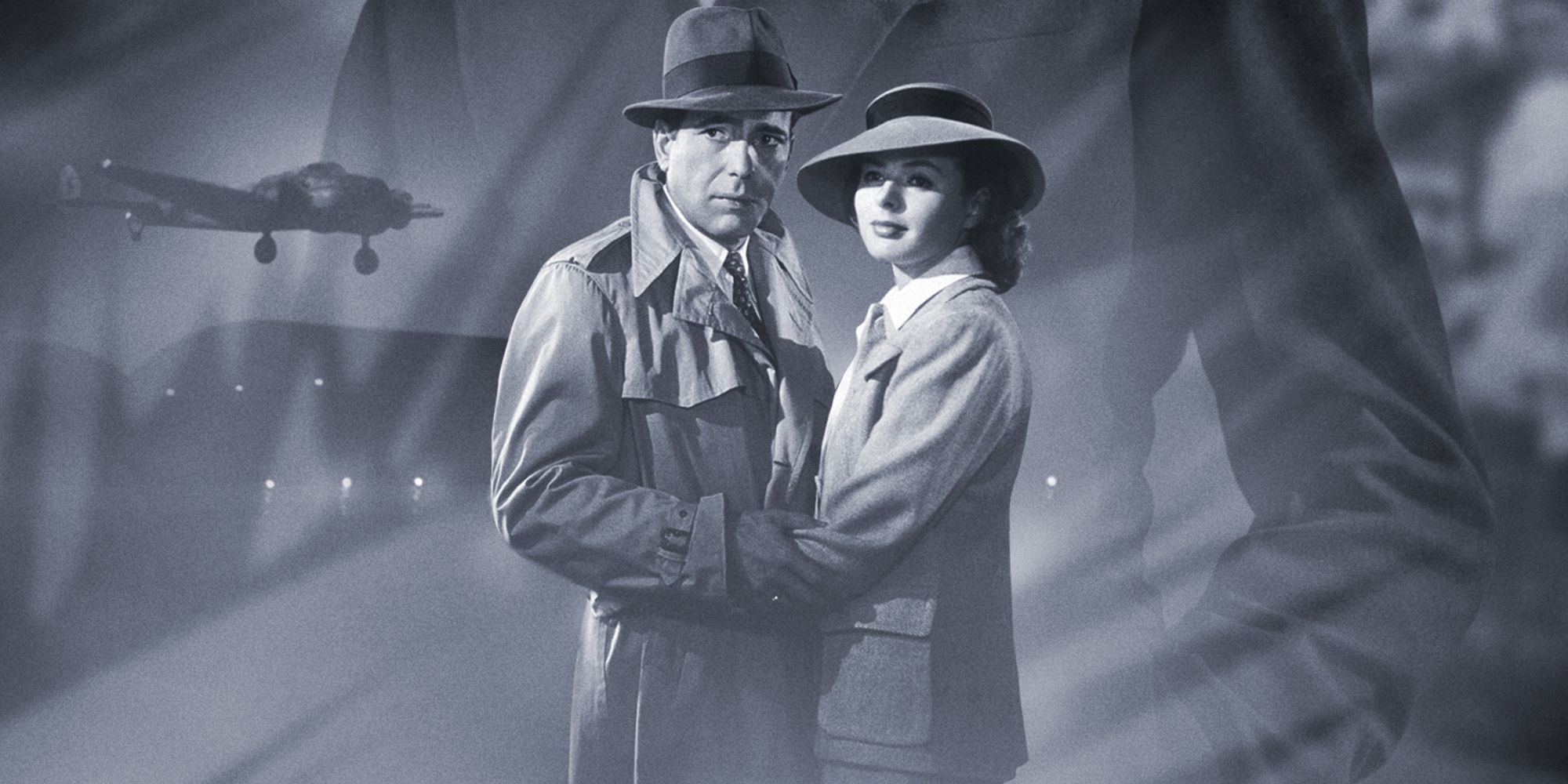
Since it’s packed with memorable dialogue and contains perhaps the greatest of all the Humphrey Bogart performances, Casablanca is just about as good as movies of its era get, and it’s also an all-timer more generally speaking. There is an undeniably high degree of entertainment value here, even with the love story at its center being a bittersweet one, and everything technically playing out against the backdrop of World War II, and a time when said war was still a few years away from ending.
There’s a real balance here, though, since Casablanca manages to be funny, exciting, romantic, and bittersweet all at different points throughout, and without it feeling like those different parts of the movie clash. It’s also got one of the very best endings in cinema history, so you sit through a great movie, and then you get a somehow even better-than-expected finale. It’s mostly uplifting, too, regarding what it has to say about continuing to fight in any way you can, and about appreciating the good times while they're good, all the while being able to accept when you might have to move on (especially if it’s ultimately for the best).
1 'The Best Years of Our Lives' (1946)
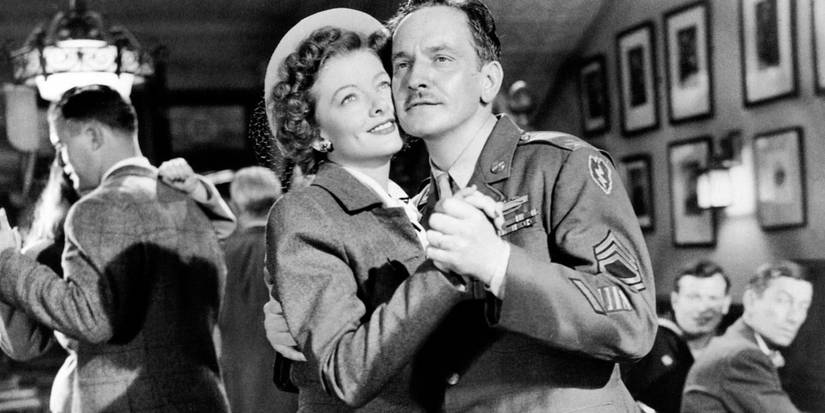
While The Great Dictator was made in 1940 and reflected feelings around a war that was then rapidly in the process of growing to a global scale, The Best Years of Our Lives was released in 1946, the year after that all-encompassing war officially ended. As such, it’s clearly more about looking forward and getting on with life, all the while acknowledging the physical and emotional scars such a conflict left on those who survived it, with the characters grappling with that in a way people at the time surely were.
So, The Best Years of Our Lives resonated strongly, to say the least. It’s definitely a unique war movie, too, being purely about the aftermath and generally focusing on a group of American soldiers as they adjust back into civilian life. It doesn’t say that whole process is easy, but there is a sense of slowly overcoming the challenges of post-war life, all while accepting how those who survived also overcame the war itself. And then also, like The Great Dictator, even though it was definitely made for people at the time, what it has to say about processing trauma and recovering still holds up as relevant, and will continue to do so, for as long as wars keep happening.

The Best Years of Our Lives
- Release Date
- December 25, 1946
- Runtime
- 171 Minutes
- Director
- William Wyler
- Writers
- MacKinlay Kantor, Robert E. Sherwood
KioskNews shows a cleaned-up reading view extracted from the publisher’s page — the original always lives on their site, not ours.