Terry Denton obituary
The author and illustrator Terry Denton, who has died 76, was the prolific creator of more than 90 children’s books. He is best known for his witty, inventive and easy-to-read line illustrations in The 13-Storey Treehouse series, written by Andy Griffiths, the current Australian children’s laureate.
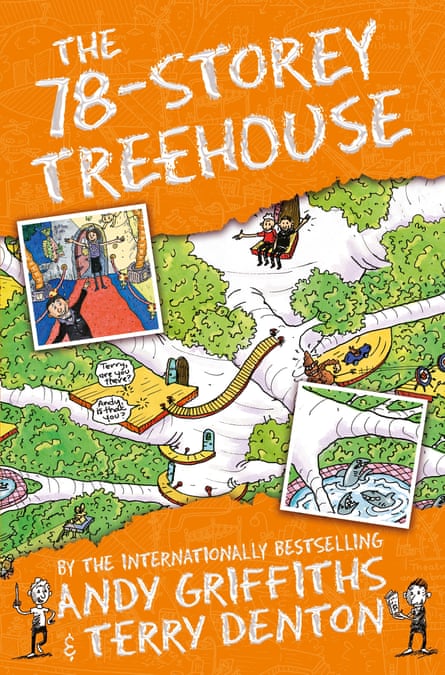
Originally published in Australia from 2011, and then quickly around the world (the first book was published in the UK in 2015), the 13 titles in the anarchic and charming adventure series ended in 2023 with The 169-Storey Treehouse; the sixth volume, The 78-Storey Treehouse, became the fastest-selling book in Australian publishing history when it appeared in 2016.
The 13-Storey Treehouse introduces the friends Andy and Terry, who make books together, and live in an elaborate treehouse whose features include a bowling alley, a tank of man-eating sharks, a giant catapult, an underground laboratory and “a marshmallow machine that follows you around and automatically shoots marshmallows into your mouth whenever you’re hungry”.
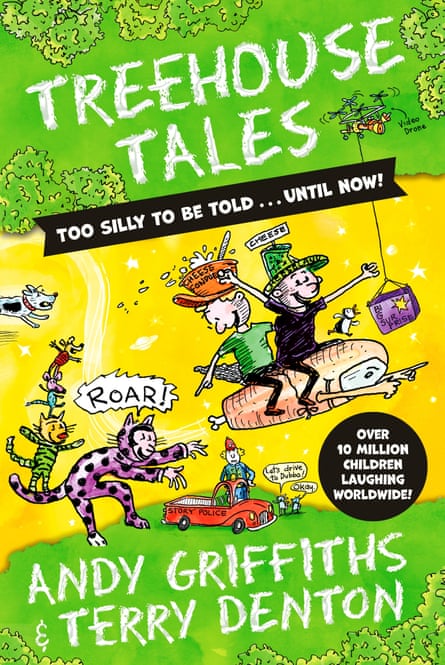
There were also standalone, spin-off titles such as The Treehouse Fun Book (2016) and Who’s Who and What’s Where in the Treehouse (2023), a comprehensive guide to “all 169 levels, all the characters and all the astonishing machines and gadgets that are in our treehouse”.
The series became a byword for attracting and holding the attention of young readers of 7+ and sold more than 13m English language copies worldwide as well as being translated into 35 languages.
Denton and Griffiths were equal partners in their creative success and they frequently celebrated their good fortune in finding each other, with Denton commenting that Griffiths was the first author whose sense of humour matched his own. Their first joint series of stories began with Just Tricking! (1997) – in which the narrator, Andy, pretends to be dead to get out of going to school – and ran to nine titles, finishing with Just Doomed! (2012).
It had many of the same qualities as the Treehouse series but, as Griffiths described it, there was a significant difference: “The Just! books are 80% anarchy, 20% nice. Treehouse is 20% anarchy, 80% nice”. Denton captured both in a particular style of illustration: “I’m trying to make it look like I’m drawing quickly so that it seems unskilled, but the key thing is the idea. It’s all about the idea. Kids like my artwork. They think they can draw like this. It’s like I’ve entered into their territory.”
Denton’s record-breaking creative partnership with Griffiths came after many years as a successful illustrator and author of picture books, junior fiction and non-fiction titles as well as collaborations with other writers. He had an instinct for what entertains young readers, which he reflected in his several styles, from his gifted water colours for picture books to inventive line drawings for longer stories.
In the latter, his cartoon-style illustrations captured the ideas of the story in a way that is appealing for being both quickly absorbed as well as full of details that repay close attention. In describing his work Denton said: “I suppose the two things that interest me most are human emotions and the wonderful, pointless detail of our existence. We’re a weird race. Oh! … and colour … three things.”
Denton found immediate success with his first picture book, Felix and Alexander (1985), a touching story of the relationship between a little boy and his toy dog set in a wittily dramatised but nonetheless evocative and recognisable urban landscape; it won the Children’s Book Council of Australia picture book of the year award in 1986.
In a completely different style, Gasp! (1996) launched a series of six short comic picture books featuring the dramatic life of a goldfish. The series was later adapted into an animated TV series.
Illustrated picture book stories by many of Australia’s best-known writers including Gillian Rubinstein, Mem Fox and Paul Jennings followed. One of the most striking books he created was Jandamarra (2013) with Mark Greenwood, a full-colour, graphic novel retelling of the story of the eponymous Aboriginal Australian, of the Bunuba people, who led an armed insurrections against the British colonial settlers of Australia.
He also illustrated nonfiction, including Jane Godwin’s Dreaming of Antarctica (1997) and books in Alison Lloyd’s comic history series including The Upside-Down History of Down Under (2018). Denton enjoyed his creative partnerships – especially if there was minimal input from the authors. “A good writer shouldn’t need to talk to the illustrator,” he told an interviewer. “All they need to communicate should be in the text. The greatest skill of an illustrator is to read the text and pick up the threads of what the writer is on about.” Later, Denton wrote and illustrated his own nonfiction books including the visually entertaining Terry Denton’s Really Truly Amazing Guide to Everything (2020).
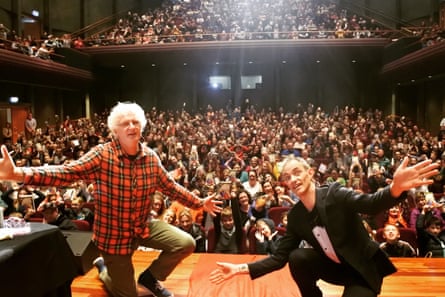
Denton was hugely popular with children in schools and at events. His energetic engagement combined with the success of his books ensured that he made a substantial contribution to children’s books in Australia.
Born in Melbourne, the son of Frederick and Alma, Denton was the second youngest of five boys. He grew up in the city and studied at Xavier college. He subsequently enrolled at the University of Melbourne to study architecture but abandoned the course before he completed his degree. While a student he regularly contributed cartoons to the student newspaper.
On leaving, he explored different creative paths, including animation, painting, theatre, etching and sculpture, before launching his career as an author and illustrator.
Denton is survived by his wife, Kristen, his children Max, Imogen and Eve, and his grandchildren Georgia, Lucy, Charlie, Alfie and Felix.
KioskNews shows a cleaned-up reading view extracted from the publisher’s page — the original always lives on their site, not ours.