‘This is direct’: positive early feedback from pilot community mental health hub in Cumbria

The night Tamara first walked through the doors of Hope Haven, a new community mental health hub in the heart of Whitehaven, she was afraid. “Terrified, actually,” she says. “Like, my life was falling apart. I didn’t know how to stop it from hurting.”
The 22-year-old, who works in children’s transport, had been in and out of therapy and counselling since she was 14, after being abused by an acquaintance as a child. After a lengthy legal process her abuser was sentenced, but the “mental challenge” of dealing with what had happened to her was not over.
“I was having a really hard time at home, and my best friend told me that I could go and stay with her for a bit, but I needed to ask for help first, so she dropped me off here at like 11 o’clock at night,” she says.
That night was a turning point: Tamara was seen immediately by a member of staff and offered an appointment for the next day. She believes that if she hadn’t been offered help at Hope Haven, she would still be at “rock bottom”.
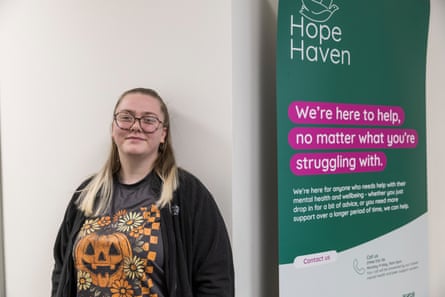
Hope Haven is part of a pilot scheme of six hubs across England. It offers preventive, open-access care 24/7, meaning people do not need a diagnosis or referral to access its services. Its alternative approach reflects concerns that more traditional NHS services have struggled to improve local wellbeing.
In its first five months from March to July, about 3,000 people accessed support either digitally or in person. Nearly half of them had never been in contact with NHS mental health services before. Admissions to inpatient mental health wards in the area fell by 24% between January and September compared with the same period last year.
The five other pilot centres, which are part of NHS England’s 10-year health plan, are in Lewisham and Tower Hamlets in London, Birmingham, York and Sheffield. After Andy Burnham’s announcement of £343m towards “the biggest redesign of mental health services in a generation” this summer, 100 more are due to open gradually, starting this autumn, with an evaluation of the pilot centres later this year.
The hubs build on the Trieste model of mental health care, a 24-hour holistic approach which started in 1980s Italy. They offer more than just mental health support, hosting several local services under one roof, from exercise classes to financial advice and housing support. They also house several short-stay beds, allowing teams to offer overnight support.


Hope Haven is in the centre of coastal Whitehaven, a pretty but quiet and isolated town in the far north-west of England. Nearby, several shops have closed down and sit empty; the market opposite the hub boasts a single stall. The town’s main employer is Sellafield Ltd, a nuclear decommissioning site and the largest environmental restoration project in Europe.
The area has one of the highest suicide rates in England, with 20 people per 100,000 dying by suicide, according to NHS Alliance – almost double the national rate. Since 2017, referrals to local mental health services have trebled.
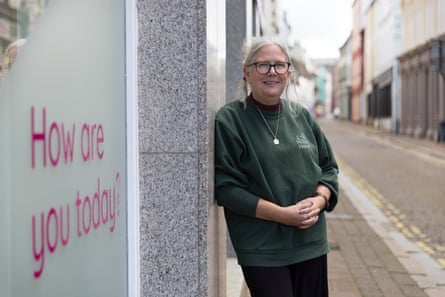
“Over the years, with the closure of all the factories and the big employers, there’s been very little by way of input into Whitehaven, and I think people have lost hope,” says Vikki Ford-Powell, 53, a staff member at Hope Haven.
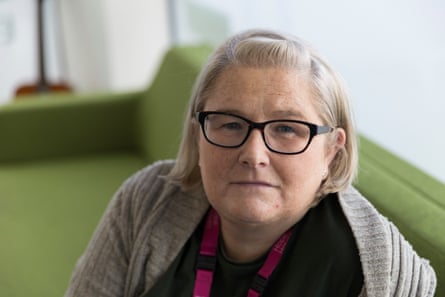
Sue Papworth, 49, another member of staff, says there are areas of deprivation in and around the town: “A lot of people think, oh, you’re in the Lake District, people have got lots of money. We haven’t.”
Josh MacAlister, the Labour MP for Whitehaven and Workington, praised the work of the centre. “West Cumbria is a really special place. Our community is really strong and filled with groups, volunteers and connections. We should be so proud of that,” he said. “But it can be hard to ask for help in such a tight community and when mental health services are far away.
“Our high rates of suicides are extremely concerning and a source of deep pain for so many friends and families who’ve lost people. That’s why Hope Haven has been so warmly welcomed and the early signs are positive. Having a walk-in, low-stigma service that offers a range of help could prove to be a big part of the solution.”
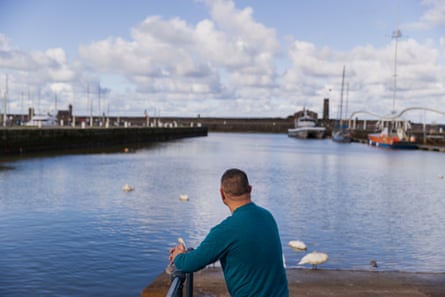
Hope Haven offers support for people regardless of their mental health history. Gordy, 47, originally from Scotland, has struggled with alcohol addiction and was on antidepressants for four and a half years. Since engaging with services at Hope Haven, he has been able to come off them. He says the one-to-one, non-judgmental support has meant he is now able to walk in public without being terrified.
“You’re not a barcode here,” he says. “Suicide’s massive around here, and this is direct, 24 hours a day, seven days a week.”

Another regular at Hope Haven is Mary Bragg, 91, who lost her husband seven years ago and lives alone. She attends a weekly chair-based exercise class at Hope Haven and has made friends through the hub.
“I’m a lot happier now in myself,” she says. “I just love the company.”
KioskNews shows a cleaned-up reading view extracted from the publisher’s page — the original always lives on their site, not ours.