Mysterious volcanic rock discovered in the Mariana Trench
Space exploration tends to suck up most of the oxygen when it comes to venturing out into the unknown. But there’s an arguably even more mysterious frontier hidden beneath us. Nowhere is that more real than at Challenger Deep. The deepest known point on Earth, Challenger Deep is located in the 1,580-mile-long Mariana Trench at the floor of the Pacific Ocean. Getting to the bottom of this ancient chasm means diving more than 6.8 miles (around 36,000 feet) underwater. For a sense of scale, Mount Everest could be dropped into this chasm, and its summit still wouldn’t reach the surface.
That absurd depth and bone-crushing pressure make Challenger Deep brutally difficult to study. As a result, assumptions about what lies down there rarely hold up for long. Scientists long believed the area’s frigid, pitch-dark depths couldn’t sustain life, until a pair of divers reported animals near the seafloor in 1960. Now, a team using a robotic submersible in the trench says they have found the deepest evidence of explosive volcanic eruptions ever documented in the ocean.
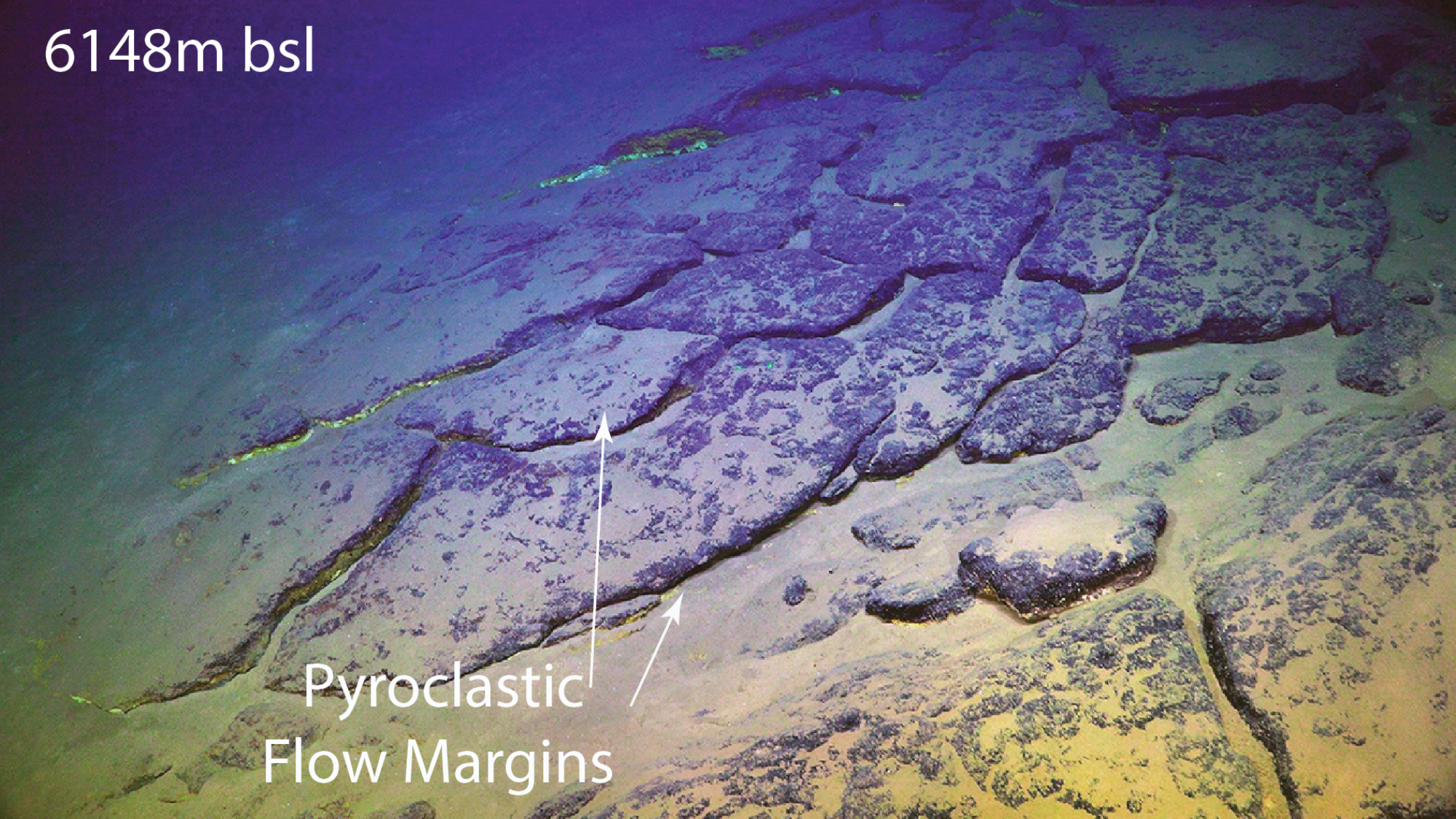
Using the remotely operated Jason/Medea submarine robot, the team documented evidence of pyroclastic rocks (the shattered debris of violent eruptions) on the trench wall some 20,000 feet below the surface. Finding those kinds of rocks there was unexpected and will change the way geologists view the area. Writing today in the journal Frontiers in Earth Science, the researchers say their discoveries may also “help explain why the Challenger Deep is so deep.”
“Explosive volcanism near trenches is unusual, so we were very surprised,” Dr. Robert J. Stern, a geologist at the University of Texas at Dallas and study co-author, said in a statement. “These are the deepest pyroclastic rocks documented to date from anywhere in the ocean.”
Veteran robot still making discoveries 30 years on
Reaching the depth needed to study the Mariana Trench takes some serious equipment and preparation. In 2012, Titanic director James Cameron famously made the dive with a specially designed submersible that reportedly cost around $10 million to build. In this case, the team of scientists turned to a veteran robotic system called Jason/Medea. Part of the National Deep Submergence Facility and funded by the National Science Foundation, Jason/Medea traces its earliest version back to 1988. From the outside, the ROV somewhat resembles a Zamboni machine used to surface ice skating rinks.
The robot can operate as deep as 21,385 feet below the surface, thanks to a roughly six-mile long fiber-optic cable connecting it to a vessel on the surface. Jason is equipped with a video and still-imaging systems. Its footage travels up through Medea, a companion robot that hangs slightly higher in the water to buffer Jason from the motion of the vessel above. In addition to taking photos and videos, Jason has mechanical arms he can use to collect rock and sediment samples. The robotic duo has completed hundreds of dives around the world, analyzing hydrothermal vents in the Atlantic and Pacific Ocean, and even visiting a 1,600-year-old sunken Roman trading ship.
In this case, the scientists deployed their robot companion in late 2024 along a 341 mile segment of the trench near Challenger Deep. Over seven dives, the robot team covered around 186 miles, taking photos and videos along the way. Analyzing the footage, the human team determined that the eastern part of the stretch is deeper than the western part and has steeper trench walls. They came across the old volcanic rocks on that steeper western side, seen below arranged in a thin flat layer. Exactly where these rocks erupted from remains unclear.
”We haven’t identified the eruption sites yet,” Stern added. “We know that these hot pyroclastic flows moved down slopes, but we don’t think they moved very far. They retained enough heat to re-weld themselves into pretty hard rocks, and that heat would’ve been lost if the pyroclastic flows traveled great distances.”
The unexpected rocks were only one part of the expedition. The team also set out to study fragments of older, exposed crust and mantle. They also tasked the robot with studying the Shinaki Seep Field, one of deepest known hydrothermal vents sites on the planet. There was some cleanup duty as well: the team recovered fluid-sampling devices left behind by a previous group of Japanese scientists in 2016. Explorers have rather glibly documented human trash all the way down at the bottom of Challenger Deep but these scientists, at least, won’t be adding to the litter.
KioskNews shows a cleaned-up reading view extracted from the publisher’s page — the original always lives on their site, not ours.