Meet the Aki, the Hawaiian bird with a ‘Frankensteined’ beak
What’s small, winged, and slams its beak into trees? If you said a woodpecker, you’re not entirely wrong. But woodpeckers don’t live in Hawaii, where biologists are investigating a curious bird that takes up a similar ecological niche—with its own unique twist.
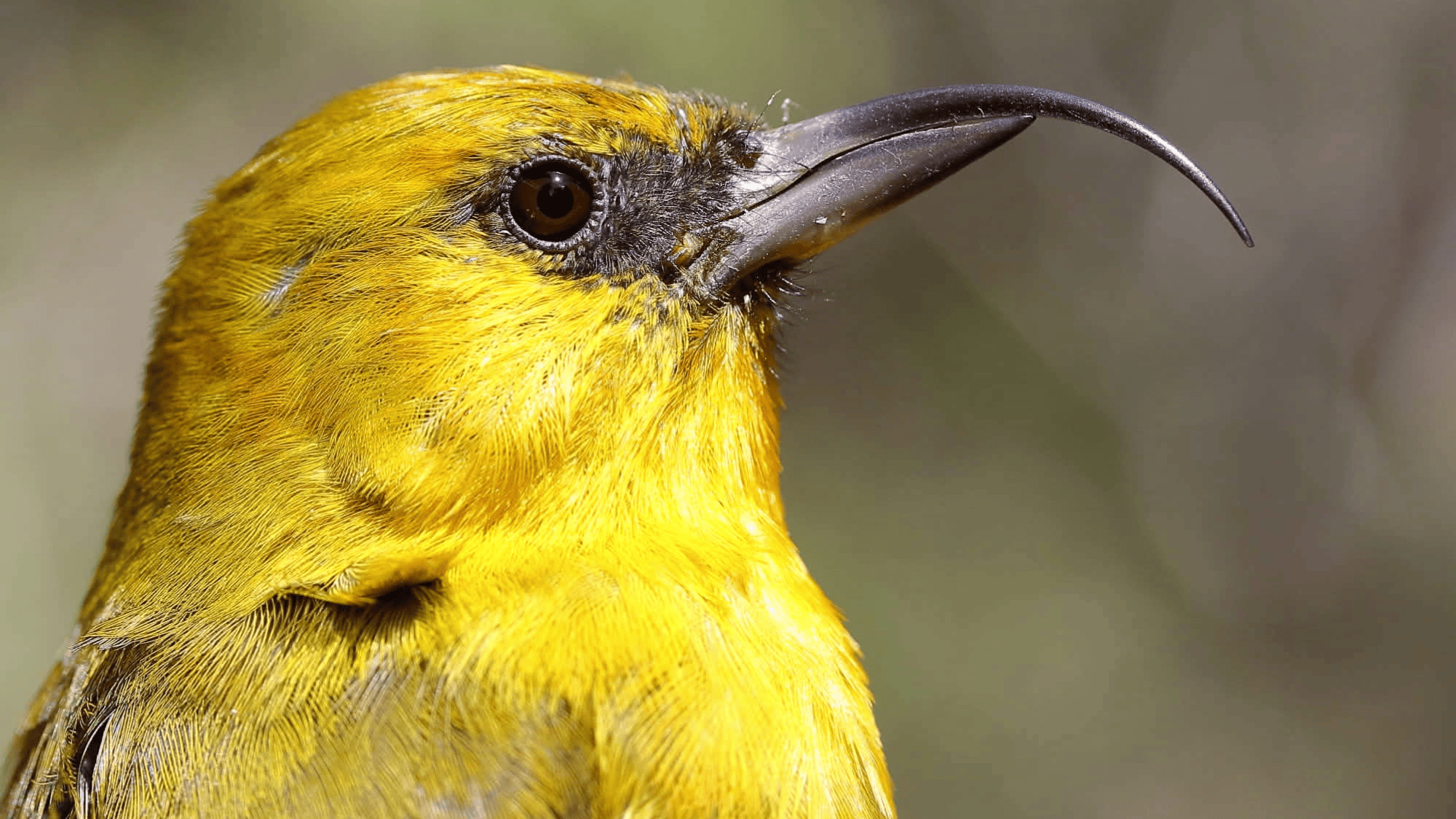
Meet the ‘akiapōlāʻau (pronounced “Ah-key-ah-pole-ah-ow” and nicknamed the Aki): a small yellow-feathered friend with a wacky beak that looks like it has been “Frankensteined together,” because its two main components are totally different. Its long, slender, and flexible upper beak is great for pulling food out of nooks and crannies. The Aki’s short and robust lower beak, on the other hand, enables the bird to drill holes into wood. These two functions have earned the bird the nickname of the “Swiss Army Knife of the Hawaiian islands.”
The Aki is “the only bird, that we currently know of, to have evolved essentially two different bill types on the same head. It’s the only bird to use each of its bills (upper and lower) to do totally different tasks – each of which can only be accomplished by their respective bill,” Alexander Clark, an evolutionary biologist and functional anatomist at the University of Chicago, tells Popular Science.
Clark is lead author of a study published today in the journal Ornithology, in which he and his colleagues reveal the Aki’s anatomy in the greatest detail yet. The team found that the upper bill’s internal bony structure is much shorter than its external sheath. And while its beak is an exceptional feature, they discovered that the bird’s entire body is adapted to drilling, down to its foot and ankle structure.
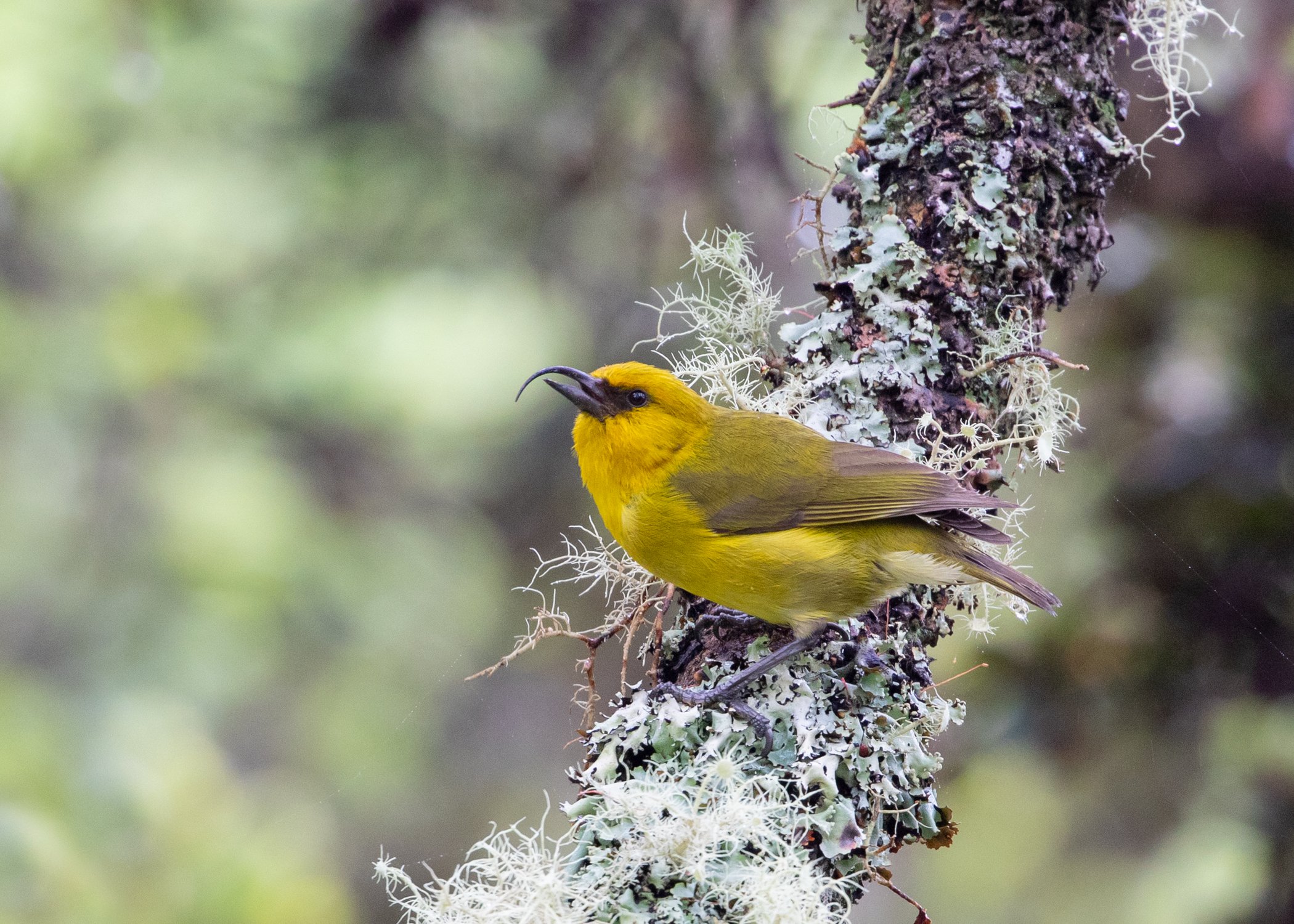
This quirky species also has a relatively large tendon for a muscle that flexes the ankle, enabling it to bring its body down rapidly and strongly. Unlike woodpeckers, which mostly use their neck muscles to drill, Akis employ their entire body’s momentum, from feet to beak, to slam into the wood.
“When woodpeckers drum, they primarily use the muscles in the neck to cock back and then lunge forward. In ʻakiapōlāʻau, it’s a whole-body affair,” says Clark. “Like effectively swinging an axe, you have to put your whole body into it. This well-developed muscle attachment shows that the gouge process begins in the legs as the bird lifts its body up, and brings it forcefully down starting with a forceful bend of the ankles.”
The unique species must have evolved in the context of intense competition, explained Paul Banko, a study co-author and former researcher at the USGS Pacific Island Ecosystems Research Center in Hawaii. When the island of Oahu rose above the surface of the water around three million years ago, many animal species evolved all at once because of the competition over valuable resources to feed their offspring, he added.
Today, the Aki is listed as endangered. Scientists estimate that there are fewer than 2,000 individuals remaining in the wild, and they are all found on one slope of one mountain on the island of Hawaii.
“Hawaii has incredibly high rates of endemism, meaning many of the species that live on the islands are not found anywhere else in the world,” Clark said in a statement. “It is also the most isolated island chain on the planet right now. With these island ecosystems, you have such amazing examples of evolution and unique adaptations, but with this isolation, you also get incredible fragility.”
KioskNews shows a cleaned-up reading view extracted from the publisher’s page — the original always lives on their site, not ours.