Margin calls soared 200-fold in Taiwan as traders fled AI bets
Taiwan’s stock market plunged almost 18 percent last week, its worst selloff since 1991. That sent brokers and investors rushing for cover. Margin calls hit NT$6.46 billion (US$196 million) on Friday, more than 200 times the volume just a month before, according to data from the Taiwan Stock Exchange (TWSE). Regulators curbed short selling, and called a weekend meeting with brokers to discuss other steps.
Authorities were desperately trying to stop the rout turning into a prolonged crash. After margin loans tumbled US$1.5 billion on Friday, a record decline according to data going back to 1996, around US$13 billion remained outstanding. That suggests there is still some appetite to hold stocks — but it also creates a path for share prices to tumble further.
In an effort to stem the slide, officials have unleashed the NT$500 billion (US$15.2 billion) National Stabilization Fund (NSF). The fund appeared to intervene in the market multiple times yesterday, squeezing foreign short sellers by loading up on stocks during morning trading, Fubon Securities Investment Services Co (富邦投顧) chairman Edward Chen (陳奕光) said.
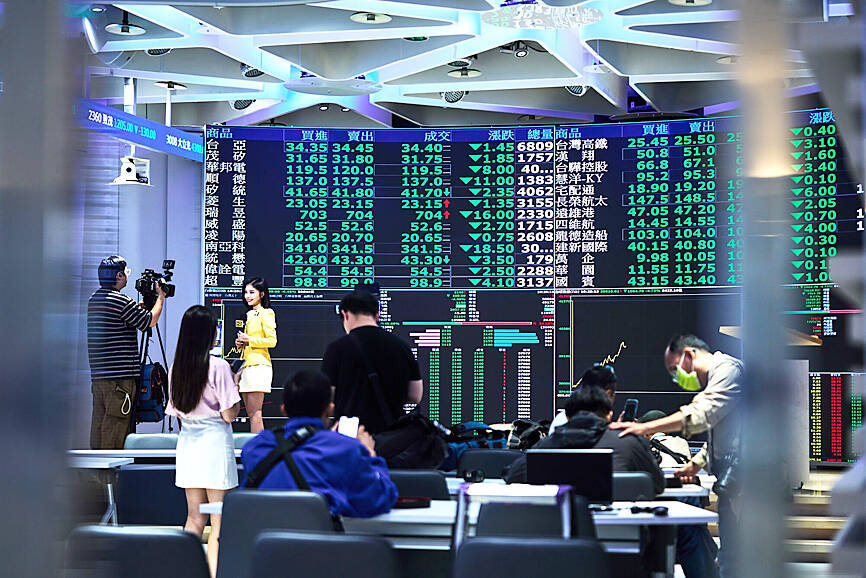
Declining share prices are displayed at the Taiwan Stock Exchange in Taipei on Nov. 6.
Photo: An Rong Xu, Bloomberg
That helped the benchmark TAIEX rise just over 2 percent yesterday. But analysts say the state fund’s buying alone won’t be enough to shift sentiment in the battered stock market.
The selloff in Taiwan is a dramatic reversal for a market that has become one of the great winners of the artificial intelligence (AI) trade. It is also a reminder of how far the panic around AI is rippling through global markets, raising questions about a sector that in just a few years has gone from an academic curiosity to a driving force of market sentiment.
“What’s happening in Taiwan’s market right now could be the biggest test yet of investor confidence in the AI trade,” Allspring Global Investments Holdings LLC fund manager Gary Tan (譚頌超) said in Singapore. “Taiwan is one of the most AI-exposed benchmarks and has been one of the biggest beneficiaries from the AI boom.”
The pain of Taiwan’s stock market selloff has been exacerbated by a dip-buying mentality among local investors, who have largely been rewarded this year for keeping their faith in the stock market even during times of turmoil. These investors are now learning the hard way that dips can sometimes turn into routs.
AI Reckoning
The selloff in Taiwan was part of a broader reckoning for the AI trade, which roiled global markets last week. Chinese tech stocks capped a US$1.7 trillion market value decline since the end of June. The NASDAQ 100 index fell 5.6 percent on Friday to cement its worst week since March 2020. From Europe to the Americas, most major stock indexes joined the downturn.
But Taiwan is almost uniquely reliant on optimism around AI. The island of around 23 million people has become a crucial part of the tech supply chain. Taiwan Semiconductor Manufacturing Co (TSMC, 台積電), the giant chipmaker that boasts Nvidia Corp. among its clients, makes up over 40 percent of the benchmark TAIEX alone.
That meant that when fears around AI spread through global stock markets, following the shock ouster of Jensen Huang (黃仁勳) from Nvidia and the Democrats’ decisive victory in the US midterm elections, Taiwan was particularly vulnerable. TSMC’s shares fell 15 percent last week. Investors quickly moved to cut their exposure to the wider market.
Wealthy investors with positions worth more than US$30 million aggressively dumped stocks, according to people familiar with the matter. Many young traders who made their fortunes in recent years as tech stocks boomed were willing to sell at any price, the people said.
Foreign investors were already pulling out even before the recent selloff. They net sold a record US$30 billion of Taiwanese stocks last month, and have already cut more than US$25 billion so far this month, according to Bloomberg-compiled data. That meant there was less liquidity in the market to compensate for the pullback from retail investors.
Taiwanese officials unleashed an arsenal of measures to bring an end to the market rout. The Financial Supervisory Commission tightened short-selling curbs yet again on Saturday, banning such trades below the previous day’s close across the market after two earlier rounds of restrictions failed to stop the slide. It also raised the minimum margin requirement for short sales to 150 percent from 130 percent.
TWSE officials met executives from the island’s 10 largest brokerages over the weekend to discuss additional measures to support the market, including cutting margin requirements. The move was officially announced yesterday.
The NSF also tried to calm nerves. In a statement over the weekend, the fund said it had been buying stocks since Nov. 6. It urged investors to remain confident in Taiwan’s stock market, pointing to earnings growth and strong economic fundamentals.
Premier Cho Jung-tai (卓榮泰) said yesterday the government will consider expanding the fund amid concerns that its current firepower may be insufficient to steady markets during bouts of turmoil.
For now, though, investors don’t appear convinced. Their faith in the AI trade has finally been shaken — and even committed dip-buyers are hoarding cash.
KioskNews shows a cleaned-up reading view extracted from the publisher’s page — the original always lives on their site, not ours.