‘A big responsibility’: Clifton Suspension Bridge master hails £7.6m renovation

The job does not give the holder age-old perks such as the right to drive sheep across the great structure but the title – “bridge master” does have a certain ring to it.
“I don’t tend to say I’m the bridge master when I’m at a party,” said Tristan Ralph, the current holder of the title. “But people do seem to know and bring it up. It’s a job less ordinary, isn’t it? It’s a Victorian sounding title and people are really, really interested.”
There is, however, nothing ceremonial about the title. Ralph is in charge of maintaining and running the Clifton Suspension Bridge, one of the UK’s most iconic structures, without any public money.
“It does feel a big responsibility,” said Ralph. “When the chairman of the trustees rang me to say, we’d like you to do it, you suddenly feel the pressure. It’s so famous and people in Bristol, quite rightly, are proud and almost possessive of it. Bristolians think: ‘It’s our bridge.’”
The bridge master – and the not-for-profit charity the Clifton Suspension Bridge Trust – have the task of maintaining the bridge “in perpetuity”. “I’m a temporary custodian,” Ralph said. “When I’m finished I have to make sure it is handed on in just in good condition or better than I inherited it.”
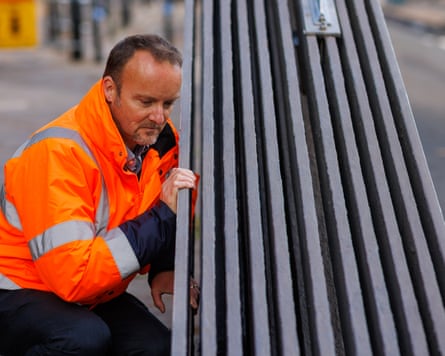
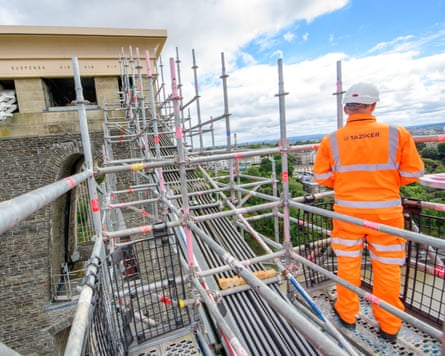
Ralph, a bridge engineer by profession, was speaking to mark the conclusion of a large refurbishment project that has taken two and a half years and involved hand-painting more than 4,000 original iron chain links and installing a new energy-efficient lighting system. It has cost about £7.5m. “It’s been a big job,” he said. “But it’s come pretty much bang on budget, which is rare these days.”
That is important because, to many visitors’ surprise, the bridge does not receive public funding. “The upkeep of the bridge, the running of it, the salary costs and everything are all paid only by our toll money,” said Ralph. “People think that we might get something from local or central government. But, no, it’s just the toll money.”
Motorised vehicles – including motorcycles – pay £1 to cross the bridge. There is no charge for pedestrians, cyclists or horse riders. As well as being a beautiful structure, it is also a vital part of Bristol and North Somerset’s transport system.
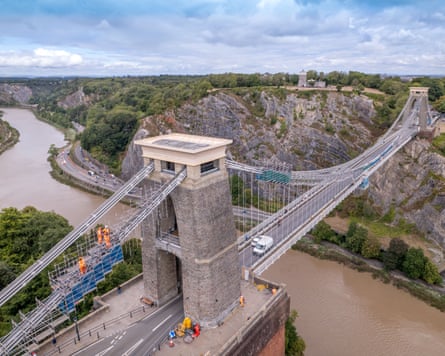
Ralph said: “It draws the tourists in. We get visitors from hundreds of countries every year but primarily, it’s still a vital piece of local infrastructure. If it’s the bridge wasn’t here, the difference it would make to Bristol traffic would be incredible. We average over 8,000 vehicles a day still. Maintaining it as a transport link is utterly vital.”
The end of the refurbishment does not mean Ralph can rest on his laurels and spend more time hobnobbing with members of the Bridge Owners Forum.
“In a few years, we’ll need to paint the underside of the bridge. The under-bridge gantry unit itself will be replaced over the coming years. So there’s always something. We need to keep on top of things. It’s like your house or your car. If you just ignore it, don’t do things for a couple of years, they start breaking down.”
As in most walks of life, the climate emergency is a challenge Ralph and the trust are having to face. “We were monitoring the bridge daily in the summer with the very hot weather. And maybe if the bridge was being designed today there would be a little bit more robustness around wind.”
The prevailing south-west wind is not usually a problem and the bridge rarely has to close but if it blows directly through the Avon Gorge it can be more difficult. “We need to keep an eye at both the magnitude of any wind events but also their frequency,” Ralph said.
The engineer admires the bridge’s designers, including Isambard Kingdom Brunel. “It’s remarkably advanced for its time.”
And there is no sign that is days are numbered, largely because the Victorians did not skimp. Ralph said: “There are three layers of chains. The original Brunel design only had two, but because it went from a timber design to a cast iron deck, they upped it to three.
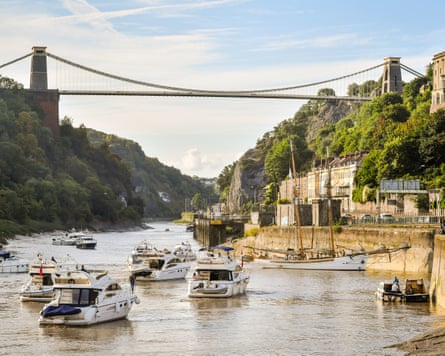
“There’s a little bit of comfort in there. Today there might be pressure to say, well, can you keep it to two but in Victorian times they did like to add a little bit of meat on the bones.
“It doesn’t have a finite life. There’s no end date in our plans. We all just keep it going in the highest standards as we can. It’s in really good condition as long as we keep doing what we need to do, keep our attention on it and don’t let things drift. Forever is a long time but there’s no reason why we have any need to worry at the moment.”
KioskNews shows a cleaned-up reading view extracted from the publisher’s page — the original always lives on their site, not ours.