Solar-powered vehicles take on 2,500 km road challenge
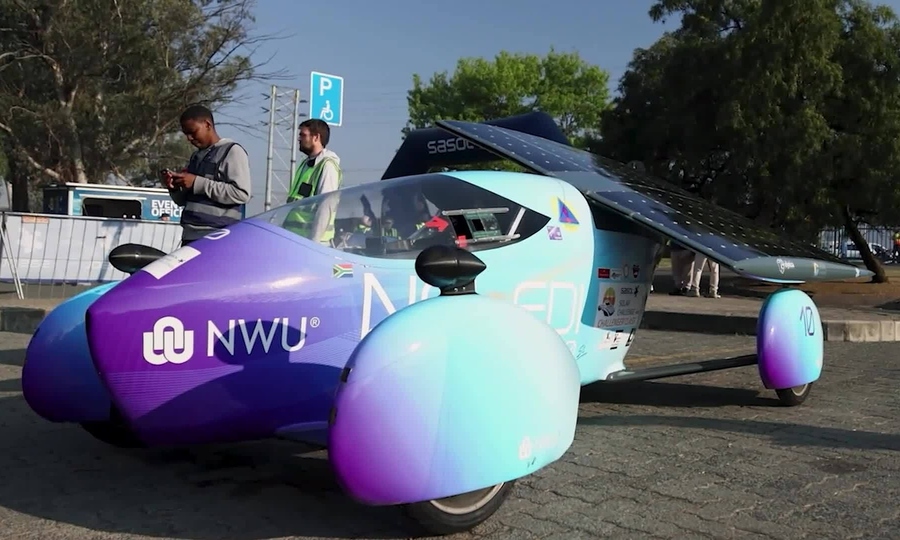
Young engineers and university teams set off from Johannesburg in solar-powered vehicles as the 2026 Sasol Solar Challenge puts their designs to the test on a journey of more than 2,500 kilometers towards Cape Town.
"The winner is not the team that arrives first, but the team that accrues the most kilometers over the course," event director Rob Walker said.
"Each day, we have a set minimum that the teams must achieve, and then they have optional loop stops where they can rack up extra kilometers. So we are a distance-first competition," he added.
For Denzel Brits, a mechanical engineering student and driver for North-West University, the terrain poses the biggest challenge.
Solar-powered vehicles lining up before taking to city streets in Johannesburg, as team members make final adjustments and check electrical components, Sept. 10, 2026. Video by Viory
"2,500 kilometres is a long distance, but that's not the biggest challenge. I think the biggest challenge we will be facing is the terrain," Brits said.
"Even just a slight uphill means demanding power from the batteries," he added, warning that dust, rain and cloud cover could also affect solar charging.
North-West University's Solar Eagle team has developed a tilting solar panel designed to maximize the energy it collects.
"Our car has a unique feature of having a tilting wing that we can rotate during the day so that the panel looks at the sun the whole time," team manager Dr Kruger explained.
"This system works automatically by looking at the shading of the car and the GPS coordinates to calculate the angle that must be tilted to look at the sun in the best possible way," he continued.
For Central University of Technology driver Masheko Mhore, the challenge carries significance beyond the competition.
"I am paving a way not just for a female, but <...> for our kind, our African Black people," Mhore said. "Being part of the people that are paving the way <...> is really amazing."
"We've done all the math, we've done all the calculations. We did our best, and all we can do is just press on that accelerator and taste the sun," she added.
The challenge runs from Sept. 10 to 17, with teams competing to accumulate the greatest distance rather than finish first. It also includes a schools programme encouraging young learners to pursue science, technology, engineering and mathematics.
KioskNews shows a cleaned-up reading view extracted from the publisher’s page — the original always lives on their site, not ours.