What the Australian government’s apology to LGBTQ+ Defence personnel and veterans means
Thousands of lesbian, gay, bisexual, trans and gender diverse and queer (LGBTQ+) veterans have served in the Australian Defence Force (ADF) with honour and dignity. Yet, for the majority of Australia’s military history, their service was officially banned. Many LGBTQ+ personnel experienced persecution, witch-hunts and forcible discharge on the grounds of sexuality or gender identity.
(In this piece we are using the acronym LGBTQ+ because the ADF policies being discussed were not about intersex and asexual personnel. We use the broader acronym LGBTIQA+ when discussing the community.)
The journey to official acknowledgement and some form of justice has been long and is ongoing. Until 1992, lesbian, gay and bisexual Defence personnel were banned from serving. It was not until 2010 that the ADF lifted the ban on transgender service.
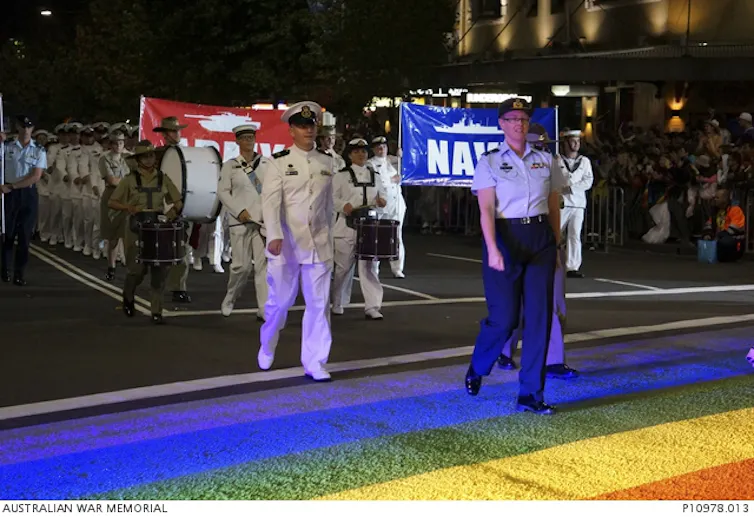
This week, the Minister for Veterans’ Affairs announced that current or former Defence personnel may “apply to have historical homosexual convictions extinguished from their service records”.
This sits alongside a commitment to issue a formal apology later this year for the harms LGBTQ+ personnel and veterans experienced because of historical discriminatory policies.
An apology will have real meaning to many veterans. It has been hard won and owes everything to the courage of LGBTQ+ veterans who have spoken about serving under the bans.
A number of LGBTQ+ veterans told their stories at The Royal Commission into Defence and Veteran Suicide. Their accounts of sacrifice, duty and persecution, alongside the lifelong impact on their mental health and wellbeing, are harrowing.
We heard many similar, courageous accounts from the 140 LGBTIQ+ service members we interviewed between 2014–18.
Different ways of discriminating
This week’s announcement is significant but requires important context.
Under Australia’s military justice system, rooted in the Defence Force Discipline Act 1982 and before that, British laws, service members can face disciplinary or administrative action for committing specific offences.
Disciplinary offences go through tribunals (courts-martial or Defence Force Magistrates, for example), which are quasi-judicial proceedings that can result in a conviction.
Administrative offences are handled at lower levels, have different evidence rules and do not have the same judicial-like processes or burdens of proof. They also do not result in convictions, but the outcome can still be a discharge.
This distinction is important because historically, the ADF dealt with the vast majority of homosexual-related offences administratively. From 1974, the policy on homosexuality stated that unless there was an aggravated offence (sexual assault, for example), cases of homosexuality should be dealt with through administrative action.
This means that from the mid-1970s onward, there were almost no convictions for homosexual-related offences. Even before the 1970s, the vast majority of such offences were treated as administrative matters.
A history of administrative action
This accords with the experiences of many of the veterans we interviewed.
Yvonne Sillett joined the Women’s Royal Australian Army Corps (WRAAC) in 1979. By 1985, she was one of the first women instructors at Kapooka, the Army’s main base for recruit training. Her promising military career ended in 1989 after service police discovered she was homosexual. Following interrogation by the Special Investigation Branch, her security clearance was downgraded. This effectively forced her to leave the Army and a career she loved.
Sillett has been moved by the prospect of the forthcoming apology. “I did not think it would happen in my lifetime,” she told us.
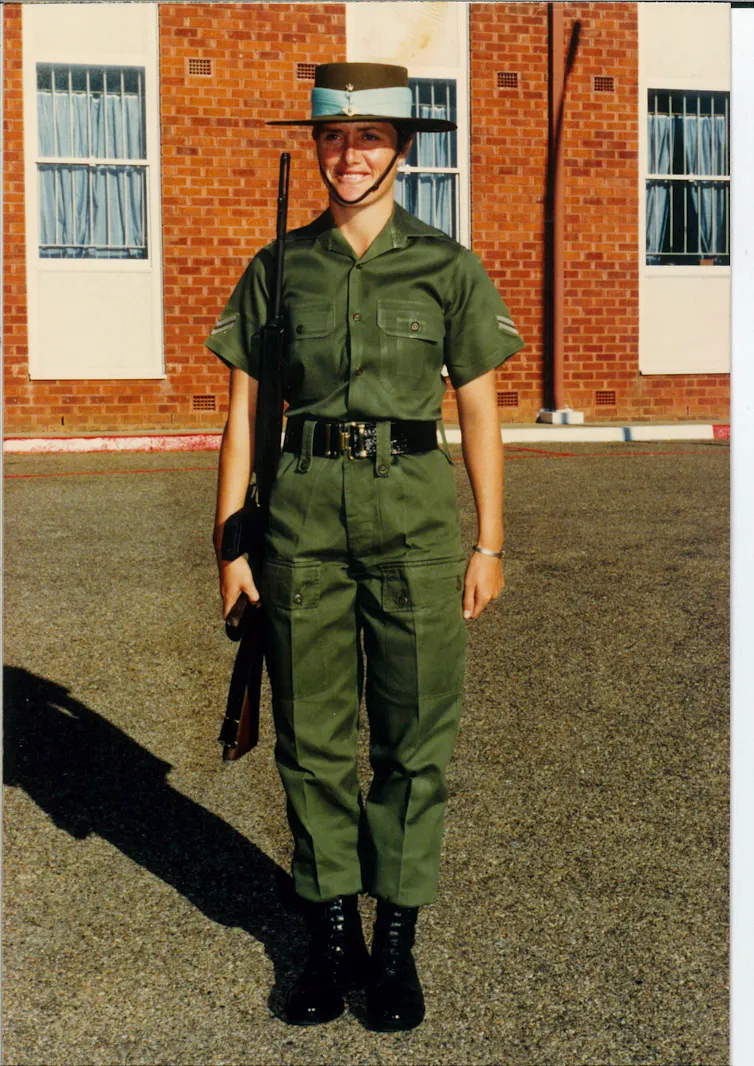
Similarly, Jennifer Jefferies joined the WRAAC in 1979. On the day she should have graduated from driver training, military police instead interrogated her about her sexuality. The level of detail provided made it clear she had been surveilled for weeks, alongside three other women who faced interrogations.
Jefferies was discharged from the WRAAC. Two of the other women who were also interrogated are no longer alive. These stories remind us to reflect on those who did not survive to see an apology.
The experiences of Sillett and Jefferies reveal how military police consistently applied administrative action against LGBTQ+ service members. The government’s new scheme includes a process for those who faced administrative action. It is not as visible on the Defence website as extinguishing convictions, but it is an important recognition of harm caused by discrimination.
That process also includes people who faced administrative action because of their gender identity.
Bridget Clinch, a former infantry officer, was the first transgender soldier in the Army to affirm their gender. In early 2010, after 11 years of service, she was told she would no longer be considered suitable for service if she lived openly as a woman.
She challenged this and blazed a path that made open service for transgender Australians possible.
Yet, she still lives with the toll. Clinch told us:
I feel like I had the ability to do another 10 or so years and that was cut short by hostility. Now I’m looked after, but I’m still messed up by that traumatic process. And then, in the following years, all the injuries and chronic conditions started to pop up. I don’t think I’ll ever be okay with how it went down.
An important step
An apology cannot change the past.
Yet, it can and should include prompt, concrete actions to address the needs of LGBTQ+ veterans, including mental health and wellbeing support and an acknowledgement of lost careers.
It should also foster much wider recognition of the courage all LGBTIQA+ veterans displayed at great personal cost. This change has only occurred because of their bravery, in both serving and speaking up.
KioskNews shows a cleaned-up reading view extracted from the publisher’s page — the original always lives on their site, not ours.