Bill Gates says AI companies self-regulating isn’t enough and governments should be involved
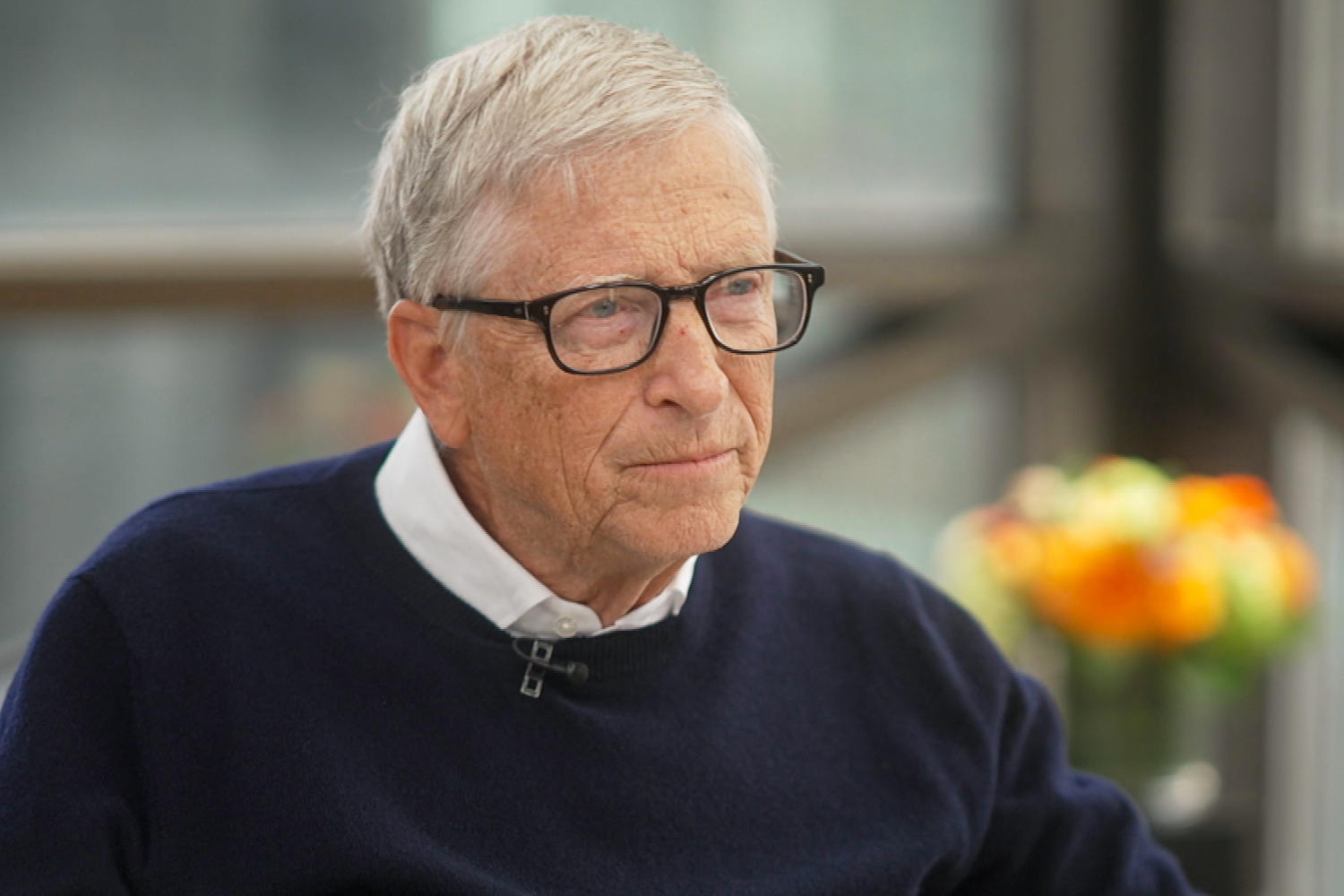
Microsoft co-founder and billionaire philanthropist Bill Gates on Wednesday called for lawmakers in Washington to regulate the development of artificial intelligence, weeks after the CEOs of some of the nation’s biggest AI labs agreed on the need to slow the pace of AI progress.
“No one thinks self-regulation is enough,” Gates told NBC News’ “Meet the Press” in an interview set to air in full Sunday.
Asked by moderator Kristen Welker whether there needs to be legislation passed in Washington, Gates said, “Absolutely.”
“You need law enforcement and the politicians to get into the discussion about what safeguards and monitoring look like,” he said. “And that has to be a required thing. And it will be a little bit of overhead for the industry, but not a dramatic slowing of what they’re doing.”
Earlier this month, the CEOs of Anthropic and OpenAI, two of the nation’s biggest AI labs, agreed that the race to develop powerful AI systems should slow down. Their statements on the issue came after a whistleblower who recently resigned from Anthropic, Jacob Coxon, publicly declared that “neither company is acting responsibly. They are racing straight to self-improving superintelligence and gambling with our lives.”
“The people building AI earnestly believe that it could kill us all by the end of the decade,” Coxon added in a series of social media posts and interviews that week.
In Wednesday’s interview, Gates didn’t downplay the risk that AI could wipe out humanity in several years, but called for Americans not to ignore the risks that AI could be used by bad actors to cause large-scale harm as soon as today.
“AI is certainly powerful enough to drive events that, you know, cause a billion deaths. You know, so even though it’s pretty hard to get to 100%, there’s never been a weapon as powerful as the combination of people with ill intent using the latest AI tools,” he said.
In an interview with “Meet the Press” earlier this month, Coxon said that AI companies should be allowed to regulate themselves.
“I do think that the people running the labs, especially their recent communications, are completely genuine. They would like to slow themselves down,” he said.
Appearing earlier on the same program several weeks ago, Speaker Mike Johnson, R-La., declined to bring House lawmakers back to Washington to pass legislation to regulate the pace of AI growth, saying that he would defer to the AI companies.
“We have to put some guardrails, some safety measures in place to ensure that AI doesn’t run away,” the speaker said, adding that while AI CEOs had called for a slowdown, they hadn’t yet offered a path forward that involved federal legislation.
“They don’t themselves even have the answer as of today. So we can’t rush in and have Congress do something that would be detrimental to national security,” Johnson said.
In his essay calling for a slowdown in the pace of AI development, Anthropic CEO Dario Amodei specifically called for global and federal cooperation.
“The most effective method of pacing is via regulation that targets all U.S. frontier AI companies, as that covers even those who are unwilling to cooperate voluntarily,” he wrote, adding later in the piece: “Global pacing will require cooperation with China, the autocratic country with by far the most advanced AI capabilities.”
Sam Altman, the CEO of OpenAI, on Wednesday spoke before a gathering of the United Nations, calling for international standards for “measuring capabilities, assessing risks, determining whether safeguards are sufficient and preserving meaningful human oversight” over AI.
Meta founder and CEO Mark Zuckerberg disagreed with that approach.
“I don’t think that we need some kind of industrywide coordination,” he told NBC News in an interview published Thursday. “I think that each lab needs to take the time, and when it sees that there are issues, you just take the time that you need internally to basically make sure that you’re proceeding safely.”
At the state level, some governors have already begun the process of regulating AI companies and the data centers they use to power their development.
In California, Gov. Gavin Newsom last week signed an executive order creating a board of experts tasked with creating a plan for the state to strengthen its laws on AI safety.
This week, in Maryland and New York, Govs. Wes Moore and Kathy Hochul each also released plans aimed at boosting AI regulation in their states.
Moore’s order creates a “three pronged approach” to regulation, while Hochul’s creates a new Office of Digital Innovation, Governance, Integrity and Trust to oversee legal compliance for AI companies.
Speaking at a United Nations session on AI and human development this week, Microsoft President Brad Smith rejected the notion that AI companies have to wait for federal regulation to slow themselves down and criticized them for constantly racing against each other to make more advanced AI products.
“Imagine for a moment that there’s only two big companies in the world that produce commercial airplanes,” Smith said.
“Imagine that somebody comes into your office and says, ‘I know we’re in a race to get out the next airplane first, but we’re worried that the airplane will crash and people will die.’ Would you say, ‘I need to win this race’?” Smith asked. “Or, would you say, ‘I’m going to put the safety of my passengers and the safety of the public ahead of my winning that race’? That is the fundamental question.”
KioskNews shows a cleaned-up reading view extracted from the publisher’s page — the original always lives on their site, not ours.