Silk traces found on 101 ancient Chinese ritual objects dating back 3,000 years
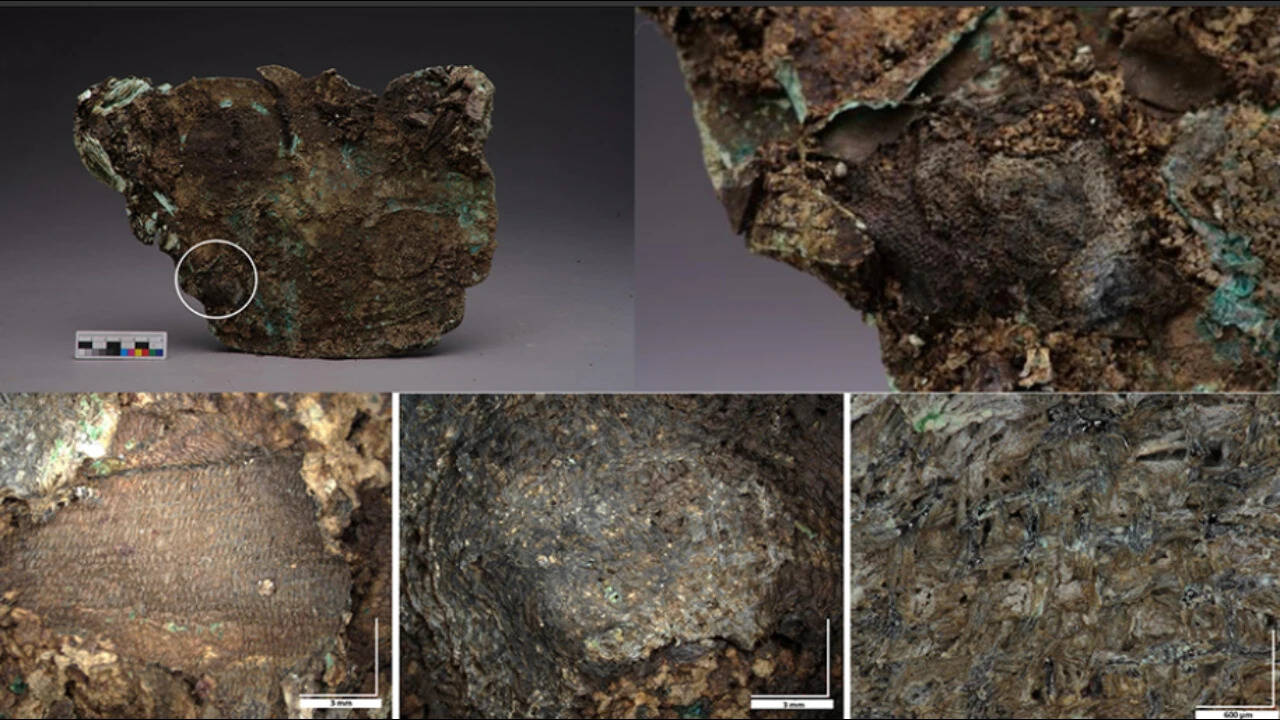
Textile residues adhering to artefacts excavated at Sanxingdui (Photos: Antiquity)
Scientists examining 3,000-year-old objects recovered from the Sanxingdui archaeological site in China's Sichuan Province have found traces of silk on 101 artefacts, including bronze masks, gold, jade and ivory objects.
According to a study published in the journal Antiquity on Sunday, researchers used microscopic and chemical tests to examine the remains and found evidence that the ancient Shu people may have used silk to wrap or cover valuable objects during religious ceremonies. The tests also revealed traces of red colouring on some of the fabric.One of the objects examined was a large bronze mask with small patches of silk still attached near its right eye and eyebrow.
Scientists identified three separate areas where the fabric had survived. Interestingly, the pieces did not all have the same weaving pattern or condition. This led researchers to consider whether different pieces of silk had been placed on the mask for decoration or as part of a ritual.The mask was among several objects recovered from Sanxingdui, a site associated with the ancient Shu culture. The objects belong to the Late Shang period, between 1300 and 1046 BC.
Archaeologists have been studying the site for decades, particularly because of the large number of bronze objects discovered there.The first major collection of bronze artefacts was recovered in 1986, when excavations of two sacrificial pits produced more than 780 objects. Further excavations between 2019 and 2022 uncovered six additional pits. During investigations of these finds, researchers identified silk attached to several different materials.
The latest study examined selected samples to find out what kind of fabric had survived and what its presence could reveal about the ceremonies performed at the site.
What the tiny fibres revealed
Most of the silk remains were too small or damaged to be examined like ordinary pieces of cloth. Scientists therefore studied them under powerful microscopes and carried out chemical tests.Scanning electron microscopy (SEM) allowed researchers to examine the surfaces and shapes of the fibres.
They found that the threads were generally smooth, with an average diameter of approximately 10 micrometres. Their shape closely resembled natural mulberry silk.The team then used Fourier-transform infrared spectroscopy (FTIR) to study the chemical structure of the material. The results showed that the fibres contained proteins. By comparing these findings with the physical appearance of the threads, researchers were able to distinguish silk from animal hair.The examination also showed that the fabrics were not all made in the same way. Some were loosely woven, while others had tightly arranged threads. Most followed a plain-weave pattern, although more complicated weaving techniques were also present.When the researchers compared these fabrics with textiles from other Chinese archaeological sites of the same period, they found that some Sanxingdui samples had equally advanced or even higher weaving densities.
Red colouring found on the silk
Some samples contained coloured particles, prompting researchers to investigate how the fabric might have been coloured.In one sample, they discovered bright-red particles on the surface. Chemical analysis showed the presence of iron, while further testing identified the substance as ochre, a mineral pigment.
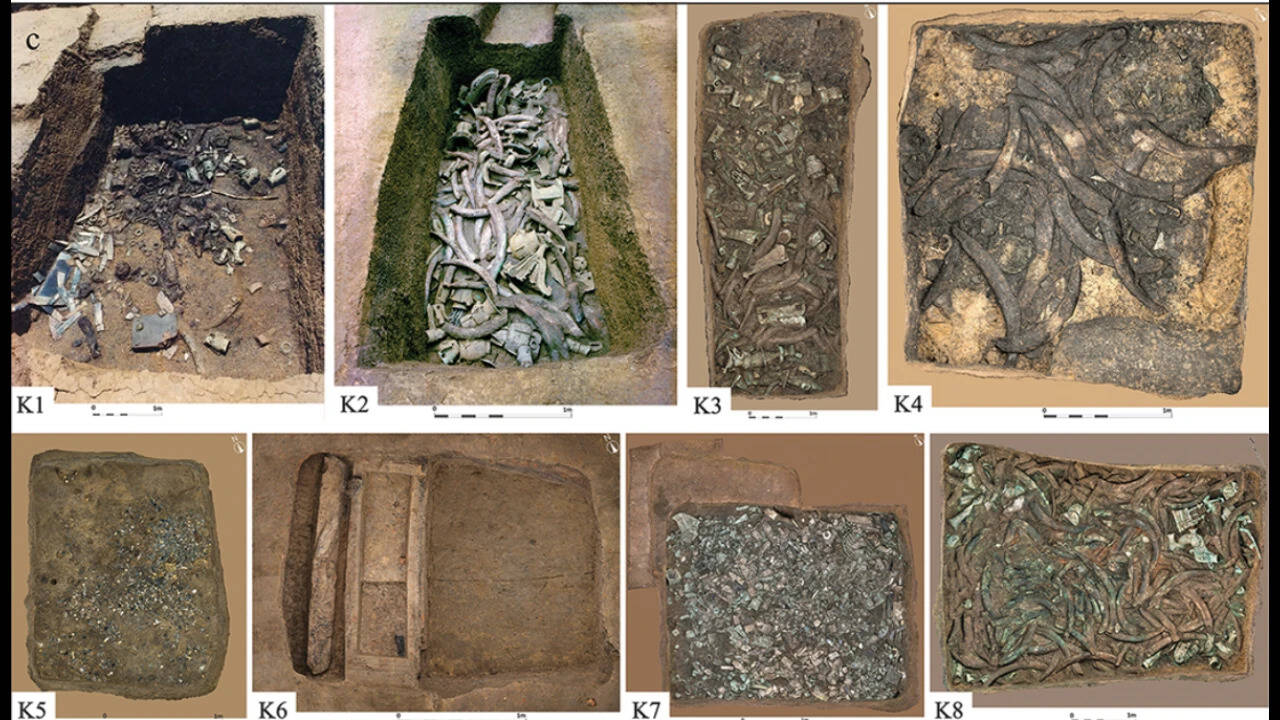
Photographs of the eight sacrificial pits during excavation
Another part of the same sample contained calcite. Although this mineral is generally white, researchers believe prolonged contact with the surrounding soil may have changed its appearance.
They also suggested that it could have been used as a coating on the silk.A different sample showed that instead of coloured particles simply sticking to the outside, a deep-red substance had entered the fibres themselves. The researchers believe this colour probably came from an organic dye.
Why position of the silk matters
Finding silk on valuable objects was important, but its location inside the pits provided further evidence about its possible purpose.In two of the more recently excavated pits, the fabric was mainly found underneath the artefacts. Some objects also carried several layers of silk. A circular bronze ornament, for example, had as many as five identifiable layers.This arrangement led researchers to believe that people may have deliberately placed silk beneath or around objects during ceremonies.The researchers suggest that the material could have protected objects, covered them or formed part of the offerings themselves.
Many objects deposited at Sanxingdui had also been broken or burned, adding to the evidence of ritual activity at the site.
How such delicate fabric survived
Silk usually deteriorates over long periods underground, but the conditions at Sanxingdui allowed some traces to survive.Much of the fabric had been preserved through mineralisation. As bronze objects corroded, copper and other metal substances interacted with the fibres, helping retain their original shapes.Not every piece survived in the same condition. Some had become carbonised, turning black and brittle, while others remained relatively well preserved. Researchers found that even different parts of the same sample could show different forms of deterioration.Although no systematic written records have been found at Sanxingdui, the researchers suggest that silk might once have carried writing or symbols. There is, however, no direct evidence confirming this possibility.Similarly, textile tools discovered at the site suggest that people were making fabrics, but scientists have yet to establish whether the silk itself was produced locally.
KioskNews shows a cleaned-up reading view extracted from the publisher’s page — the original always lives on their site, not ours.