S’pore to contribute marine expertise, international connections to global ocean protection: Gan Kim Yong
SINGAPORE – Singapore will contribute its marine knowledge and connections to international efforts to protect the oceans, a global resource that must be managed responsibly, said Deputy Prime Minister Gan Kim Yong on Oct 7.
“The ocean sustains livelihoods and supports ecosystems, much of which we still know very little about, (and) that we are also still discovering and learning about.
“No country owns the ocean, and no country can protect it alone,” added Gan, who was speaking at the OceanX Summit aboard the OceanXplorer research vessel at the Marina at Keppel Bay.
OceanX is a US-based non-profit ocean-exploration initiative. Its annual three-day summit brings together experts in ocean science, education, technology and finance to advance ocean conservation and research.
Gan, who is also Minister for Energy, Trade and Industry (Trade), said Singapore can contribute by working with regional and international partners to develop capabilities and share knowledge and expertise with other countries in the management of the marine environment.
He highlighted a 24-day expedition in 2025 by researchers from the National University of Singapore and OceanX to explore a largely unexplored seamount chain in international waters off Christmas Island, called Monsoon Rise.
They mapped more than 8,300 sq km of sea floor and uncovered deep-sea sharks with glowing bodies and sea pigs, a type of sea cucumber that dwells in the deep sea.
The mission was carried out aboard the 87m-long OceanXplorer vessel and also involved scientists from other countries such as Indonesia, Fiji, Thailand and Vietnam.
Discoveries from the mission were showcased through an interactive exhibition on the ship. Guests could point to a 3D model of two underwater mountain ranges to unveil creatures dwelling beneath.
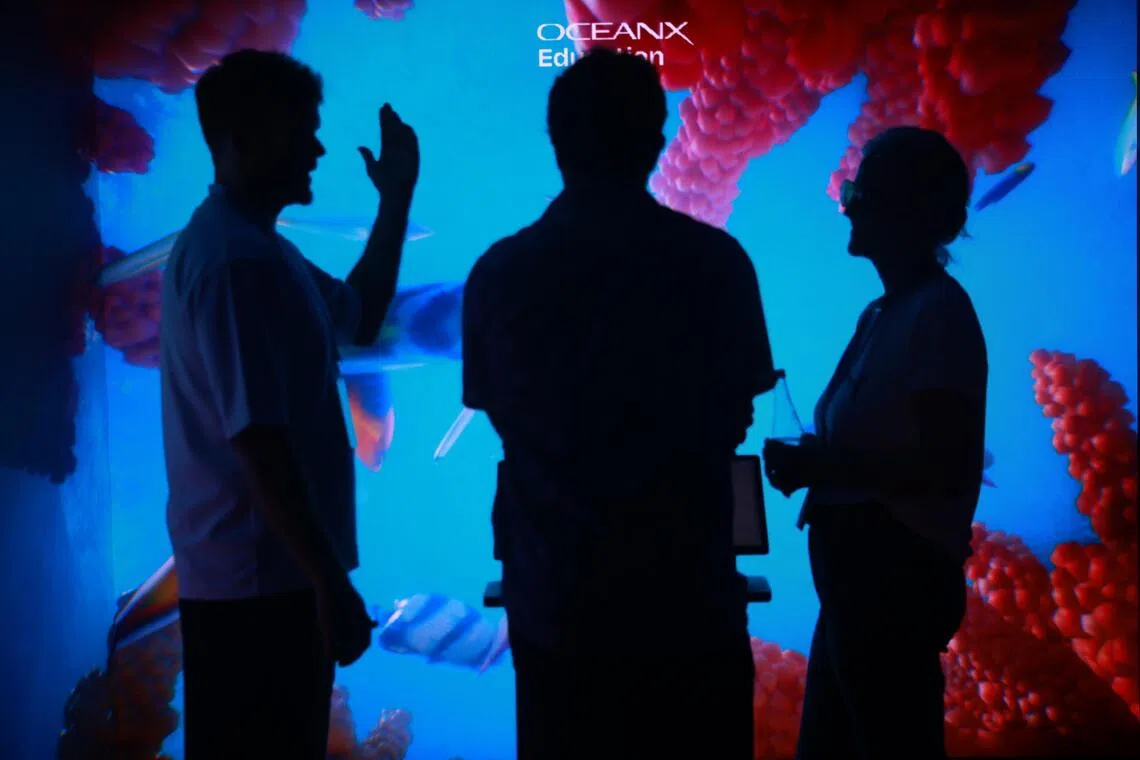
Attendees viewing a coral reef through an immersive display at the OceanX Summit aboard the research vessel.
ST PHOTO: JASON QUAH
In other immersive exhibits, visitors could pilot a virtual submersible through a Malaysian coral reef and learn about environmental DNA – genetic material that animals shed – by following the journey of an octopus through virtual reality headsets.
Gan pointed out that research initiatives such as the Monsoon Rise mission will become increasingly important as countries implement the UN High Seas Treaty, a global deal that aims to protect marine life in the two-thirds of the ocean beyond national boundaries, where illegal fishing, pollution and wildlife trafficking are rife.
The treaty comprises several key pillars that more than 100 signatory countries, including Singapore, must adhere to: It provides a legal framework to protect marine biodiversity and conduct environmental impact studies, sets out rules for sharing gains from scientific discoveries on deep-sea marine life, and helps developing countries participate fully in ocean research and conservation.
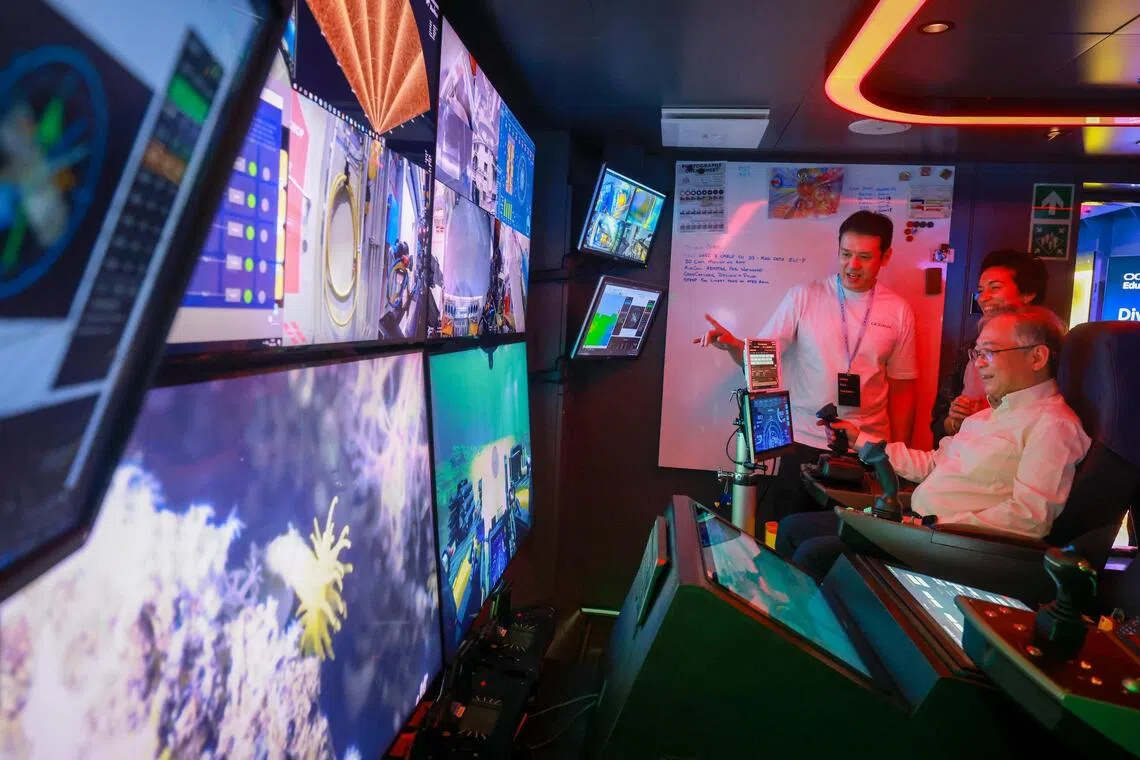
Deputy Prime Minister Gan Kim Yong trying out a virtual submersible simulator during the OceanX Summit.
ST PHOTO: JASON QUAH
“The (treaty) gives the international community a framework to preserve biodiversity and use marine resources responsibly,” said Gan.
Experts have also said that Singapore’s strengths lie in high seas research and the sharing of expertise with developing nations, which is also a key component of the UN accord.
“Advances in sensors, robotics, artificial intelligence and other technologies are giving us new ways to observe the ocean as well as understand the changes that are going on,” he said.
His remarks also come two weeks after a $60 million national research initiative on marine science was launched to help Singapore and the broader South-east Asian region deal with challenges ranging from coastal development to climate change, which harms marine life and habitats like coral reefs.
The National Institute for Marine and Ocean Sciences will develop the tools needed for sustaining and valuing marine ecosystems alongside economic development.
However, research will not be sufficient until it is turned into practical solutions, and that requires different forms of capital, noted Gan.
Governments will continue to invest in research and infrastructure, while companies bring technology and the ability to deploy solutions at scale.

Attendees networking at the OceanX Summit.
ST PHOTO: JASON QUAH
Philanthropic organisations and family offices can play a complementary role, he added.
Gan said: “(They provide) patient capital, networks, and expertise to support exploration and early-stage ideas, where the potential benefits may be very significant, but commercial returns will take time to realise.
“Working together, we can create pathways for promising ideas to move from research to test of concept, and eventually to wider application.”
Also attending the summit was Hollywood film-maker James Cameron, known for Avatar and Titanic. He executive-produced and narrated the National Geographic documentary series OceanXplorers, which follows the research vessel on its ocean adventures.
In 2012, Cameron became the first human to complete a solo dive to a depth of 11km, reaching the deepest, darkest part of the ocean – Challenger Deep in the Mariana Trench – in a submersible.
At a dialogue onboard on Oct 7, Cameron highlighted the importance of using underwater robots to continuously monitor the deepest parts of the ocean. Unlike satellites that continuously observe atmospheric patterns and dynamics, there is no equivalent tool for monitoring the ocean’s deepest parts.
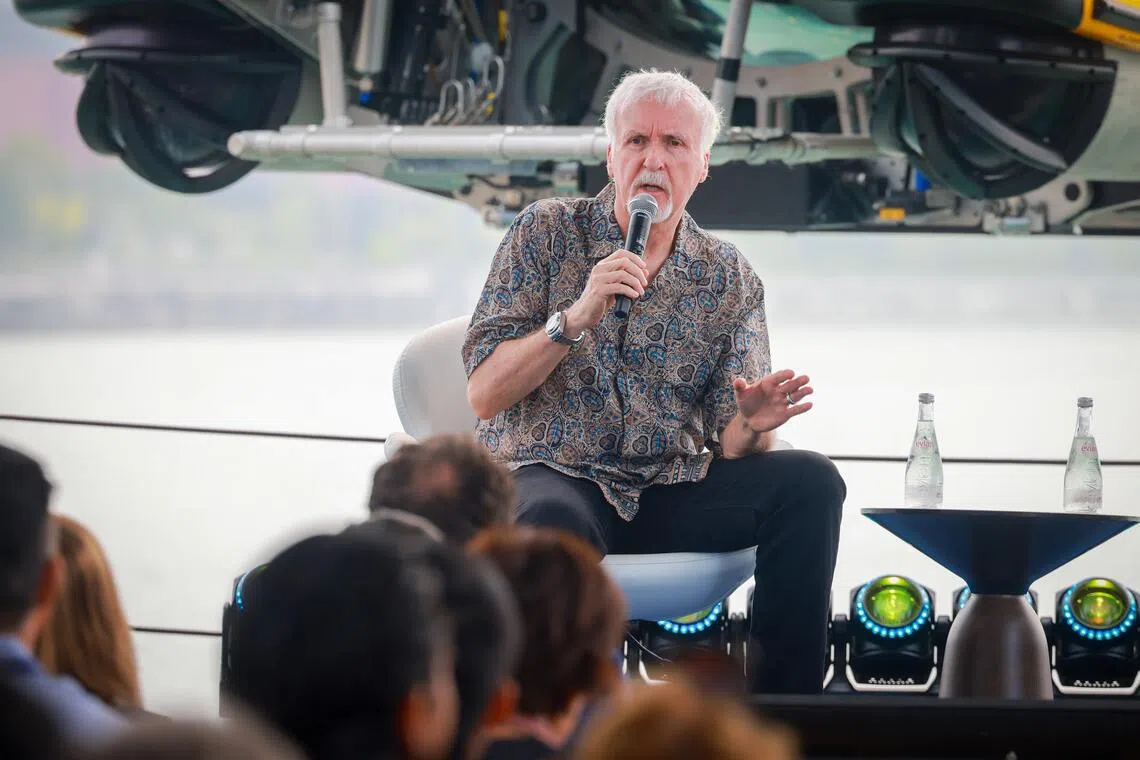
Famed Canadian film-maker James Cameron speaking at the OceanX Summit.
ST PHOTO: JASON QUAH
“The ocean is at least as complex as the atmosphere... Just going to one point in space and time and getting samples and data from one point doesn’t tell us about this enormous dynamic system,” he added.
“We’re never going to get a 100% handle on the speed and impact of climate change until we understand the carbon (movements) in the ocean.”
KioskNews shows a cleaned-up reading view extracted from the publisher’s page — the original always lives on their site, not ours.