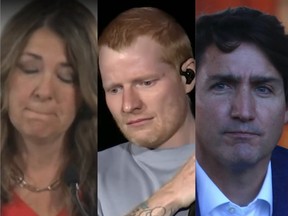
Danielle Smith did it, so did Ed Sheeran. When is it OK for a public figure to cry in public?
To cry, or not to cry? In the realm of politics, that is the question. And the answer, says one University of Toronto expert, largely depends on your sex.
Sign In or Create an Account
“If you’re a woman in the public sphere, you cannot win in terms of the expression of emotion,” said Megan Boler a professor at the Ontario Institute for Studies in Education and acting chair of the Department of Social Justice Education at the university. “You are hung in the court of public opinion either way.”
Two recent examples of crying in public were tears shed by Alberta Premier Danielle Smith and singer/songwriter Ed Sheeran. The reasons for the tears were as different as the people shedding them.
Smith’s emotional outburst came last Saturday during a virtual conference about the upcoming referendum on separation from Canada.
She began by saying: “Let me start with the feeling. Because if you understand the feeling, the rest makes sense.” She said many Albertans are angry or even hurt by a decade of feeling like Ottawa “was working to shut our economy down.”
Smith listed a number of grievances, including cancelled pipelines, emissions caps and electricity regulations, adding: “When a proud, hardworking people feel their contribution is taken for granted and their livelihood is treated as something to be phased out, some begin to ask a painful question.”
She paused for several long seconds and cleared her throat before continuing: “Does this country actually want us?”
The outburst, while rare, was hardly new. Boler recalled Hilary Clinton tearing up during the Democratic primary campaign in 2008. She noted that, while it had the effect of humanizing a politician often seen as cold and unfeeling, it ultimately may have hurt her chances against her opponent Barack Obama.

“It came back to bite her,” said Boler. “People felt that it was an example of a woman’s hysterical tendencies and a symptom of the fact that women are too emotional to be in the public sphere or be political leaders.”
In 2016, International Trade Minister Chrystia Freeland faced backlash when she became emotional and choked back tears after announcing that talks on a Canada-EU trade agreement had collapsed. “Roll up your sleeves and don’t leave,” demanded Gerry Ritz, the Conservative party’s trade critic and former agriculture minister.
Sheeran’s tears came Saturday during a concert in Philadelphia following a week of chaos surrounding his tour. The musician had landed in controversy after his support act, rapper Macklemore, was dropped from the tour over pro-Palestinian remarks made on stage. Sheeran’s other opening acts then also withdrew in protest.
“I’ve had to take and make difficult decisions,” Sheeran told the crowd. “And I am making mistakes. And I’m so so sorry. I don’t want to disappoint fans. And I’ve never wanted to be an activist musician, but this has put me in the middle of an important and passionate argument about freedom of speech and the most complex political issue on the planet.”
He became visibly emotional and said the attack on Israel on Oct. 7, 2023, “was horrific and compounded centuries of Jewish pain.” He added: “What is happening in Gaza is catastrophic and unjustifiable and disproportionate. My heart has been broken by the scale of devastation and loss of civilians lives, of children’s lives.”
Boler said displays of emotions by men are generally more accepted by the public, though even here context is key.
“Justin Trudeau crying when he was speaking about truth and reconciliation some years ago,” she said, “there was a lot of really mixed public response to that. A lot of people felt it was sort of using that emotion to render a kind of focus on him as an individual, or on how these historical horrors and genocide are experienced by white folks, when really the focus should be on Indigenous populations and how it affects them.”

Tears of joy might be easier for people to stomach, she added, regardless of the sex of the crier.
“Another example that was perhaps one of the most widely accepted and less pilloried examples of public displays of crying was when Obama was elected and Jesse Jackson cried, and there was a shot of him crying that got used repeatedly.”
Oprah Winfrey was also photographed weeping that day. “Those were examples where there was I felt greater public acceptance of those displays of emotion as legitimate or reflecting something that was quote-unquote acceptable.”
Whether the tears are real or not is a more difficult question to answer.
“The genuineness of what a person is feeling as opposed to its performative aspect I think is very difficult to dissect,” Boler said. “I think the moment that it is captured in the public sphere in a political context, we are necessarily talking about a performance, right? There’s just no way around that.
“So it may very well be that the person is feeling the emotion genuinely, but … it (also) functions always as a performance, whether we like it or not.”
Tom Lutz, author of Crying: The Natural and Cultural History of Tears, told the New York Times in 2010 that Bob Dole had cried “exactly twice” before his 1996 campaign for the U.S. presidency. “But in the early 1990s, Bill Clinton had transformed the political meaning of crying; it tracked very well with women voters. All of a sudden Bob Dole couldn’t control his crying and did it often.”
The supposed performative nature of public crying was taken to extremes by a 2011 article in Forbes magazine that asked: “When Should You Cry In Public?” and promised “5 Rules For Successful Emoting.”
They came down to reading the room, being aware that emotional outbursts are “hot TV” and would often be covered, and that, “when the emotion runs counter to the dominant story about you, it will make news.”
Even that piece was unable to parse real crying from crocodile tears, however. The Hilary Clinton episode, it noted, “was said by some to be a calculated effort to make her appear more human, whereas others said it was a genuine moment that made her appear more human.”
Maybe the difference doesn’t even matter. Research from Tilburg University in the Netherlands found that women who didn’t cry were not only seen as being less competent than men who didn’t cry, but also less competent than men who did cry.
Said Boler: “One of the tricky things in the moment that we are in, the world of soundbites and mis- and disinformation … is there is no way to measure how a public will respond to something like that. And the cost of those tears is very different depending on who is crying.”
Join the Conversation
This website uses cookies to personalize your content (including ads), and allows us to analyze our traffic. Read more about cookies here. By continuing to use our site, you agree to our Terms of Use and Privacy Policy.
KioskNews shows a cleaned-up reading view extracted from the publisher’s page — the original always lives on their site, not ours.