KMT planning campaign for referendum
LANGUAGE: Environmental groups said that the vague wording of the nuclear power referendum does not provide enough information to make an informed choice
By Sam Garcia / Staff writer, with CNA


The Chinese Nationalist Party (KMT) yesterday said it was planning 100 local events and launching a social media campaign to rally support for a referendum on whether to abolish the government’s policy to phase out nuclear power.
The Central Election Commission (CEC) on Friday reviewed three referendum proposals, passing one on whether to abolish the nation’s nuclear-free homeland policy and rejecting a referendum on using caning as punishment and another on using traffic fines to pay for road-safety improvements.
The rejected proposals did not meet the Referendum Act’s (公民投票法) requirement that referendums concern “the initiation or reconsideration of major policies,” CEC Chairman Michael You (游盈隆) said.
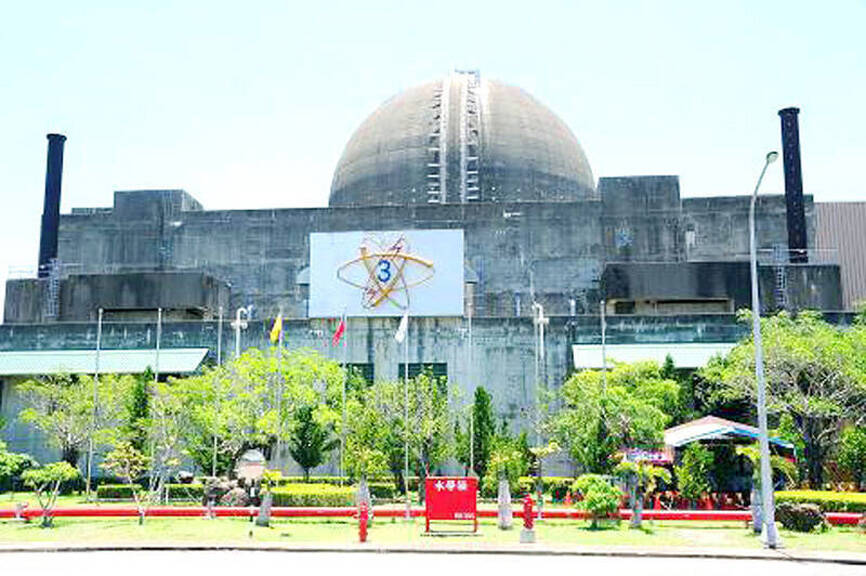
The Ma-anshan Nuclear Power Plant in Pingtung County is pictured in an undated photograph.
Photo: Tsai Tsung-hsien, Taipei Times
The KMT’s nuclear power referendum asks: “Do you agree that the government should abolish its ‘nuclear-free homeland’ energy policy to safeguard public health, ensure stable electricity supply and affordable electricity prices, enhance national defense resilience and support the development of the artificial intelligence [AI] industry?”
The referendum is an issue that affects Taiwan’s overall national competitiveness, KMT Culture and Communications Committee Director Charles Chen (陳以信) said in a statement.
KMT Chairwoman Cheng Li-wun (鄭麗文) has said that reliable electricity is essential to Taiwan’s competitiveness, as well as its high-tech and AI industries, he added.
The Democratic Progressive Party (DPP) government has shut down nuclear power plants, forcing Taiwan to become reliant on natural gas and putting the nation’s energy security on a single source that is dependent on imports, Chen said.
The KMT would center its referendum campaign around the idea that energy is vital to national security, computing power is key to national strength and Taiwan must secure energy for AI, he said.
The party is calling for a stable power supply, a stronger economy and continued growth of the AI industry, he added.
The KMT would pursue three strategies: tying the referendum to elections, cooperation among opposition parties and promoting energy development, Chen said.
It plans to hold about 100 local events, coordinate with local candidates and use social media and other platforms to rally support for the referendum and overturn the DPP’s “misguided” non-nuclear energy policy, he said.
Meanwhile, environmental groups on Saturday said in a joint statement that the vague wording of the nuclear power referendum and one-sided explanatory statement do not provide voters with enough information.
The voter information booklet would only include the question and explanatory statement approved by the Legislative Yuan, with no views from other government agencies or civil society groups, the Taiwan Environmental Protection Union (TEPU) said in a statement.
That presents only the majority parties’ side of the argument, denying voters accurate, sufficient and comprehensive information, which contravenes the spirit of democracy, it said.
The referendum’s explanatory statement is riddled with false and misleading claims, most seriously asserting that the EU considers nuclear power to be green energy, it said.
The EU classifies nuclear power as a “transitional activity” to help achieve net zero emissions, it said.
The EU’s nuclear power policy requires concrete plans and funding for the disposal of nuclear waste, the group added.
As part of the global semiconductor supply chain, Taiwan needs green power, but also diverse, locally produced renewable energy to enhance its energy security, TEPU said, urging the government to continue developing renewable energy rather than abolish the non-nuclear homeland policy.
KioskNews shows a cleaned-up reading view extracted from the publisher’s page — the original always lives on their site, not ours.