Fresh tariffs blitz pushes Asian nations to speed up trade deals with Washington
US President Donald Trump’s fresh tariff blitz aims to pressure Asian countries into sealing trade deals with Washington to avoid unfavorable duty rates, analysts said yesterday.
The proposed levies announced on Wednesday affect a range of nations in the region. They could result in rates of up to 20 percent on exports from the targeted countries, but face a period of public comment before taking effect, at the earliest in January.
The announcement came after Washington concluded a months-long probe into alleged excess production in the targeted economies.
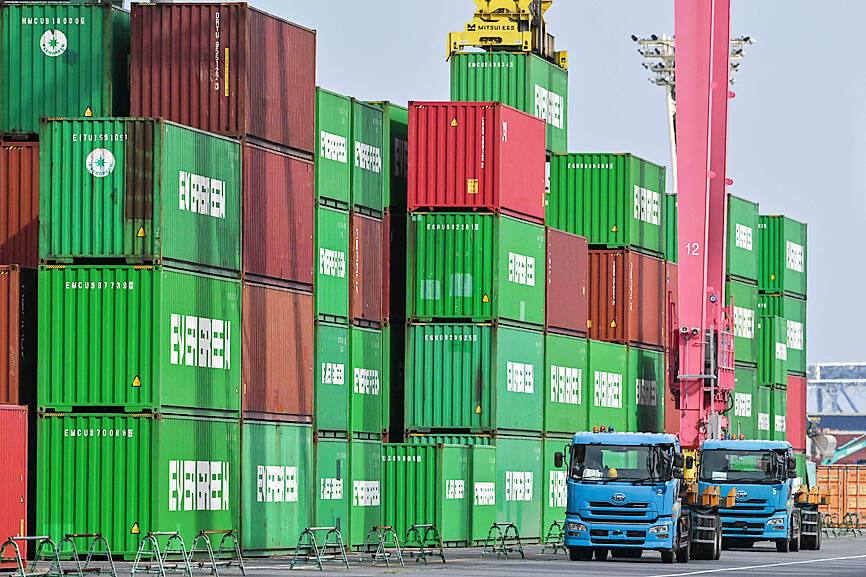
Trucks wait to be loaded with containers to transfer to an awaiting cargo ship at the Aomi Container Terminal in the port of Tokyo on May 22, 2024.
Photo: AFP
However, “several of these economies already have prior negotiated tariff rates with the US, which would effectively cap the applicable rate,” Mitsubishi UFJ Financial Group Inc economist Lloyd Chan (陳力德) said in a note.
The US has also indicated that the new tolls would not stack on top of other tariffs already imposed on 60 countries over forced labor concerns. Instead, the higher rate would apply.
“In all, that should help contain the incremental tariff shock, assuming prior negotiated commitment remains in place,” Chan said.
However, it does mean that Washington has established higher tariff ceilings that can be activated “should trade negotiations or existing commitments break down,” he added.
Capital Economics Ltd economist Stephen Brown also said that “the US has left open its ability to hike these tariffs if trade agreements fall apart,” particularly with China.
In Beijing’s case, the new levies stand at 20 percent, meaning the total rate could jump to 40 percent if its current trade truce with Washington, set to expire in January, is not extended.
Such a scenario “could take the two largest economies back to the trade wars of 2025,” Atlantic Council international economics chair Josh Lipsky said in a note.
However, that is not something Trump wants, he said.
Instead, Trump is banking on an extension of the truce, although this is “far from a sure thing,” he said.
Other Asian economies, also in Trump’s crosshairs due to significant trade imbalances, are likewise under pressure. Vietnam faces a maximum additional tariff of 35 percent, which could be cut to 20 percent if a trade deal is reached.
Hanoi on Wednesday reiterated that it has made commitments under a framework agreement in October last year, and that it is working for a final deal “as soon as possible.”
India said that trade concerns should be addressed in ongoing talks with Washington for a bilateral trade deal.
The US has proposed a 17 percent rate on Indian goods, rising to a possible 25 percent if no deal is reached.
The countries reached an interim agreement in February aimed at reducing US tariffs on Indian goods.
However, the US Supreme Court struck down Trump’s levies days later, fueling uncertainty over when the agreement would take effect.
In contrast with Indian uncertainty, Taiwan, which reached a deal with Washington early this year, struck a reassuring tone.
“We are confident that when tariffs are finalized early next year, we will return to a 15 percent non-stacked tariff under the agreement between Taiwan and the US,” Vice Premier Cheng Li-chiun (鄭麗君) told a news briefing in Taipei.
KioskNews shows a cleaned-up reading view extracted from the publisher’s page — the original always lives on their site, not ours.