Alien 'phoenix planet' was born from the ashes of a dying star
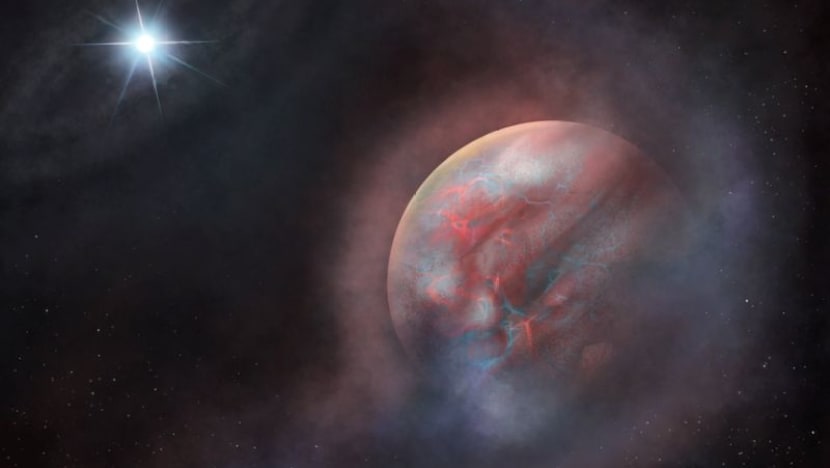
WASHINGTON, Oct 6 : In ancient mythology, the phoenix was a miraculous bird with a cyclical pattern of life and death, perishing in flames only to rise again from the ashes. Astronomers have now found a world that rightly can be called a phoenix planet.
Researchers said this exoplanet, as planets beyond our solar system are called, appears to have been born from material expelled into space during the death throes of a star a bit bigger than the sun, and now orbits the highly compact stellar remnant that was left behind, called a white dwarf.
It is classified as a second-generation planet, meaning it did not form from the swirling disk of material surrounding a newborn star, as Earth and other first-generation planets did, but rather from the leftovers of a doomed star.
"This is the first example of a planet forming around a white dwarf," said Jamie Williams, a doctoral student in astrophysics at the University of Warwick in England and lead author of the study published this week in the journal Nature Astronomy.
The white dwarf is located about 250 light-years from Earth, near the constellation Cetus. A light-year is the distance light travels in a year, 5.9 trillion miles (9.5 trillion km).
The planet is a gas giant perhaps slightly more massive than Jupiter, our solar system's largest planet. It orbits the white dwarf every 4.4 days at only 4 per cent the distance between Earth and the sun. It is so close that the blazingly hot white dwarf's extreme ultraviolet radiation is causing the planet's outer atmosphere to evaporate, with a portion then falling into the white dwarf.
The planet's chemical pattern points to its second-generation origin. It is rich in niobium, copper and zinc, the type of elements that certain dying stars cast off when they expand in their death throes, indicating the planet formed from a disk of this expelled material that surrounded the stellar corpse.
"In myths, a phoenix is born again from its own ashes. In the case of this planet, it is born again from the ashes of its dying host star, and therefore the planetary system is reborn. A second-generation planet is defined as one born after its host star dies — in this case after it has become a white dwarf," Williams said.
The researchers used data from the orbiting Hubble, TESS and FUSE telescopes, and hope to use the James Webb Space Telescope to confirm their conclusions.
A small number of potential second-generation planets previously have been identified orbiting pulsars, a rare type of neutron star, another type of stellar remnant.
"White dwarfs are much more common than pulsars, and over 95 per cent of stars in the Milky Way will evolve to become a white dwarf. Therefore, there would be many more second-generation planets around white dwarfs than around pulsars," Williams said.
While the newly discovered planet would be inhospitable for life, another second-generation planet potentially could be habitable.
"If a gas giant formed around a white dwarf, then a rocky planet could form, too. White dwarfs cool predictably over time and as they get cooler, their cooling slows. So if a second-generation rocky planet formed close enough to the white dwarf then it could remain in the habitable zone for billions of years," Williams said.
A RED DWARF AND A BROWN DWARF
A second study published in the same journal describes another exotic celestial phenomenon roughly 300 to 500 light-years from Earth in the constellation Taurus.
Researchers used the Zwicky Transient Facility at Palomar Observatory in California to discover a red dwarf star about 8 per cent of the mass of the sun in a tight orbit with a brown dwarf, an object too small to be a star and too big to be a planet. The brown dwarf is about 30 times the mass of Jupiter and a third of the mass of the star.
These two companions orbit each other every 87 minutes at slightly more than half the distance between Earth and the moon, and the star's gravitational pull appears to be siphoning material from the brown dwarf. The researchers detected a hot spot on the star's surface where this material appears to be landing.
"This is the first observed example of this phenomenon," said Aaron Householder, a Massachusetts Institute of Technology graduate student in astrophysics and lead author of the study.
"The two objects are so close together that the entire orbit would fit inside the sun," Householder said.
KioskNews shows a cleaned-up reading view extracted from the publisher’s page — the original always lives on their site, not ours.