‘Mom encouraged me to get breast implants’: Disney child star Christy Carlson Romano on fame, family and freedom

In a class at college, Christy Carlson Romano was encouraged to think about her “community”. Who were their people, the tutor asked the class, and where did they belong? The answer that popped into Carlson Romano’s head was child actors, but not the ones that went on to have successful grown-up careers. “The ones who were once the shining stars,” she writes in her memoir, “and who are now just trying to find out their places in the world.” Carlson Romano had returned to college after initially dropping out. She had survived sexual assault and toxic relationships, was broke and drinking too much. But before all that, she had been a teenage Disney star. She had made it.
The title of her memoir, Once Upon a Trainwreck, gives you a flavour of where Carlson Romano, 42, is coming from, but what’s most striking isn’t that she goes off the rails (she doesn’t, hugely, compared to other former child stars), but how sensible and mature she is as a child. It’s alarming. When fans recognise her now – she was in the popular Disney series Even Stevens which started in 2000 – they tell her she was a huge part of their childhoods. She had been acting the part of a normal suburban girl, the perfectionist Ren Stevens, while having no idea what that was like. She was already a mini adult.
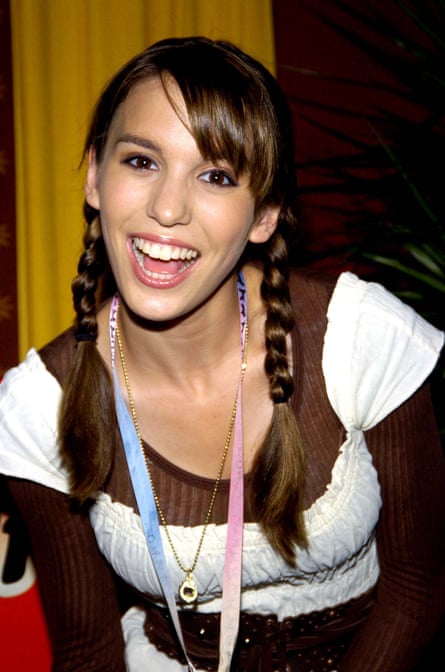
Now Carlson Romano has a social media career, which has given her a detachment from the entertainment industry. “I’m outspoken at this point, but for a lot of people they can’t do that,” she says. “What hurts is when I see other child actors suffering, because I know that means they haven’t found their way through the pain.” We speak, over Zoom, not long after Hayden Panettiere, the “Nashville” actor and singer who had started as a child and had talked about her experience of early fame, addiction and mental illness, had been found dead.
Carlson Romano grew up in Connecticut, the youngest of four. Her mother, Sharon, she says, had a competitive streak – she encouraged her two elder daughters to enter dance competitions – and focused her attentions on her youngest child. “They were less compliant, that’s what my mother said,” says Carlson Romano. “My mother said that I was a ‘good girl’, and that I would do what I was told.” Compliance, she says, is “the secret weapon of early childhood fame, and that comes at a cost over time”.
She loved performing, but she remembers that the feeling of impressing adults eclipsed any natural joy in it. “I was locked in a beam of approval and people-pleasing and wanting to make people happy with my performances.” If she did well in auditions, she was pleased that her mother was pleased.
By the time Carlson Romano’s career as a child actor was peaking, she and her mother were living in Los Angeles. Stage parents, says Carlson Romano, “can be very complicated. They are people who have dedicated their lives to their children and not to themselves. They’ve often displaced themselves from their marriages and their other children so that they could sacrifice on behalf of one child.” Now that she is a mother of two daughters, “I have a hard time reconciling how my mom justified being a stage parent to one child and not really to all of us.” She thinks her mother found it fun to shepherd her career, have a lifestyle within the entertainment industry and the reflected glory of her daughter’s success. “We enjoyed the bond that we had, but that bond got tested over time. It became more toxic and unstable and our dynamic became more professional rather than personal.”
Now, her mother lives near her in Texas and they have a good relationship. “She understands that I feel the way I feel, but she also still supports me.” She even supports Carlson Romano’s memoir, in which “she’s not portrayed in the best light, but it’s a true and complex light, and that goes to show just how motivated a stage mother my mom is.” Carlson Romano is also close to her brother, who became her financial adviser after she lost all her money (not helped by her mother’s financial mismanagement and certainly not helped by the $20,000 she paid to a psychic who claimed she could lift a curse on her). But she says she doesn’t really talk to her two older sisters. “I think that has a lot to do with what happened with my mom just not being there for them.”
Carlson Romano’s career started with roles in adverts, then she got her big break at six, with a part in a production of the musical Annie in Atlanta. Another musical followed – The Will Rogers Follies – which meant she and her mother left the family again and moved to San Francisco for a year. “It became normalised for me, but originally I think I missed my family. I missed the normalcy of being home and having friendships and learning how to be a kid.” She felt pulled in different directions, she says. “I really wanted the feeling of fitting in, but I really could only fit in in the industry.”
From a young age, she was aware she was in the world of adults, and often felt uncomfortable, whether it was with naked actors backstage in the theatre between costume changes, or sexual jokes on sets. “It happens so frequently that you eventually become numb to it, and it becomes just an acceptable thing. Then, to fit in, you start to make jokes as well.” In the 1997 indie film Henry Fool, which she did when she was 13, she played a troubled teen who offers the main character a blowjob if he does something for her. She felt uncomfortable about the line, but also confused because this was arthouse cinema and what she thought she was supposed to be doing. “There’s a very big difference between doing your school musical and saying what I said in that movie,” she says. “There has to be a way for the industry to provide more mental health support so that things are easier for kids to understand.”
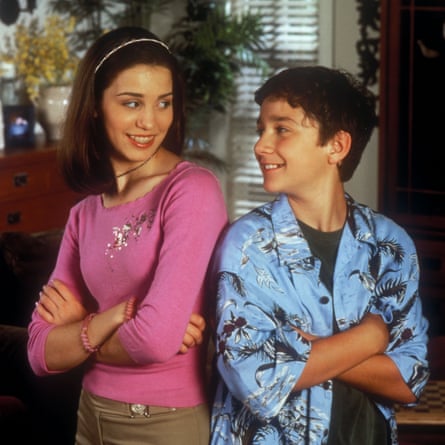
She was 16 when she started on Even Stevens, and looking back she can see how professional she was expected to be. She had to be sparkly and friendly to executives, “so you can get another job. And you have to be mature for your age, you can’t be speaking to the executives like a kid.” But her co-star Shia LaBeouf, according to her account, behaved quite chaotically on set. Why was it different for her? “I think it’s because I was female. I was expected to toe the line of professionalism. I was a little older than him, so maybe the expectation that I was almost treated like the older sister. They would tell me that I was such a good girl. ‘Christy always knows her lines.’” She was also, she has said, paid half of what LaBoeuf was.
When Even Stevens ended in 2003, Carlson Romano found it difficult to move her career on. “I would audition, and some of the feedback would be, ‘She’s not pretty enough.’” She says her management encouraged her to get a nose job. “Having these conversations felt very demoralising because I was like, my talent should be enough for me to find a job.” She says she eventually learned to separate herself from criticism. “You have to have your own self-worth, your own identity, or it will eat you alive.” And unfortunately, it ate me alive for a lot of my life.”
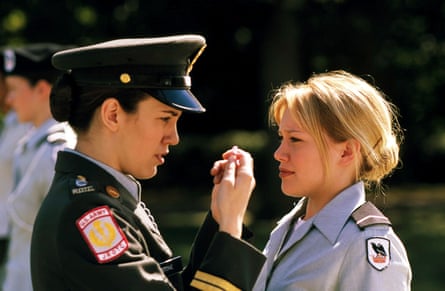
She didn’t change her nose, but around the same time, “I did cave and get a breast augmentation.” That was after she appeared in the 2002 film, Cadet Kelly, opposite Hilary Duff. “I asked my mom and she said, ‘If you’re going to be taken seriously for adult roles, I think you should.’ So my mom encouraged me to get my breast implants.”
Carlson Romano avoided the fate of many young actors in the early 2000s who were hounded by the paparazzi and tabloid magazines, but not for want of trying. “The only way to change your image was to get into the tabloids,” she says. “I thought it was because my lifestyle wasn’t exciting enough.” She started going to clubs, drinking more and taking drugs to try and get into magazines. “I didn’t know what I was doing,” she says. “I was clueless.”
She thought going to college was the answer to what to do with her life, though she dropped out after a year. “I think having not had the socialisation of going to school and not really having a good home life … I wasn’t ready.” Her ability to have healthy relationships was also affected, she thinks, by her compliance and rock-bottom self-esteem. She was in relationships with toxic men; one, she writes, threatened to sell naked photographs of her online. “I came into relationships broken and looking for someone to fix me, instead of taking accountability for my own mental health and having a firm grasp on my autonomy,” she says. “I had been conditioned to just be very passive. When the first big relationship happened, he pushed me to stop talking to my family – it may have been a good choice to set up boundaries, but I went no contact for an entire year.” She should have said no to him, she says, but “everything in my life was always, ‘Say yes to the next opportunity.’”
One night out in LA, she was plied with drinks by one of the bar staff she vaguely knew; he took her to the basement of the bar, locked the door and sexually assaulted her. The next day, traumatised and bruised, she told her mother, who seemed to blame her. In her book, she writes it “was shocking to me that I didn’t report it and that I was encouraged to just let it go and blame myself. It’s sad to think about that in hindsight.”
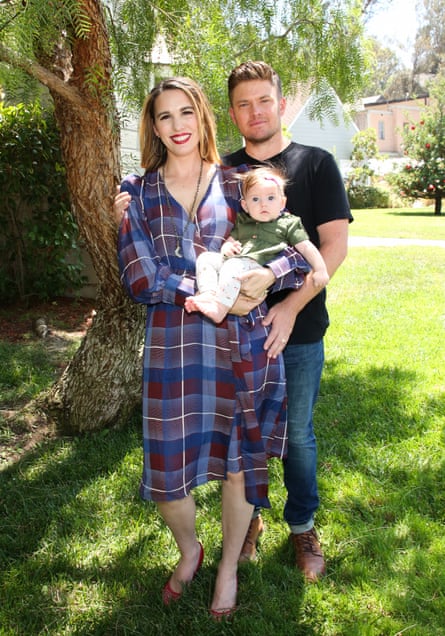
When early success, with all the sacrifices it entails, doesn’t turn into a long career, it can be particularly difficult. “I was supposed to be the girl that was most likely to succeed, and everyone told me I was perfect, but in real life, I wasn’t,” she says. “That was a hard thing to embrace. It felt like I was failing every day.” Aged 26, having run out of money, she ended up back at home in Connecticut and restarted her degree. It was at college again, studying film, that she met her husband, Brendan, another mature student.
The couple work together on Carlson Romano’s social media and podcasts. She started a YouTube channel in 2019, mainly cooking and chatting with other former child stars, then during the pandemic started posting much more personal videos, monetising her experiences in Hollywood. The titles, such as “Why I don’t talk to Shia LaBeouf anymore”, were undoubtedly clickbait, but it meant her platform grew. “I’ve really found my voice, and social media has had a big part in that,” she says. She now has more than 850,000 followers on Instagram where she makes money from sponsored posts, has paying subscribers and is launching a new podcast. She has also made a return to acting, with a role in a Hallmark movie, her first part since 2019.
When she sees people who started at the same time, such as Scarlett Johansson, or Anne Hathaway – one of Carlson Romano’s videos had the arresting title “How I lost Princess Diaries to Anne Hathaway”, even if the story of being too busy to audition didn’t quite live up to its promise of juiciness – does she feel envious of their careers? “Not really, because I know how hard they work to stay in the business,” she says. “It’s still very difficult to have to deal with the pressures of getting older and people judging them. And they’re also parents. I feel a lot of peace when it comes to who I am now. I think it’s because I have so much more independence from the industry that I can look back and say everybody’s got their shit, and we’re all just human.”
KioskNews shows a cleaned-up reading view extracted from the publisher’s page — the original always lives on their site, not ours.