'The Social Reckoning' Misses What Made the Original So Great


Taylor Gates is an Indiana native who earned her BFA in Creative Writing from the University of Evansville. She fell in love with entertainment by watching shows about chaotic families like Full House, The Nanny, Gilmore Girls, and The Fosters.
After college, she moved to Los Angeles to pursue a career as a writer, editor, and filmmaker. Today, she’s a sucker for dramedies — especially coming-of-age stories centering around complex female and LGBTQ+ characters. She has been with Collider since May 2022.
The Social Network, which follows Mark Zuckerberg as he creates Facebook and famously makes a few enemies in the process, was a massive success by every metric. Not only did it gross $225 million on a budget of just $40 million, but it also received eight Oscar nominations, stands at an impressive 96% on Rotten Tomatoes, and was even preserved by the Library of Congress in 2024. Expectations were high when it was announced that Aaron Sorkin would be making a follow-up entitled The Social Reckoning, but so was skepticism. Could a sequel possibly recreate the magic of the first movie, especially without Jesse Eisenberg? And would Sorkin be able to justify its existence at all?
The answer, it turns out, is complicated. There are certainly glimmers of excellence in The Social Reckoning, even if it never quite reaches the heights of its predecessor. And there’s no doubt that the themes tackled in the film are timely, though the execution doesn’t make it feel as urgent or groundbreaking as Sorkin intended.
While The Social Network explored Facebook’s rapid rise, The Social Reckoning depicts its ugly downfall — at least in terms of its reputation for being a tool to unite people instead of sowing division. The film covers the period between 2019 and early 2021, examining how Facebook impacts the culture around major events such as COVID and the January 6th insurrection.
The film begins in earnest when investigative reporter Jeff Horwitz (Jeremy Allen White) starts working for the Wall Street Journal. Despite coming from the world of political journalism and being far from technologically savvy, Horwitz begins covering the newspaper’s tech beat and begins chasing a story on Facebook, reaching out to the company’s civic integrity team to try to get a source. With a culture of extreme secrecy, nearly everyone refuses to talk to him, though he does find one unlikely ally in the form of engineer Frances Haugen (Mikey Madison).
Though she believes Facebook is having a positive impact on society, Haugen is becoming increasingly concerned about the extremist groups the site seems to be recommending — and frustrated that none of her coworkers seem to care. Seeing no other option, she begins covertly meeting with Horwitz, initially acting as an anonymous source and eventually sharing highly classified internal documents with him so he can inform the public of Facebook’s irresponsible actions of ignoring — and, in many cases, even promoting — dangerous rhetoric on its platform to make a profit. It’s a move that puts her career, freedom, and even safety on the line.
Mikey Madison and Jeremy Allen White’s Dynamic Is the Highlight of ‘The Social Reckoning’

The Social Reckoning is the kind of film that lives and dies by its performances, and luckily, both Madison and White give solid ones. Madison plays Haugen with a compelling combination of arrogant brilliance, short-tempered frustration, and bone-chilling fear. She’s able to effortlessly deliver a sharp, witty insult one moment and be consumed with fidgety paranoia and anxiety the next. Her bluntness and condescending nature juxtaposed with her surprisingly optimistic viewpoint about the company gives her refreshing nuance.
White brings a complementary energy as the dogged but perennially patient reporter. He gives the film a much-needed grounded energy, and his fish-out-of-water arc is frequently hilarious. The film is at its best during the low-key moments when he and Madison are sharing the screen, trading barbs about banana daiquiris and commenting on the basketball game left on the TV. His dynamics with the newspaper boss (Betty Gilpin) and interns (Aidan Laprete and Kelley Pereira) add nice moments of levity, too.
Jeremy Strong does a fine job stepping in for Eisenberg as Mark Zuckerberg, though the movie isn’t really about him, and thus, he isn’t given all that much to do. For the vast majority of the time, he’s relegated to doing a mock Q&A with his legal team, which never feels as interesting as what’s happening with Haugen and Horwitz. His most riveting scene is a brief moment when the civic integrity team comes to his office, which he writes off as nothing more than an irritating waste of time.
‘The Social Reckoning’ Is Quintessential Sorkin (For Better and Worse)

The Social Reckoning offers all of the typical hallmarks that Aaron Sorkin is known for: fast-paced dialogue, politics, and a deep dive into a highly specific world most people may not know the inner workings of. In many ways, this is a great thing, as the film moves at a snappy pace and is able to present complex information in a digestible and entertaining way. The direction, cinematography, and score are inoffensive, albeit unmemorable, without a particularly distinct aesthetic or creative vision.
But while the film thrives when it focuses on more intimate character beats, it falters a bit when it comes to the larger scenes and themes. Madison can’t manage to sell one of Haugen’s centerpiece monologues, with the delivery feeling stilted and like overacting, though one gets the sense that’s more the fault of the screenplay than her skills as an actor. The movie leans heavy-handed when it comes to the crescendo of political extremism and January 6th but underbaked when it shoehorns in the topics of cyberbullying and teen girls’ body image.
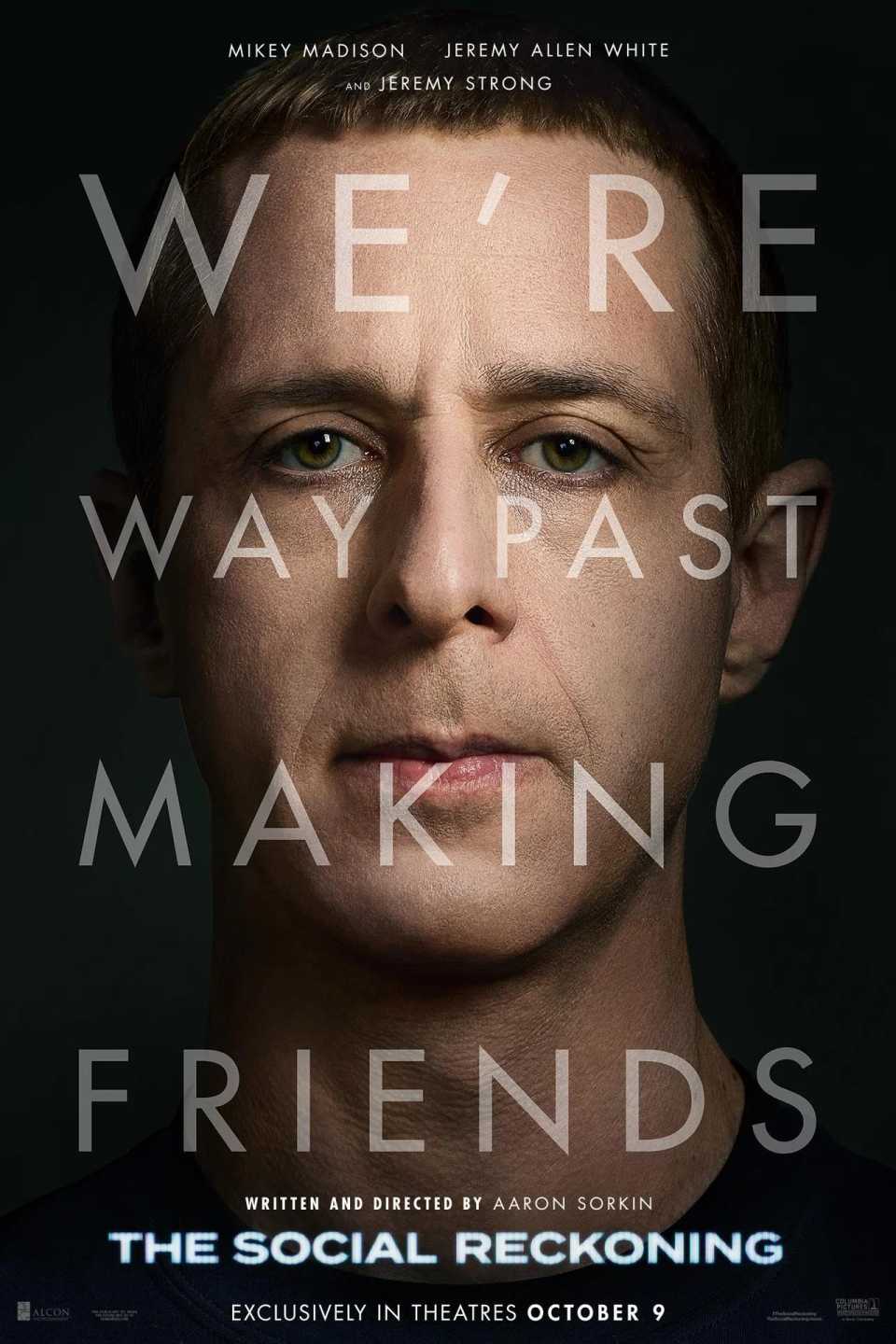
The Social Reckoning is a clear downgrade from The Social Network, but Sorkin fans will still find it an enjoyable enough watch. Madison and White’s relationship is the heart and soul of the story, and the film is strongest when it remembers that. It may not do enough to deserve the more coveted reshare or comment, but it’s a solid enough film to earn a like.
- Release Date
- October 9, 2026
- Runtime
- 112 Minutes
- Director
- Aaron Sorkin
- Writers
- Aaron Sorkin
- Producers
- Stuart M. Besser, Todd Black, Aaron Sorkin, Peter Rice
-

Mikey Madison
Frances Haugen
-

Jeff Horowitz
Pros & Cons
- Mikey Madison and Jeremy Allen White both give solid performances, with their relationship being the best part of the film.
- The film contains a surprising amount of humor that gives it some much-needed levity.
- Sorkin manages to make complex tech concepts digestible and interesting.
- Jeremy Strong isn?t given enough to do.
- The film falters when it moves away from more intimate character work to try and address larger issues.
- The direction is unmemorable, without a strong vision.
KioskNews shows a cleaned-up reading view extracted from the publisher’s page — the original always lives on their site, not ours.