Taichung touted as future robotics and drone hub
By Liu Wan-lin and Jake Chung / Staff reporter, with staff writer


Deputy Legislative Speaker Johnny Chiang (江啟臣), the Chinese Nationalist Party’s (KMT) candidate for Taichung mayor, yesterday touted the city’s potential to become a global hub for robotics and drone manufacturing, while saying that political maneuvering for the 2028 presidential race has already begun.
The Legislative Yuan in August passed the Act for Strengthening Defense Autonomy and Unmanned Vehicle Industry Development (強化國防自主暨無人載具產業發展條例) after heated debate over how to balance national defense procurement with industrial development, Chiang told the Chinese-language Liberty Times (sister paper of the Taipei Times).
Some party caucuses prioritized national security, while others focused on developing domestic industries, he said.
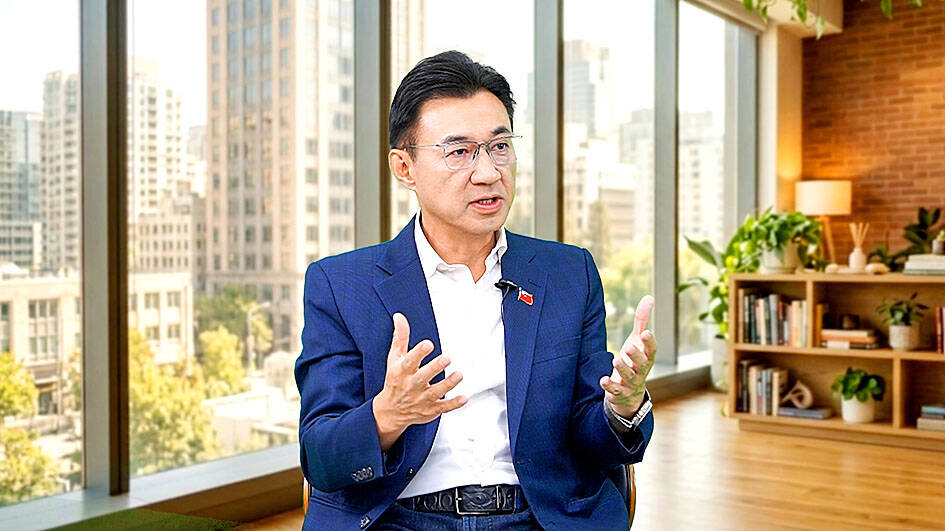
Deputy Legislative Speaker Johnny Chiang speaks in an interview in Taichung yesterday.
Photo: Chang Chia-jui, Taipei Times
As deputy speaker, he was expected to remain neutral and help build consensus, he added.
The uncrewed vehicle industry could eventually generate hundreds of billions of US dollars in output value and create substantial market opportunities, Chiang said, adding that Taiwan must ensure that its industries can meet defense procurement requirements and benefit from government purchases.
The version of the act that passed was proposed by the KMT and the Taiwan People’s Party, with provisions proposed by the Democratic Progressive Party on urgent defense procurement needs, Chiang said.
The compromise includes a NT$240 billion (US$7.4 billion) budget over six years, and mandates that domestic production rates reach 50 percent within two years and 80 percent within four years, he said, adding that all party caucuses would support the budget as long as it benefits industrial development.
Taichung is well positioned to develop uncrewed vehicles and robots because of its strong manufacturing base, Chiang said.
Turning artificial intelligence into physical products requires manufacturing capabilities, he added.
The city’s dense manufacturing network means that all components needed for precision machinery are less than an hour away, Chiang said, adding that Taichung is a “golden valley.”
“I am optimistic about Taichung’s manufacturing prospects, and overseas companies are also looking at the city,” he said, adding that some representatives from the American Institute in Taiwan and other US organizations have visited and begun working with local partners.
Proper use of the funding under the act would benefit Taichung’s industries, Chiang said.
Turning to politics, Chiang said next month’s local elections would serve as a warm-up for those seeking the presidency or legislative seats in 2028.
Winning this year would not guarantee victory in 2028, as the elections would be fought on different political terrain and voters’ views could change with events and government performance, he said.
“Even though there are only 13 months between the two election seasons, a lot can change in Taiwan’s political landscape in that time,” Chiang said.
KioskNews shows a cleaned-up reading view extracted from the publisher’s page — the original always lives on their site, not ours.