The six-year promise that led to Khawaja blowing open Sandpapergate scandal
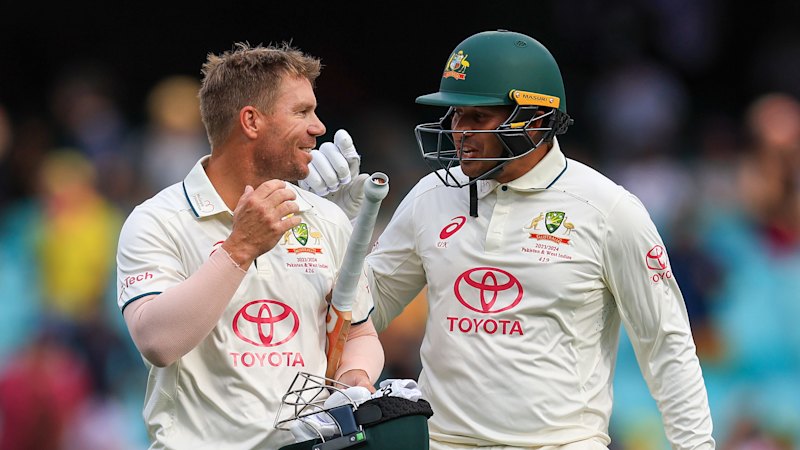
Usman Khawaja says he decided to set the record straight on Sandpapergate to fulfil a six-year promise he made to David Warner, and has denied his explosive autobiography Sabr was motivated by money.
Speaking on Antoinette Lattouf’s We used to be … podcast, Khawaja said he decided to re-open the Sandpapergate can of worms because he felt his longtime friend had been harshly treated.
“I had promised him for ages, because he’s had to carry this for eight years. I didn’t tell David Warner what was in my book until two months ago,” he said.
“If you’ve read the chapter, a lot of it is dedicated to ‘Bull’ or Davey in a lot of ways and I only told him two months ago.
“There’s a period of time from 2020 when I sent a text message to 2026, where we barely discussed it – but I made a promise to him in 2020, and I stuck to it.
“I text him two months ago, and he had no idea I was writing it, he was shocked. I was fighting with what I was gonna put in the book the whole time.
“I’ve stood up for the three guys [Warner, Steve Smith and Cameron Bancroft] who I feel like were treated unfairly, but there’s other guys still playing in the team right now that it might be some sort of cost [for them]. I tried my best to balance that out.
“I’m not playing the victim here, because I knew what I was getting into and knew what was coming, I just didn’t realise it would be so personal.
“I’ve given the facts and think whatever you want now. I could have taken the sandpaper chapter out any time I wanted, I had full control.”
More than eight years after the sandpaper scandal rocked Australian cricket, the recently retired Test star reopened the country’s biggest can of worms earlier this month with the release of his autobiography.
In the book, the 39-year-old claimed the entire team knew ball-tampering was taking place in South Africa.
The details in the book and Khawaja’s comments since its release have plunged Australian cricket into civil war, with Warner, who was suspended for a year for his role in the ugly episode, backing up his former opening partner’s comments last week.
That revelation was strongly denied by fast-bowler Mitch Starc last Tuesday, before current captain Pat Cummins declared Khawaja’s recollections as complete nonsense during a stunning 70-minute press conference in Sydney last Friday.
But Chadd Sayers, who was the spare bowler during the 2018 tour of South Africa and came in for the fourth and final Test, gave credence to Khawaja’s comments on Sunday, saying he was tasked with taking the sandpaper off the field in his duties as 12th man.
“My recollection isn’t as clear as it was obviously eight years ago, I just know that there were numerous conversations of it around in the change rooms. I knew that it was going to be used, as I believe everyone else did,” he added.
While Khawaja has pulled out of events since copping a barrage of backlash following the release of his book, the former opener, who became the first Pakistan-born cricketer to play for Australia, is still completing some commitments.
“Sandpaper didn’t just happen overnight, I wrote a whole bunch of stuff down days after it happened,” the former Aussie batsman explained during the 45-minute podcast interview with Lattouf.
“So much happened that I didn’t want to forget and I also thought, I had this thing and did it again a year later, where it would be more of a cleansing thing for my mind to get it out of my mind onto a piece of paper, then I could let it go.
“Part of me was also like, I don’t want to forget what happened. I didn’t write it down because I wanted to write a book … I didn’t look at it again for years.”
Khawaja hit out at the penalties handed down to Warner, as well as Smith and Bancroft.
“The penalties that happened to these guys were grotesquely overboard,” he said.
“The reason I say this is because the ICC gave them the penalties. Smith got a game and 100 per cent of his match fee, Bancroft got 75 per cent of his match fee and David Warner got nothing because he didn’t do anything.
“No one had ever gotten these penalties before … the benchmark should be ICC penalties. Cricket Australia went over the top and I go into details about why I think that happened and the context of what made that happen.
“As I said before — we win as a team, we lose as a team and we take this as a team. I think if we genuinely do that and there’s an opportunity to do that, we can move forward once and for all, but I don’t think we’ve ever done that.
“That’s why we keep coming back to this over and over again, speculation just keeps rearing its ugly head.”
Although several cricketing figures have slammed Khawaja for publishing the details in the book for commercial gain, the maligned figure, who has spoken out about political and humanitarian issues like the war in the Middle East, said those critiques couldn’t be more off the mark.
“I’m so grateful, God has given me so much, I don’t need any more money. Having more money in my life is not going to change my life any more,” he said.
Khawaja added that he decided to write the book following Australia’s extraordinary defeat in the third Ashes Test at Headingley, after Ben Stokes’ match-winning 135.
“Ben Stokes played an unbelievable innings, where we should have won and he played it and we lost and I wrote it all down, and the reason I wrote it down is because I got dropped after that game and my head was in a spin,” he said.
“That’s when my book technically started ... I wrote it all down because a part of me needed to cleanse but a part of me was that I never wanted to forget what’s happened here.”
More:
KioskNews shows a cleaned-up reading view extracted from the publisher’s page — the original always lives on their site, not ours.