The resilient roots of a quaint west coast town
Exploring Fangyuan’s coastal landmarks, from its serene harbor port to its sweeping turbine views and elevated mangrove trail.
By Shane O’Reilly / Contributing reporter


Fangyuan Township (芳苑) in Changhua County is a quiet, unassuming setting, known for its wetlands, eco tours and trained sea-ox that transport the oyster harvest in carts. Topographically speaking, it’s also enormously diverse, boasting a proud tradition of aquaculture and an ecologically rich coastline.
Fertile fields abound with an abundance of crops from green onions to dragon fruit, with vineyards to the east in neighboring Erlin Township (二林鎮).
WANGGONG FISHING PORT
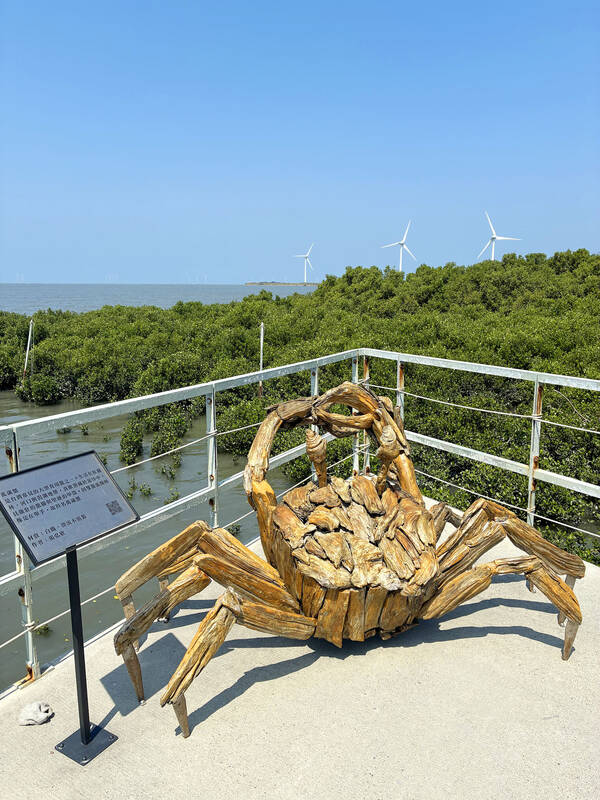
An artistic and photographic addition to the walk.
Photo: Shane O’Reilly
To the northwest of the township, flanked by the Wanggong Fishing Port (王功漁港) and harbor, stands the tall two-tone lighthouse. Built in 1983, this popular landmark is still fully operational.
The Wanggong Fishing Port has itself become synonymous with the region. Though small in stature, it has held on tight to its legendary status as Taiwan’s epicenter for oyster fishing.
Disruption by offshore wind farms means reduced yields, and as such, locals have had to adapt, introducing guided eco-tours and ox cart rides around the intertidal zone with optional clam digging or oyster grilling.
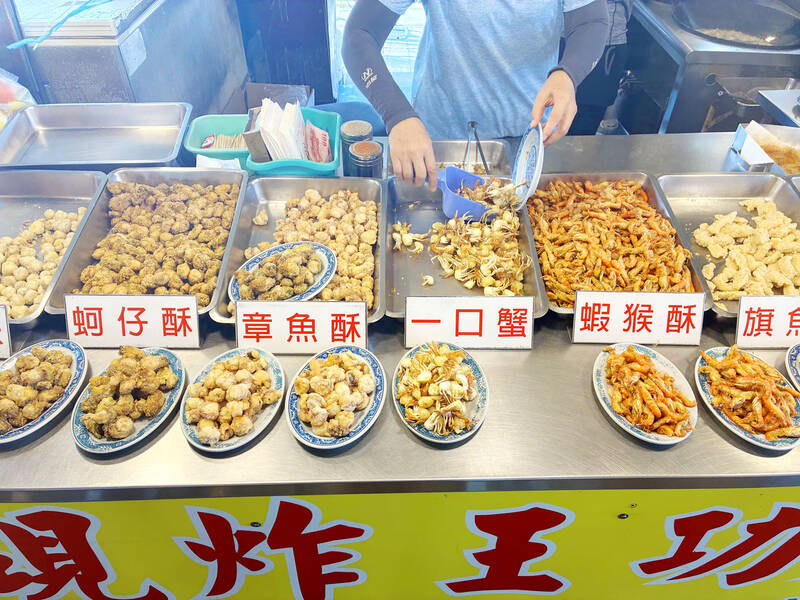
Soft-shell crab, oyster, and fish tempura ready to be fried.
Photo: Shane O’Reilly
The modernization of a world looking toward a cleaner, more efficient planet may put an end to the old ways of life one day, but for now the deep-rooted heritage remains.
A food court nearby sells watermelon smoothies to be paired with soft-shell crab and fish tempura.
It’s all flash-fried with fresh basil leaves and doused in a generous helping of salt to be carried away in little brown bags and eaten elsewhere.

Part of the Jade Emperor Hall at Fangyuan Putian Temple in Changhua County’s Fangyuan Township.
Photo: Shane O’Reilly
Dining al fresco, there’s usually a light breeze; everything’s so still, so quiet, the water surface shimmering under the glaring sun.
There’s a slight rhythmic swell outward from the moored boats of the harbor to the pelagic expanse around the legs and blue arches of the King’s Bow Bridge (王者之弓橋).
FANGYUAN PUTIAN TEMPLE
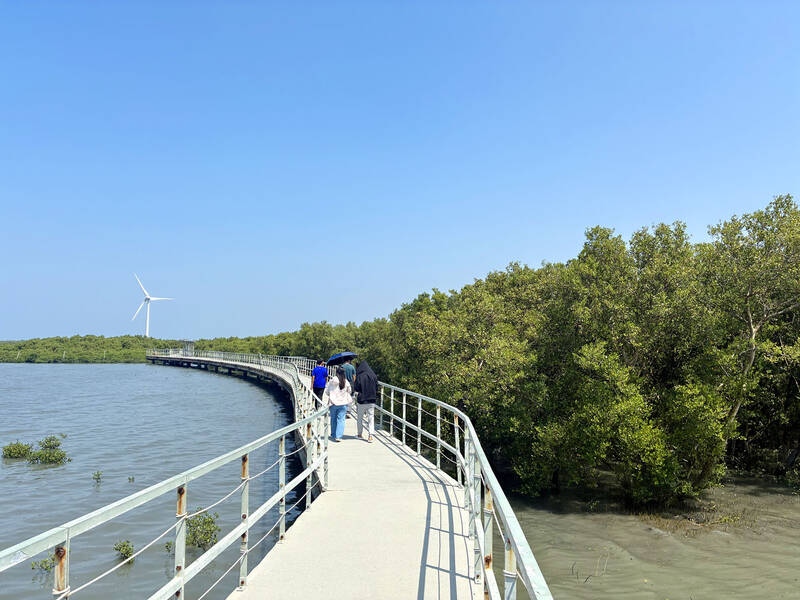
Mangroves along the coast of Fangyuan Township.
Photo: Shane O’Reilly
A short drive away is one of the country’s largest Mazu Temples, the Fangyuan Putian Temple (芳苑白馬峰普天宮).
A commanding presence flanked by two bell and drum towers, its grounds cover some 6 hectares, and it stands 35 meters tall at its highest point.
The ground floor acts as an expansive welcoming plaza, while the opulent halls, side altar rooms, and main sanctuary spaces can be found on the second and third floors.
When visitors have finished their prayer route (參拜順序), it’s a short 3-minute walk to the central entrance of the Fangyuan Wetlands Trail (芳苑海空步道).
The trail is a mere 2.1km, winding through a thick, variegated mangrove fringe, heavy with the scent of sea salt in the air.
From the walkway, the mangroves are half-submerged, but as the path curls away to shallower waters, you’ll be able to view the local wildlife in the pockmarked mudflats below on either side.
The anoxic, black, viscous mud supports a flourishing benthic life of red-hued Taiwanese bowed fiddler crabs, the males distinguishable by their one oversized claw as they potter in and out of their makeshift mud tunnels.
Alongside the crabs, skittish mudskippers, similar in appearance to lengthy tadpoles, are leapfrogging one another. It’s a wonderful setting for the whole family to spot unique coastal wildlife.
For your information
IF YOU GO
From Fangyuan Township to Fangyuan Lighthouse (芳苑燈塔), it’s a 12-minute drive. From the nearby food court car park to the Fangyuan Putian Temple car park is a 14-minute drive. From there it’s a short walk to the wetlands trail. While there are a variety of mudflat tour companies available online year-round, they are highly dependent on the weather and low tide.
KioskNews shows a cleaned-up reading view extracted from the publisher’s page — the original always lives on their site, not ours.