Indonesian Film ‘Pernikahan Berdarah,’ Faded to Red, Gets Second Life as ‘Qodrat’ Director Charles Gozali Calls Out Archive Neglect at JAFF Market
A German restoration specialist based in Bali is trying to coax the original colors back into the only remaining copy of “Pernikahan Berdarah,” a 1987 Indonesian film whose image has decayed to a single shade of red.
For “Qodrat” director Charles Gozali, the job is personal: the film comes from Garuda Film, the company led by his late father, producer Hendrick Gozali.
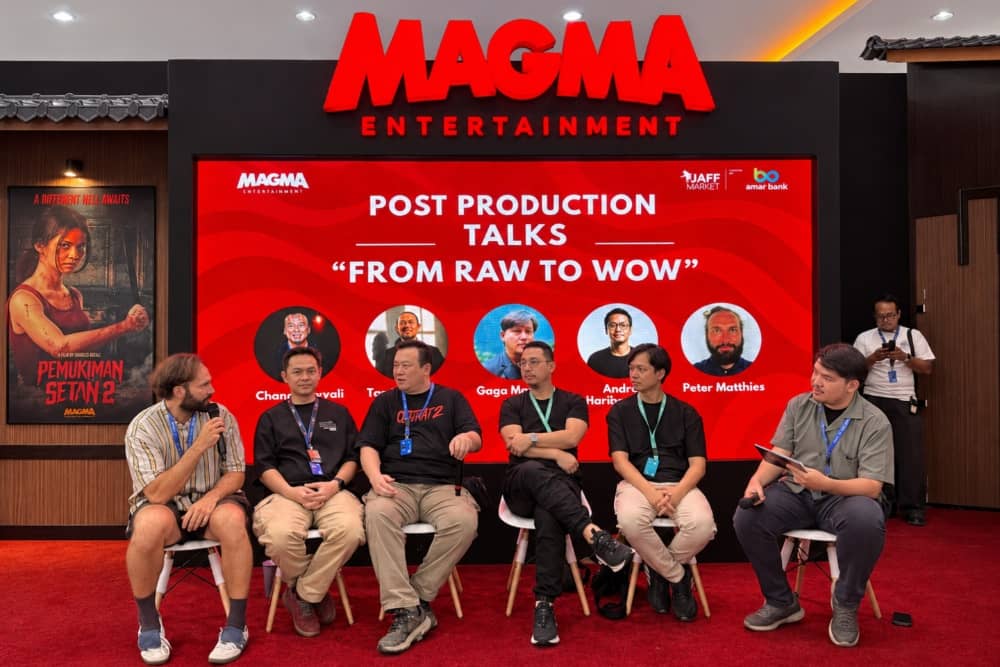
Peter Matthies, who came from Germany and helped set up the Analog Film Center in Bali, discussed the Garuda Film restoration during a post-production panel at the Magma Entertainment booth at JAFF Market in Yogyakarta. He was joined by Gozali, who is CEO of Magma as well as a director and producer, and three of his regular post collaborators.
“It’s actually gone, because it’s the last copy, right?” Matthies said. No negative survives, he added, and the print that does was well used and is now damaged. “So our problem: there’s only one color left, which is red. And we try to find the real colors and bring them back to life.”
Restoration usually begins with cleaning by hand, Matthies said, and some reels arrive so sticky that he compared them to a brick, before scanning at up to 6K. On “Pernikahan Berdarah,” scanning is finished. His team is now splitting the image into separate red, green and blue channels to strip out scratches, and is trying out AI to recolor it. The plan is to scan a Betacam copy and use it as a color reference, so the result stays close to what the filmmakers intended. Among the toughest problems is dye fading, which has wiped out the magenta. Matthies said it could take around a year to settle on the right tools, with the aim of keeping the organic texture of film rather than a digital sheen.
The two were introduced at a Jakarta tourism event just as Gozali was hunting for someone to restore his father’s films. “It’s like God’s given signs,” Gozali said of the timing.
Matthies said preservation alone isn’t the issue. “The problem is that all the negatives, they have vinegar syndrome and you cannot stop it. So it’s also like time is running actually, and we need to do something,” he said.
Gozali painted a bleak picture of how Indonesia has looked after its film heritage, particularly titles made before 1990. He said Sinematek Indonesia lacked the budget and that the government has shown little interest, recalling that one Sinematek head was reduced to tears after a budget request went unsupported. “They wanted to restore and preserve Indonesian films, but the support didn’t reach them,” he said, though he noted that preservation efforts at Sinematek have since improved.
The comments come as Indonesia’s archive draws new international backing. ALIPH, the International Alliance for the Protection of Heritage, has extended its mandate to film heritage through a program unveiled with France’s CNC at the Lumière Summit, and Indonesia is one of three pilot countries. The program, which aims to help the government preserve, restore and showcase its film archives, has $500,000 earmarked for urgent projects this year, and ALIPH hopes to raise $15 million to keep it running through 2032. Possible projects are also being explored in Cambodia, Lebanon, Myanmar, the Philippines and the Pacific.
Asked about the future of archiving, Matthies said he wants the work to be open and accessible, with funding available, “and that the younger generation can see all these wonderful movies.”
The rest of the session turned to Magma’s own post-production team, which has worked with Gozali on every film since “Qodrat,” including “Pemukiman Setan,” “Qodrat 2,” “Tumbal Darah,” “Badut Gendong” and the upcoming “Jump Scare.”
“Film is a collective work. No one person makes a film, except for amateur films,” Gozali said. He pointed to “Badut Gendong,” released this year, which used a crew of 260 not counting cast. A carnival sequence added more than 350 people, putting over 550 on set in a single day for at least three days.
Gozali brings editing, sound and VFX staff in from the script reading stage, and his CG team visits the set almost daily.
“Believe it or not, I’m a fussy person. I’m really picky, I’m OCD,” he said. “But on ‘Badut Gendong,’ there wasn’t a single piece of music made by Aria Prayogi and Windu Rizkita, or sound design by Andre Harihandoyo, that I changed.”
VFX artist Gaga Nugraha even reshaped the movements of the wild dog that fights Marsha Timothy in “Qodrat,” Gozali said. Nugraha noted that while a standard film spends about three months in post, effects-heavy titles like “Qodrat” can need 10 months to almost a year.
Harihandoyo, sound designer at Alunan Post, said Indonesian crews are not short on talent or gear compared with their foreign peers. “We’re losing on budget. They can block two streets in New York so the audio is clean. Sometimes we have to rent a cafe, and the producer doesn’t have the budget to switch off the ice cream machine,” he said.
Tight budgets also rule out reshoots. “Here we don’t have that. Once we’ve shot, it’s a wrap. We have no other option,” Gozali said of the pick-up shots common abroad. Randy Pangalila’s look on the “Jump Scare” poster, he added, differs from how the actor appears in the film because he had already moved on to another production by the time of the photo shoot.
Editor Teguh Raharjo said a drama day can cover 10 to 15 scenes, while a single action scene can take one or two days to cut. He said their collaboration doesn’t have to happen in the editing room. “Eating durian together… eating satay together, that’s important,” he said.
“For film school students, your young age is the time to make lots of mistakes,” Gozali said at the close of the session.
JAFF Market runs Nov. 28–30 at the Jogja Expo Center, alongside the 21st Jogja-Netpac Asian Film Festival, which continues through Dec. 5.
KioskNews shows a cleaned-up reading view extracted from the publisher’s page — the original always lives on their site, not ours.