UPLB official defends stray animal memo, cites student safety
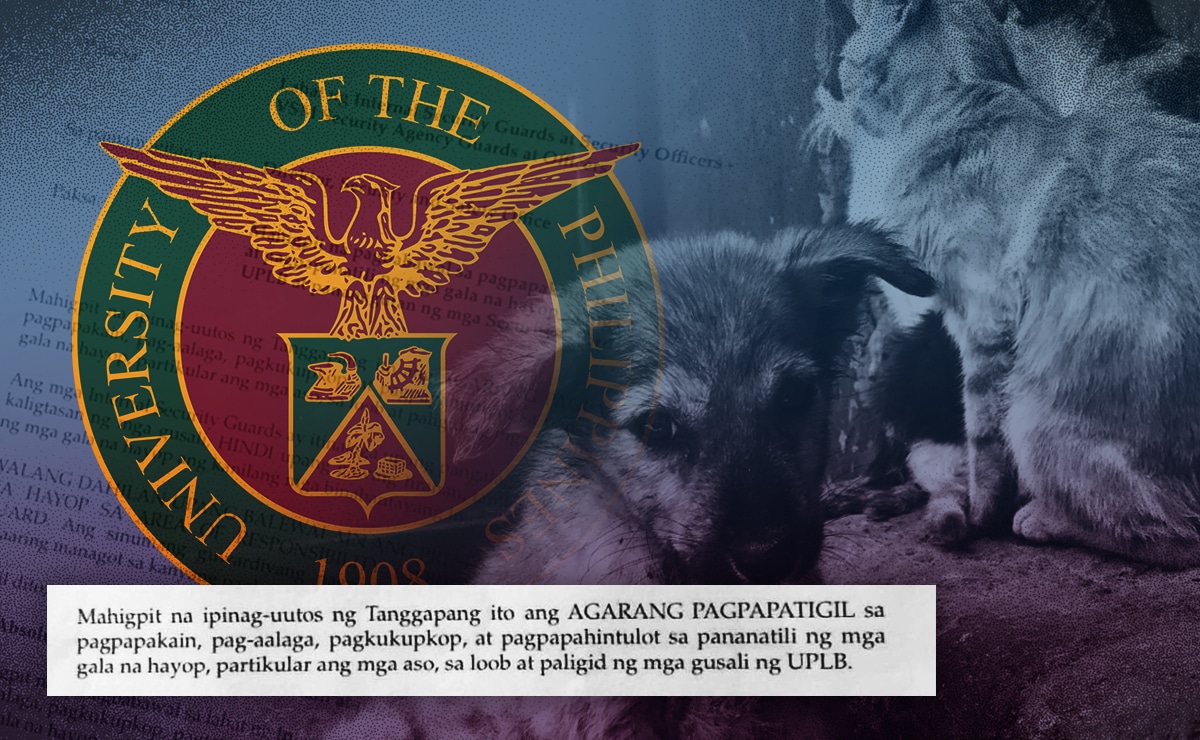
MANILA, Philippines — The vice chancellor for student affairs at the University of the Philippines Los Baños (UPLB) defended a directive issued by the Office of the Vice Chancellor for Community Affairs prohibiting security guards from feeding or sheltering stray animals, particularly dogs, and from allowing them to roam or stay inside or near university buildings.
Janette Malata-Silva explained in a Facebook post that the “directive did not arise out of nowhere,” saying that while “we can see the genuine care our community shows for the animals that share our grounds,” she asked people to view the situation through a complete and more grounded lens.
Malata-Silva, who said she had personally sat with students and families navigating the painful aftermath of campus incidents, said her office had directly assisted students who suffered dog bites and physical accidents in recent months.
Article continues after this advertisement
“In one distressing case, a student had to undergo surgery, leaving us to shoulder around ₱128,000 in medical costs. Beyond the staggering financial weight, there is acute trauma, disrupted studies, and long weeks of painful recovery,” she said.
FEATURED STORIES
NEWSINFO
NEWSINFO
NEWSINFO
READ: UPLB stray animal policy draws criticism
Malata-Silva stressed that “these are not abstract policy points,” as “they are real students under our care whose safety and well-being we are duty-bound to protect.”
She said prioritizing human safety does not require abandoning empathy for animals, noting that the law recognizes both the imperative of public health under the Anti-Rabies Act and the ethical standards of the Animal Welfare Act.
Malata-Silva said “our community must also be honest about how good intentions can inadvertently cause harm,” explaining that leaving food near doorways, hallways and stairs encourages animals to congregate, settle and defend high-traffic walkways as their territory.
Article continues after this advertisement
“When natural territorial instincts take over in crowded corridors, both humans and animals are placed in direct jeopardy,” she said, adding that she hoped “we can stop the hate and start working together.”
She said UPLB can have a coherent, humane and sustainable campus strategy by establishing proper Trap-Neuter-Vaccinate-Return programs in coordination with veterinary experts and animal welfare advocates.
Article continues after this advertisement
UPLB can also set up designated, monitored feeding stations away from building corridors and pedestrian choke points, she said, while maintaining robust institutional support so no injured student has to navigate sudden, crippling medical and academic burdens caused by accidents.
“We can always discuss implementation, critique administrative measures, and collaborate on better mechanisms. But let our discussions build sustainable safeguards rather than deepen divisions. A safe campus and a humane campus should be one and the same,” Malata-Silva said.
Your subscription could not be saved. Please try again.
Your subscription has been successful.
For Malata-Silva, “compassion should never be selective,” as it must embrace the student healing from surgery, the university and parents worrying over hospital bills, security guards stationed at their posts, and animals needing responsible care. /dm
KioskNews shows a cleaned-up reading view extracted from the publisher’s page — the original always lives on their site, not ours.