Following the scent to Singang
A Chiayi County incense factory offers a glimpse into the painstaking craft and spiritual traditions behind Taiwan’s temple rituals
By Steven Crook / Contributing reporter


Several years ago, the Ministry of Economic Affairs began encouraging legacy manufacturing enterprises to reposition themselves as tourist factories. In these places — which draw busloads of Taiwanese tourists but few international travelers — visitors can learn about the history of particular industries, observe production, join DIY workshops and gain an appreciation of the unglamorous but valuable skills that underpin Taiwan’s economy.
Among the country’s most successful tourist factories are sites which make balloons, braised foods, cookies, fishing gear, ribbons and whisky. Few are so closely tied to local traditional culture, however, as Singang Incense Artistic Culture Garden (新港香藝文化園區) in Chiayi County.
The small town of Singang (新港) is best known for its principal place of worship, Fengtian Temple (奉天宮). Each year, the massive nine-day Mazu pilgrimage that starts in Taichung’s Dajia District (大甲) arrives at the temple, then turns around and resumes its homeward trek.
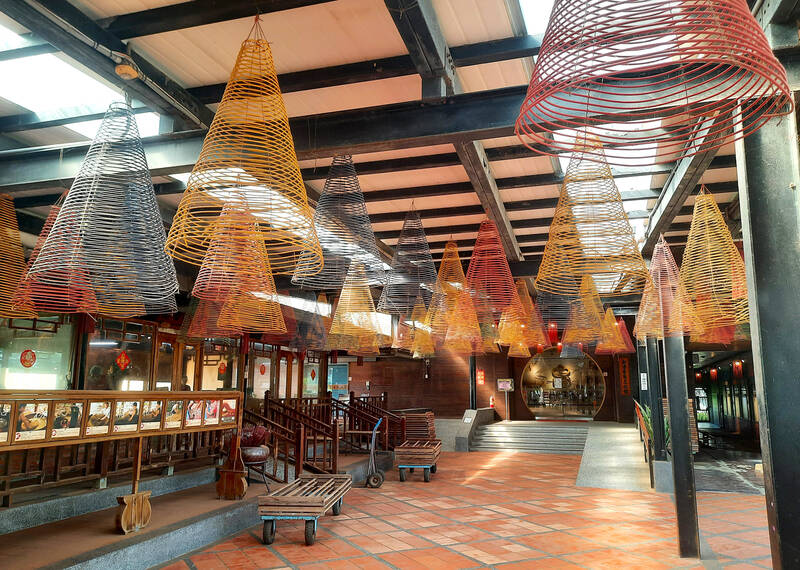
Incense coils decorate the approach to Singang Incense Artistic Culture Garden’s exhibition area.
Photo by Steven Crook
Han Chinese have been burning incense made from agarwood, sandalwood and other fragrant ingredients since at least the Song dynasty (960–1279 AD), and incense has long held a central role in Taiwanese religion and temple culture. The burning of incense establishes a symbolic connection between the human and spiritual realms. Incense smoke is believed to carry the prayers and gratitude of the pious up to the deities they worship. Pioneers wishing to consecrate a new shrine carried with them ash taken from the censer of an established temple in their home region — a ritual known as fenxiang (分香, “dividing the incense”).
These traditions are familiar to anyone versed in Taiwanese popular religion, yet a visit to Singang Incense Artistic Culture Garden offers additional insights to those who can read Chinese or use their smartphone’s translation function.
Originally a thoroughly traditional incense making operation led by three brothers surnamed Chen (陳), the site became a tourism factory in 2008. It now includes an exhibition area, a demonstration workshop, a shop and a restaurant for visiting tour groups — as well as a large production area which is off-limits to the public.
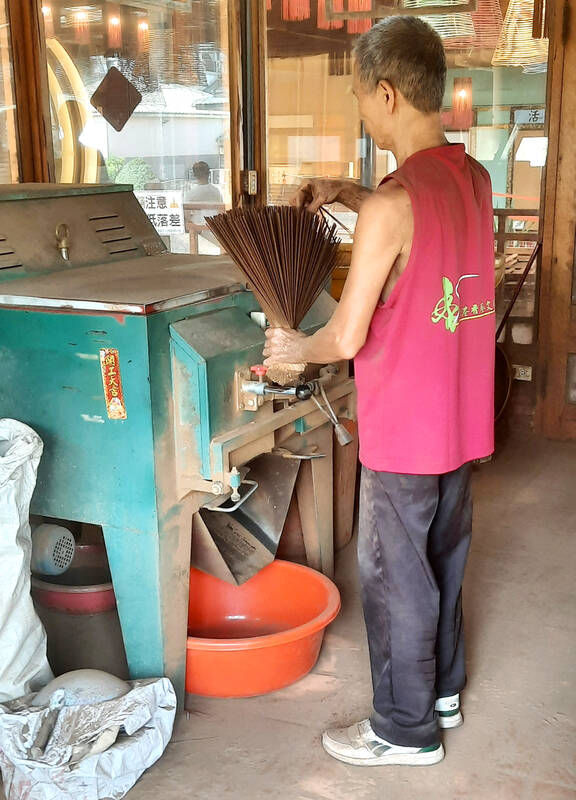
Hot, dusty toil: Making joss sticks is skilled yet repetitive work.
Photo by Steven Crook
Hoping to get some good photos of incense makers at work, I peered through the murky glass that separated me from two middle-aged men. They were busy dipping thin sticks in powder, shaking off the excess, then placing them in a machine that rolls the sticks to ensure they’re evenly coated.
To my surprise, neither man wore a respirator mask or eye protection. Even if the materials being used were 100-percent natural, the sifting and shaking generates plenty of dust. It can’t be healthy.
‘NINE SKILLS OF INCENSE MAKING’
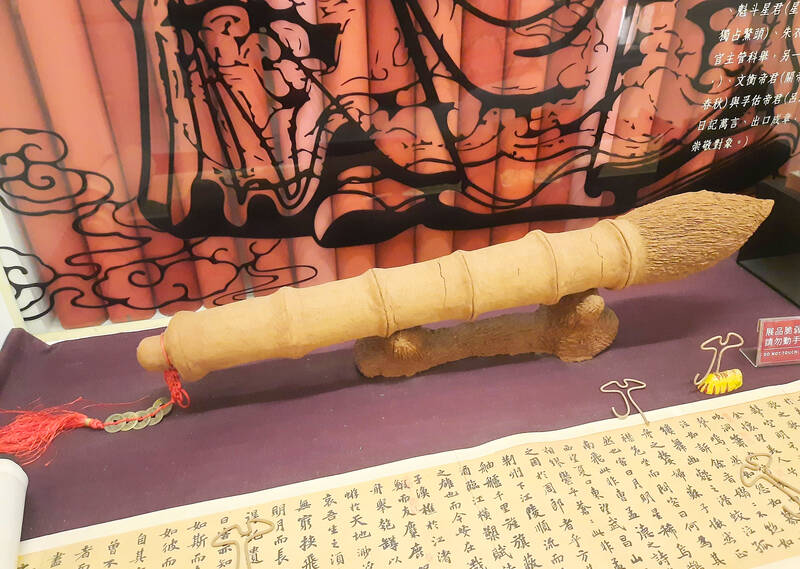
A calligraphy brush shaped from incense dough is among the many artworks displayed at Singang Incense Artistic Culture Garden.
Photo by Steven Crook
I clambered around to the other side of the building, where a couple of doors had been left open, presumably to ventilate the workshop. Pictures taken, I headed for the air-conditioned comfort of the exhibition hall.
One display focuses on the “Nine Skills of Incense Making” that were essential before machines became available. The skills are, in order: dipping (in water, to moisten the bamboo splints); twisting (in natural gum, which ensures the incense powder stays on); resoaking (with water, to activate the adhesive); spreading (holding sticks in a fan-like shape, then tossing aromatic wood powder over them); twirling (rotating the sticks so the powder coating is even); tapping (to shake off excess powder); air drying (until they’re partly but not entirely dry); dyeing (each stick’s handle using red or pink pigment); and sun drying. Even then, the work isn’t done, as the finished sticks have to be inspected, bundled and packaged.
INCENSE MOTHER
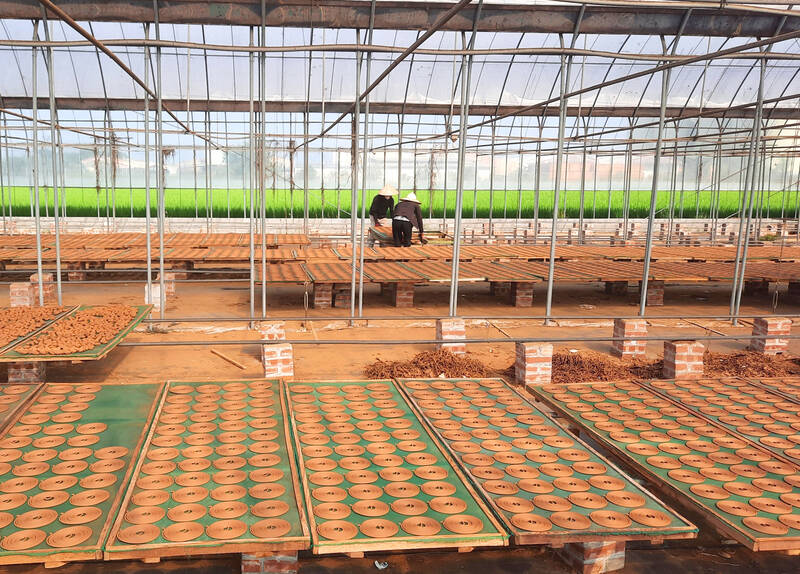
The company’s main production area isn’t open to the public, but it’s visible from the parking lot at the back.
Photo by Steven Crook
One panel tells the story of Jiutian Xuannu (九天玄女), the putative inventor of incense sticks. Myth has it that her father was desperately ill and unable to swallow the bitter herbal medicines prescribed by traditional physicians. One day, she dried the medicinal herbs and ground them up into a powder. After adding a binding paste made from tree bark, she rolled the mixture onto narrow strips of bamboo. These she lit and placed in her father’s bedchamber, so he could breathe in the herbs.
The therapeutic aromas eventually cured him — and his daughter earned an additional name, Xiang Ma (香媽, “Incense Mother”). Over the past thousand years, beyond her role as the patron deity of incense, Jiutian Xuannu has also been worshipped as the goddess of warfare, longevity and sexuality.
Another part of the exhibition concedes that Taiwan’s incense-making industry has been in decline since the 1970s, yet it doesn’t offer any explanations. Rather than any decline in the amount of incense being burnt, I suspect it’s a consequence of cheap imports from China and Southeast Asia taking market share.
Several display cases contain exceptional woodcarvings and objects crafted from incense dough. Similar works of art can be purchased on site. They’re stunning but hardly cheap; I saw one carrying a price tag of NT$398,000. More affordable purchases come in the shape of aromatic sachets, essential oils, fragrant soaps, sandalwood shampoo and various types of incense. In addition to joss sticks of different calibers, there are incense coils, incense yuanbao (元寶, the shape gold and silver ingots used in the China of yore), incense powders and jingxiangfen powders (淨香粉) used in purification rites.
Returning to the car at the end of our visit, I poked my head into the company’s production area. Being a Sunday, the machines were quiet, but outside a pair of workers moved back and forth, turning over incense coils as they dried under the sun. If I learned one thing at Singang Incense Artistic Culture Garden, it’s that incense making — like many other traditional trades — brings its participants both daily tedium and economic stability.
For your information
IF YOU GO
GETTING THERE Singang Incense Artistic Culture Garden is open from 8am to 6pm every day. There’s no admission charge and plenty of free on-site parking. Self-driving visitors taking Road 159 should aim for where it meets Chiayi Local Road 68 (嘉68); the garden is on the northeast side of the intersection. Around two dozen #7201 and #7325 buses depart from downtown Chiayi every day, but the nearest stop, Caigong Village (菜公村) on Road 159, is 500m away. The bus journey takes around 35 minutes.
KioskNews shows a cleaned-up reading view extracted from the publisher’s page — the original always lives on their site, not ours.