Israeli exit polls show deadlock, setback for Netanyahu
Already have Rappler+?
to listen to groundbreaking journalism.
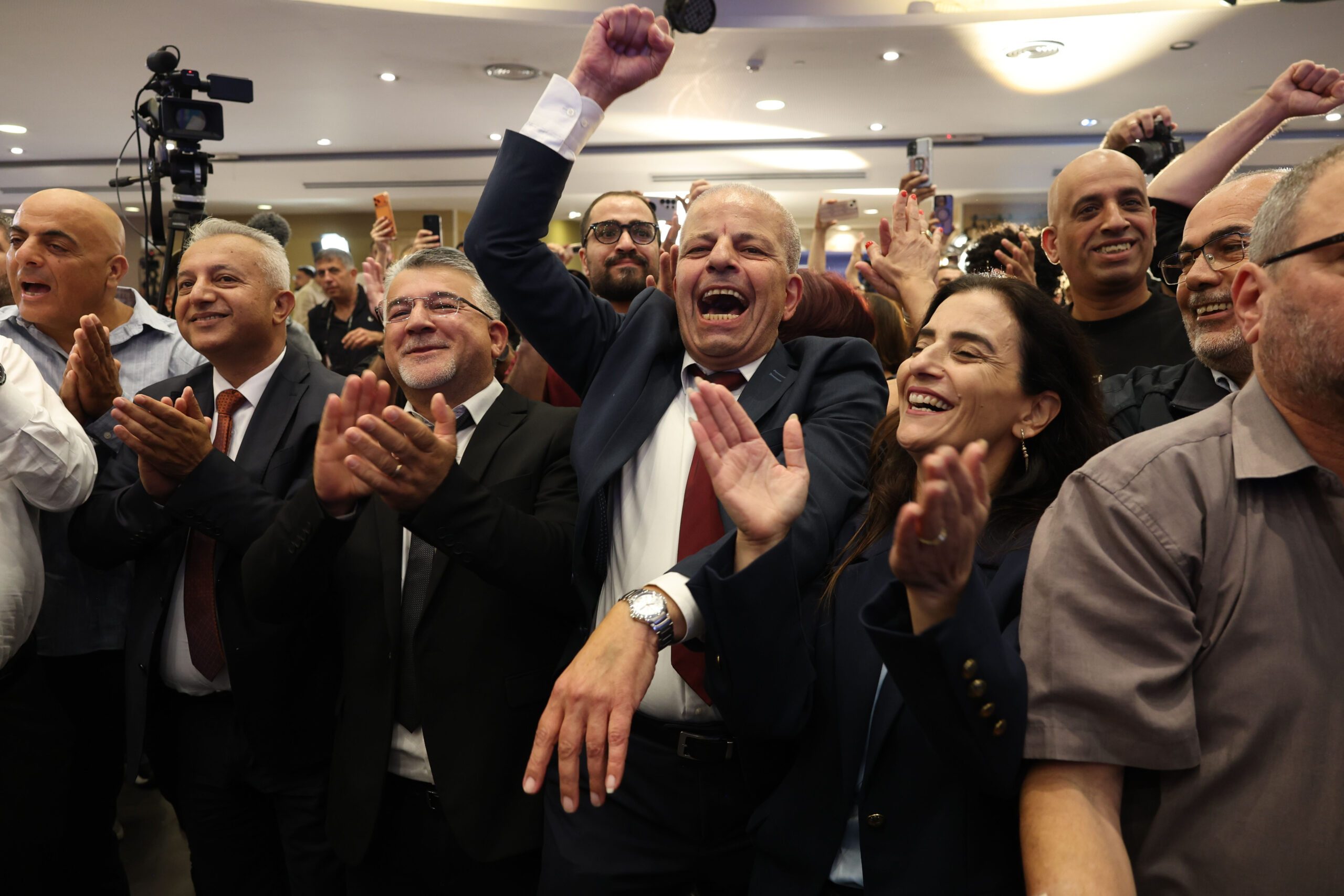
POLLS. Palestinian candidate Yousef Jabareen of the Joint List party and supporters celebrate early exit poll results, at the party's headquarters in Nazareth, during Israel's legislative election.
Reuters
The turnout was 77.7%, the highest in more than two decades and around 7 percentage points higher than in the previous election in 2022
AT A GLANCE
- Israel's wartime election results indicate a deadlock, with Gadi Eisenkot's bloc slightly leading over Netanyahu's Likud party, but no clear path to a governing coalition.
- Voter turnout reached 77.7%, the highest in over two decades, reflecting significant public engagement amid ongoing security concerns following recent conflicts.
- Eisenkot, a former military chief and Netanyahu's main challenger, emphasizes security while distancing himself from Netanyahu's far-right allies, complicating the formation of a majority government.
This is AI-generated. Read the article for full context. Report any errors.
JERUSALEM, Israel – Israel’s wartime election appeared deadlocked on Tuesday, October 27, exit polls showed, a potential setback for veteran Prime Minister Benjamin Netanyahu if the projections hold, with neither side having a clear path to power but rival Gadi Eisenkot’s larger bloc potentially giving him the first chance to form a government.
The stalemate could yet work in Netanyahu’s favor, allowing the prime minister to remain in power in a caretaker capacity while parties try to forge a governing coalition.
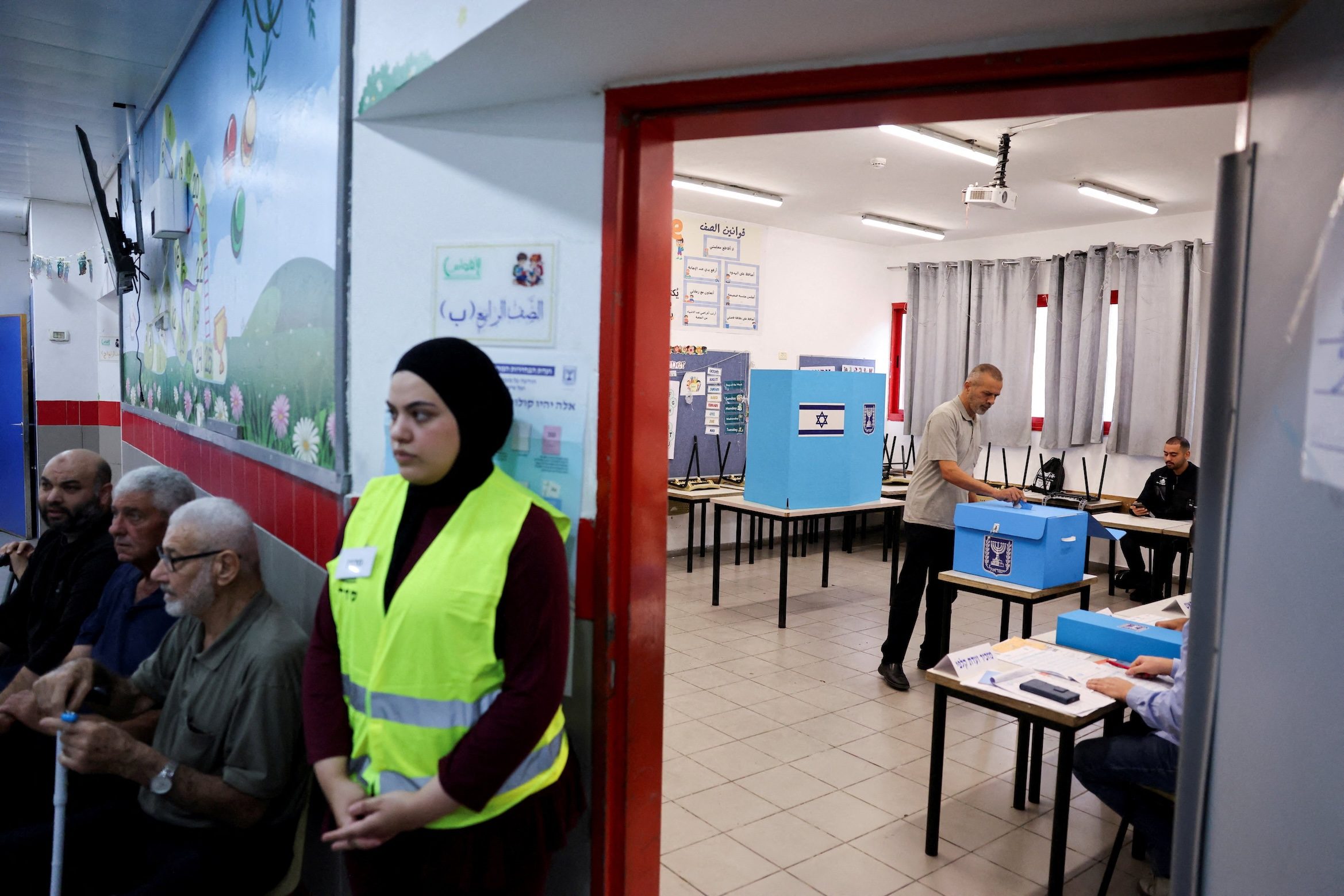
Turnout was 77.7%, Israel’s Central Elections Committee said, the highest in more than two decades and around 7 percentage points higher than in the previous election in 2022.

Israel’s three major networks updated their exit polls, giving Eisenkot’s bloc a two-seat edge over Netanyahu’s Likud-led camp, at 52-50, respectively.
The remaining 18 seats were allocated to unaligned Arab parties in the exit polls. But Eisenkot, leader of the Yashar party, has all but ruled out forming a government with them, complicating his path to a majority despite his bloc’s lead.
Some Israeli media outlets, including pro-Netanyahu Channel 14, projected a far stronger showing for Netanyahu and his parties, saying they would collectively win 60 seats.
Final results could take days, and Israel’s fragmented political system leaves smaller parties potential kingmakers. No single party has ever won 61 seats outright in the 120-seat Knesset, making coalitions the norm.
It was the first election since the Hamas-led attacks of October 7, 2023, and the ensuing wars in Gaza, Lebanon and Iran.
Anti-Netanyahu boost
While there was no clear outcome, the strength of the anti-Netanyahu opposition was evident in the exit polls.
Current opposition head Yair Lapid said in a statement: “Don’t let anyone confuse you: the Netanyahu bloc has suffered a crushing defeat. This is a total collapse and the public has told them to go home.”
Eisenkot, 66, a hawkish former military chief who lost a son and two nephews in the Gaza war, emerged as Netanyahu’s strongest challenger, stressing his security credentials while positioning himself as a centrist domestically.
He entered politics only four years ago and joined Netanyahu’s war cabinet after the 2023 Hamas attack, but quit eight months later, criticizing the prime minister’s leadership.
Eisenkot offers a break with Netanyahu’s leadership and far-right allies, but not with the hawkish security views that have hardened since the 2023 Hamas attack: He opposes Palestinian statehood and says Hamas’ military wing must be destroyed or dismantled.
The headquarters of the Joint List, an alliance of several Arab parties, burst into whistles and applause when exit polls were released at the close of voting, on a historic night for turnout among Palestinian citizens of Israel.
“We refuse the occupation and racism, and we will remain here,” said Faten Gattas, a candidate in the Joint List, in a speech at the alliance’s headquarters in Nazareth. Candidates hope that high Arab voter participation would allow them to play a decisive role in preventing Netanyahu’s coalition – the most far-right in Israel’s history – from returning to power.
A record turnout
Long lines had formed outside polling stations as voters turned out in huge numbers, grappling with the trauma of Israel’s deadliest day, when Hamas killed 1,200 people and took 251 hostage, and the wars with the Palestinian militant group, Lebanon’s Hezbollah and Iran that followed.
While Netanyahu was criticized for the country’s biggest security failure, he argued that he made Israel and the world safer by assassinating top leaders from those groups and Iran.
The policies of Netanyahu’s right-wing coalition have been divisive at home and deepened Israel’s international isolation, but he has portrayed himself as the leader with the mettle to face down Israel’s foes.
Netanyahu, 77, has served as prime minister for nearly 19 of the past 30 years and has repeatedly survived political crises. His opponents have managed to wrest the premiership from him only once since 2009, after four inconclusive elections in two years. Eighteen months later, he was back.
He entered the election facing longstanding corruption charges, which he denies, and criticism over intelligence failures that allowed Hamas-led militants to carry out their attack.
Netanyahu’s nationalist brand of politics is deeply entrenched, and Israel’s fragmented system makes it difficult for an array of opponents to force out his coalition of right-wing, far-right and ultra-Orthodox parties.
Netanyahu had urged supporters to come out to vote to balance high turnout among his opponents on the left and Arab Israelis. “You all need to stream to the polls,” he said. “This is a fateful moment.”
Netanyahu campaigned on an endorsement from US President Donald Trump, his ally in the war against Iran, who has said they should “finish the job.” – Rappler.com
KioskNews shows a cleaned-up reading view extracted from the publisher’s page — the original always lives on their site, not ours.