EverWind says Cape Breton AI data centre project on track despite concerns
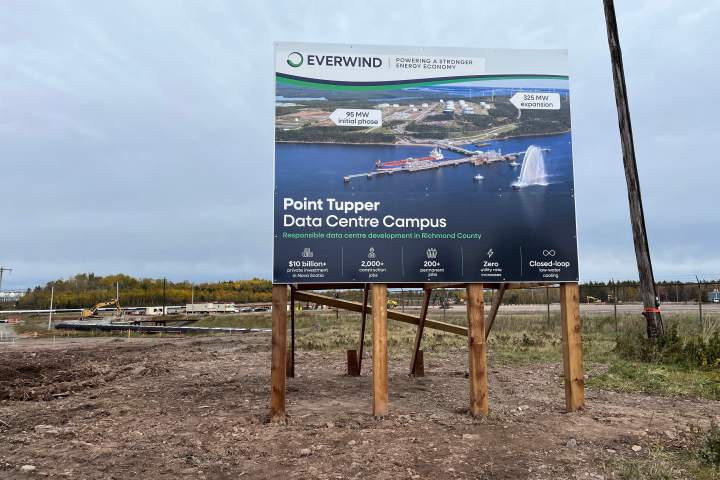
A representative of EverWind, the company behind a massive data centre project in Cape Breton, says everything is moving ahead as planned.

EverWind has committed $10 billion in private investment for the project at its existing Point Tupper site near Port Hawkesbury, N.S., and AI development company Anthropic has signed a long-term lease to use it.
Last week, EverWind signed two agreements with Nova Scotia Power.
Brendan Chard, EverWind’s vice-president of power, says steps are being taken to connect its planned AI data centre to the utility’s electrical grid.
“We have a separate agreement with Nova Scotia Power that covers some of those terms, including covering all of our incremental costs of service to ensure that none of the costs incurred to serve electricity to our facility will be borne by other customers,” said Chard.
Story continues below advertisement

EverWind announces $10B investment in N.S. data centre campus, wind projects
The electric service contract covers the project’s first 95-megawatt phase and outlines that electricity will be provided on an “interruptible basis,” meaning EverWind can be cut off from the grid whenever it’s under pressure.
“We’re prepared to cut service with 10 minutes’ notice from the grid operator if required at any point in time,” said Chard.

Get breaking National news
Get breaking Canada news delivered to your inbox as it happens so you won't miss a trending story.
In the event that happens, Chard says the facility will be powered by batteries or a backup diesel generator.
He says the company ultimately plans for the facility to be largely powered by its proposed wind projects, but notes those first turbines won’t be operational until 2028.
This means the centre will be relying on Nova Scotia Power’s grid for its first year.
“We’re working through getting all of our permits in place so that we can move construction forward as quickly as possible and maintain our timelines to being online in 2027,” he said.
Story continues below advertisement
Power grid concerns
Protests against the project have taken place across the province since it was announced a month ago.
Nick Tsergas, a science and tech journalist who founded StopTheDataCentre.ca, says he began his advocacy work when a mega data centre was proposed near his home in Hamilton, Ont.
“I’ve just been living and breathing this issue, digging into it as much as I can, and noticing a lot of patterns in these data centre conversations as they pop up, mushroom up around the country,” he said.
He says AI data centres use significantly more power than traditional data centres, which were historically used for bank transactions or website hosting.
“They use 10 times the power, let’s say, 10 to 20 times the power that a traditional data centre of the same size would use,” said Tsergas.
“And when more power is used, more heat is also produced. So you need to come up with some very creative ways to cool the data centre so that the graphics cards basically don’t melt.”
EverWind’s plan for Point Tupper indicates it will use a closed-loop cooling system where a water–glycol mixture circulates through a sealed loop rather than being routinely discharged.
Story continues below advertisement
“Heat will be removed primarily using air, with water-assisted cooling used during the hottest weather,” EverWind said in a release.
“Nova Scotia’s cooler climate reduces cooling-water requirements for much of the year.”

Growing pushback against planned AI data centre in Nova Scotia
But Tsergas points out the “full picture” of closed water-cooling systems and how much water this requires.
“Many of the data centres being proposed across Canada, the designs include either natural gas generating infrastructure or even backup diesel generators bundled into the data centre,” he said.
“Those things need water to cool them as well. So if you’re using more electricity to power the closed-loop cooling system, more and more of that water is going to be needed to cool the gas turbines attached to the data centre.“
Story continues below advertisement
New tariff structure needed
EverWind will pay an interim large industrial tariff to access Nova Scotia’s power grid until a new fee is developed.
Nova Scotia Power said in a statement that the new fee is necessary because existing tariff structures were not designed for a customer of this scale.
“Our approach to data centres is consistent with what is becoming common across North America: ensuring existing customers do not bear the costs of serving new developments,” the statement said.
EverWind says the data centre’s second phase, which could see the project expand to 420 megawatts, should be complete sometime in 2028 and is subject to approvals and conditions.
KioskNews shows a cleaned-up reading view extracted from the publisher’s page — the original always lives on their site, not ours.