‘I couldn’t walk’: The moment Rose Byrne knew she’d gone too far for her new thriller
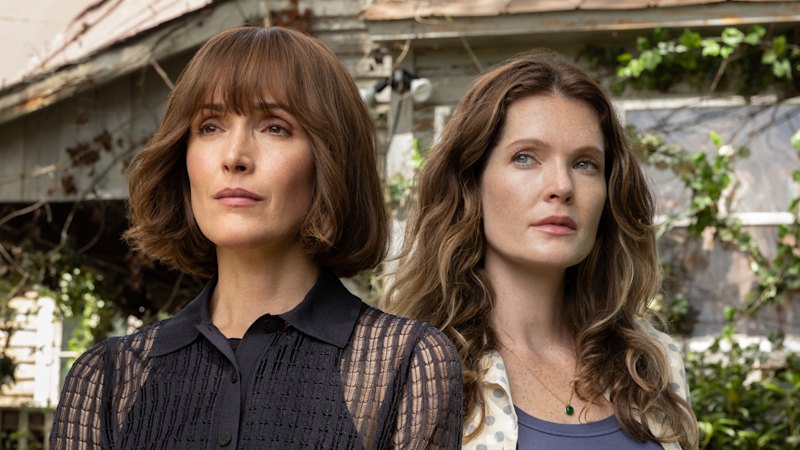
There’s a point in every crime thriller when the puzzle pieces start to click together – new evidence is unearthed, new testimony is recorded, a new suspect appears and turns the case on its head. In each episode of new thriller The Good Daughter, each assembled piece reveals only more loose ones, widening the scope of an addictive and emotional story set in the American South until just about every resident of the town of Pikeville is in the crosshairs.
At the heart of the story, adapted from legendary crime writer Karin Slaughter’s 2017 book, are sisters Samantha and Charlotte “Charlie” Quinn, played by Rose Byrne and Meghann Fahy. As girls, they were raised by a sharp, cerebral mother as interested in Emily Dickinson as she was in studying the science of weather patterns.
Their father, Rusty, played by Brendan Gleeson, is the town’s notorious defence attorney and has a list of enemies a mile long for taking on cases without neat moral boundaries. He’s a larger-than-life figure, a kind of funhouse-mirror version of Atticus Finch who keeps the town – and his girls – in line with a dirty mouth and sly smile.
“[Slaughter] has a richness of character and a detailed place in the American South,” says Byrne. “And she’s an absolute force to work with. It was interesting having the author on set because [she’s had] these characters for decades in her head.”
Fahy agrees. “Karin’s pretty unflinching,” she says. “She’s really not afraid to go anywhere with a character. And there’s not really any topic of conversation that she’s not willing to put under a microscope.”
She’s an expert at surprise, at building in twists and reveals and herrings of all colours in characters you care deeply about. “You really can’t get ahead of her plot-wise.”
We meet the Quinns, in episode one’s opening flashback, on the day the violent ripples of their father’s work floods their doorstep.
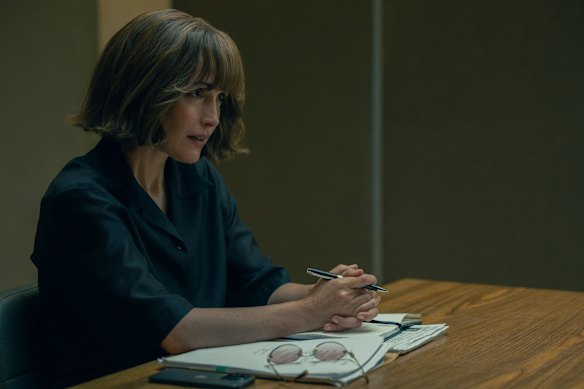
Thirty years after experiencing the town’s brutality first-hand, the sisters are splintered. While Sam is practising sterile and safe patent law in New York City, Charlie has stuck around in town to follow in their father’s footsteps, hauling teenagers in front of the judge to face their petty crimes, messing around on her estranged husband and knowing the rules just well enough to break them.
“I was involved with casting and we were so lucky to get Meghann, who brings such a lightness of touch to a character that is very tightly locked up and is hard to reach for the people around her – and the audience,” says Byrne, who served as an executive producer on the series. “Charlie is the heart and soul of this story.”
After witnessing a school shooting, Charlie senses there’s more to the story than what Pikeville’s corrupt cops are telling the community – but she can’t argue the case alone. When her sister returns home, the layers of their personal history unravel alongside this complex new case.
The sisters are like magnets with opposing fields; they push at and test each other, denying the fact they’re fated to face the world and their shared trauma shoulder-to-shoulder. When one stays, the other runs. One sister deals with her pain by enforcing control over every element of her life, while the other attracts chaos.
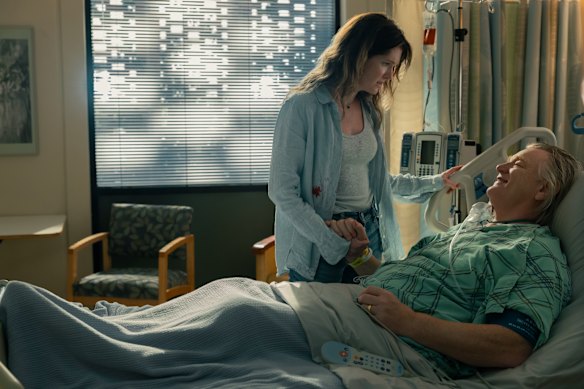
The youngest of three sisters, Slaughter wove the specificities of a sisterly bond into every line of her book, and the series’ scripts – all of which she wrote. She also served as a showrunner and an executive producer.
“Karin’s dialogue is so specific. It does a lot of the heavy lifting in terms of who the characters are,” says Fahy. “There’s a very particular way that Charlie speaks and there’s a very particular way that Sam speaks. When we were in scenes that were quite snappy and going back and forth, you do start to slip into the rhythm of these people because it’s so clearly there on the page.”
For as much as Sam tries to plaster over her past, her scars are visible on the surface. The violence in her childhood left her disabled and walking with a limp, and affected her speech.
Fresh off her Golden Globe win and Oscar nomination for last year’s If I Had Legs I’d Kick You, Byrne grabbed the opportunity with both hands – but might’ve accidentally gone a little too method.
“I worked with a PT trainer who works in rehab with people with injuries to establish [Sam’s] walk, and then with another person with dysarthria [to accurately portray] how she spoke,” says Byrne. “It had quite a consequence. I was in Melbourne on a holiday with my family and all of a sudden … my back seized up and I couldn’t walk and I had to lie down for two days.
“I saw this osteopath, and they said, ‘What have you been doing?’ I said, ‘Well, I was playing a person with a limp. I did it every day for eight weeks.’”
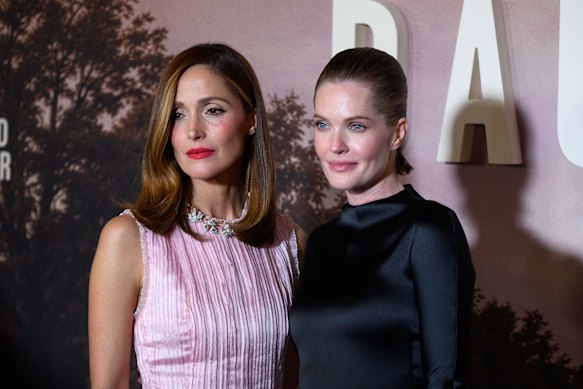
Turns out that’s the precise amount of physical adjustment it takes to fundamentally change how your body operates.
Alongside Byrne and Slaughter, a largely female creative team brought The Good Daughter to life with care and thoughtfulness. Oscar-nominated Steph Green directed the entire series, which was also overseen by Australian super-producer Bruna Papandrea, co-founder of Reese Witherspoon’s production company, Pacific Standard. “It was a very sensitive topic we were covering and it felt like we were just in really great hands the whole time,” says Byrne, referring to the crew as an “incredible coven”.
Her character, Sam, is in many ways a literary classic – the prodigal child returning home to face their family’s demons – and in others, an entirely modern invention.
“It’s something we’ve seen countless times with men, but not as much with women,” says Byrne. “It felt very fresh in that sense that it was about a woman doing that.”
KioskNews shows a cleaned-up reading view extracted from the publisher’s page — the original always lives on their site, not ours.