Heart attacks in fit women in their 30s and 40s: The hidden risk doctors want you to know

For long, women were thought to be at a low risk of heart attacks in their younger years considering the female hormone estrogen helps keep blood vessels flexible and reduces inflammation. It was only after menopause that a woman’s risk of heart attack and cardiovascular diseases was seen as equal to men. However, as younger apparently fit women in their 30s and 40s are increasingly reporting heart attacks without any risk factors like cholesterol, blood sugar or smoking, a new condition has caught the attention of researchers globally.
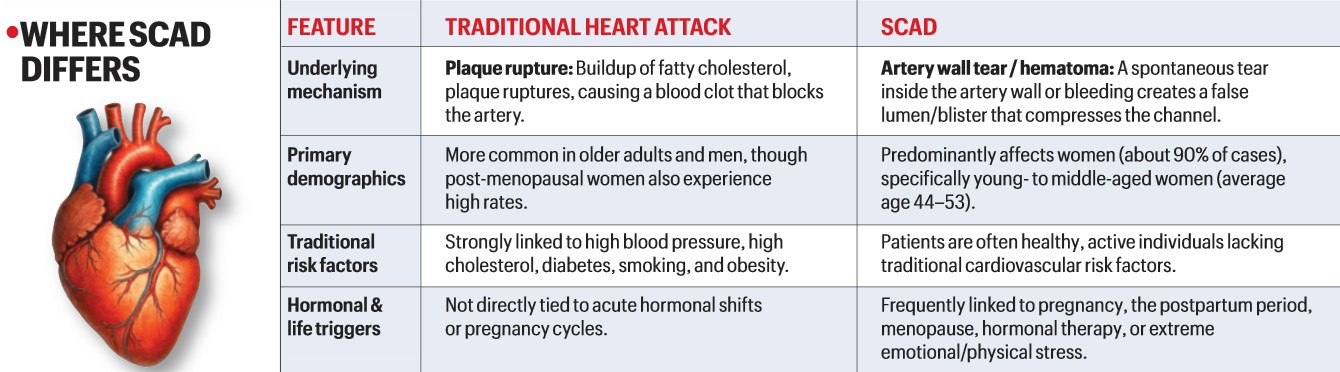
This is the Spontaneous Coronary Artery Dissection (SCAD), a hidden, sudden type of heart attack caused by a spontaneous tear or bruise inside a cardiac artery. In a normal heart attack, a cholesterol-rich plaque in a heart artery usually ruptures or erodes, causing a blood clot that obstructs blood flow. “Instead of the artery being blocked by slow-growing cholesterol or fat, the wall of the blood vessel unexpectedly splits, trapping blood inside the lining and blocking the flow of oxygen to the heart. The artery is squeezed,” says Dr Rajiv Gulati, Chair of the Division of Interventional Cardiology in the Department of Cardiovascular Medicine, Mayo Clinic, who has been specialising in women’s heart health. The American Heart Association’s 2026 scientific statement on acute coronary syndromes in premenopausal women highlights SCAD as an under-recognised problem. “Young women account for approximately 80–90% of SCAD cases. Among women under 50 who have a heart attack, SCAD may account for as many as one-third of cases,” says Dr Ambuj Roy, Professor of Cardiology, AIIMS, Delhi.
Why does SCAD disproportionately affect younger and middle-aged women?
The incidence in women suggests a hormonal link, though it is still being studied. Dr Gulati has observed that about 5-10 per cent of all SCAD cases occur after pregnancy, typically in the first week postpartum. “There are, of course, major hormonal changes at this time, which likely cause fragility of the coronary vessel wall in a small proportion of women who are susceptible,” he says. Dr Roy has seen that more than 70% of pregnancy-associated SCAD in one large series occurred after delivery, most commonly in the first week. “Pregnancy-associated cases can also be more severe, with greater likelihood of multiple-vessel involvement,” he says.
But most SCAD is unrelated to pregnancy, which, both experts agree, suggests a hormonal link. “Estrogen and progesterone can influence tissues and the structure of blood vessels, though they themselves cannot cause SCAD,” says Dr Roy. Since both influence the cellular matrix of blood vessels, their high or fluctuating levels can lead to the breakdown of collagen in the artery walls.
How often is SCAD missed or misdiagnosed?
The condition is often under-recognised. “The difficulty is that the patient often does not resemble a traditional picture of somebody at risk of a heart attack — she may be relatively young, active and without cardiac risk factors like diabetes, smoking or high cholesterol and thus may go undiagnosed,” says Dr Roy. The symptoms, however, are usually quite similar to a heart attack. “Chest discomfort occurs in more than 90% of patients, and there are eventually classical ECG (electrocardiogram) changes and rise in cardiac biomarkers suggesting a heart attack.” His message for health professionals is simple: “Do not ignore significant chest pain in a younger woman merely because her conventional cardiovascular risk is low, particularly during pregnancy or after delivery. SCAD can also be missed during coronary angiography because the commonest form may appear as a long, smooth narrowing rather than an obvious tear. Awareness of these angiographic patterns is, therefore, crucial as treatment differs from conventional therapy,” says Dr Roy.
What are the strongest known triggers or associations?
Dr Gulati, who has tracked multiple SCAD research registries of thousands of patients, lists the triggers as intense physical exertion, emotional stress, pregnancy, hormonal changes or underlying vascular conditions. Dr Roy has found one of the strongest associations. “That is fibromuscular dysplasia (FMD), a non-atherosclerotic (no plaque) disorder affecting medium-sized arteries, leading to narrowing and bulging. Other vascular abnormalities, including aneurysms and tears elsewhere in the body, are also more common in SCAD patients. Possible immediate triggers include extreme physical exertion, heavy lifting or straining, and severe emotional stress. Up to about two-thirds of patients in some studies report a preceding physical or emotional stressor. Emotional triggers appear more frequent in women and physical triggers in men,” says Dr Roy.
How to treat SCAD?
The treatment differs from a conventional heart attack. “If there is complete blockage in a major coronary artery, the vessel should be opened by angioplasty/balloon to restore blood flow and prevent heart muscle damage. We may choose to avoid placing a stent as this can in some circumstances extend the tear, but this is considered on a case by case basis. If SCAD does not cause a complete blockage, then angioplasty (and its risks) can be avoided because the vessel will heal in most cases. There is a 15% risk of worsening of SCAD in the first few days so we recommend observing patients in the hospital,” says Dr Gulati.
Story continues below this ad
Drug treatment also differs. “Beta-blockers are used, particularly for blood-pressure control, and observational evidence suggests they may reduce recurrence. Statins are not automatically required after SCAD unless there is another indication such as high cholesterol or coexisting atherosclerosis. Antiplatelet treatment (a kind of blood thinner) in patients who have not received a stent remains uncertain,” says Dr Roy.
The ultimate goal is to move beyond treating SCAD after it occurs. Dr Roy emphasises identifying the vulnerable artery and patient before the first event happens. “That is where genetics, vascular imaging and large international SCAD patient registries may eventually take us,” he says.
What is the risk of another SCAD, and what can patients do afterwards?
Recurrence can occur, including years later. “Older series have reported recurrence rates of approximately 10–30% with longer follow-up, while a large contemporary cohort reported recurrence of about 2.4% at three years.
Having SCAD does not mean a person should stop exercising. Cardiac rehabilitation and regular moderate physical activity are encouraged. Moderate aerobic activity and resistance exercise with light weights and more repetitions are generally reasonable. What we generally discourage are extremes — very heavy lifting with straining, exercising to exhaustion and extreme endurance exercise,” says Dr Roy.
Story continues below this ad
Pregnancy after SCAD requires individualised counselling. “Many women have subsequently had uncomplicated pregnancies, but recurrence can occur, particularly postpartum. Women contemplating pregnancy should ideally undergo assessment jointly by a cardiologist and maternal-fetal medicine specialist, says Dr Roy.
KioskNews shows a cleaned-up reading view extracted from the publisher’s page — the original always lives on their site, not ours.