E-bikes pose a challenge to Dutch cycling culture
AWARENESS CAMPAIGN: Bike paths are no longer the preserve of pedal bikes, as all kinds of two-wheeled vehicles take over, leading to conflict and collisions
For decades the Netherlands has been famed for its proud cycling culture, with a network of 37,000km of bike paths used by everyone from children under eight to adults over 80.
However, in the past few years, like so many countries around the world, it has seen a dramatic change in the type of vehicles using those lanes: No longer the preserve of pedal bikes, they are used by all manner of two-wheeled vehicles, including electric cargo bikes, “fatbikes,” speed pedelecs, electric scooters and even some micro cars.
Throw smartphones into the mix as well, and the result is clear: less space, more conflict, less civility and more collisions, critics said.
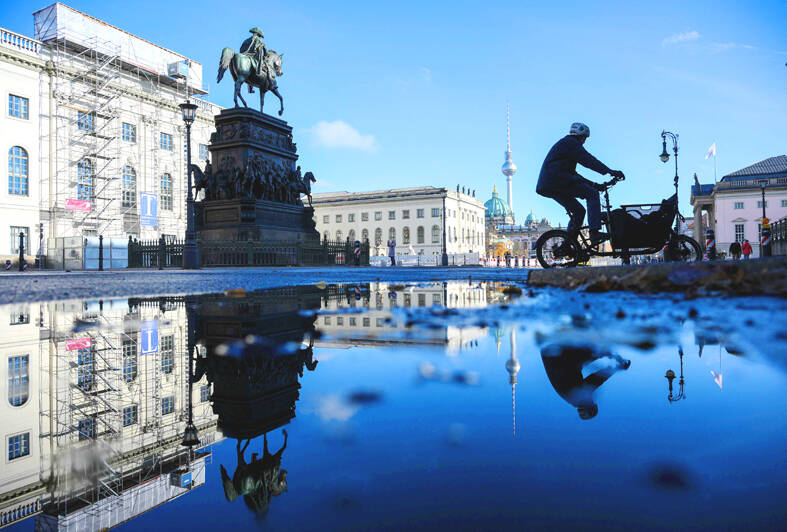
A man on a bicycle is reflected in a puddle in Berlin on Tuesday last week.
Photo: AFP
Data from the Netherlands Institute for Transport Policy Analysis showed that the annual number of cyclist deaths increased by more than 50 percent from 2015 to last year.
Some say what is needed are new rules of the road. Last week, the Dutch government sent a bill to parliament proposing mandatory helmets for under-18s on e-bikes. The moves are welcomed by those who feel that things need to change.
As one resident, Patrick van den Hoven, wrote in the Amsterdam newspaper Het Parool this month: “Let’s call a spade a spade: [e-bikes] are vehicles with a motor, which, as far as I am concerned, we should treat as motor vehicles.”
The city’s bike lanes now resembled “a permanent traffic experiment,” he said, adding: “The bicycle made our country great. It would be a shame if it eventually fell victim to electric progress.”
Another city, Leiden, earlier this month launched a public awareness campaign to remind everyone that “traffic is a team sport.” It has the Netherlands’ highest number of bike accidents per head, and cyclist injuries have risen by more than half since 2018.
“This campaign aims to say: guys, watch out for one another,” Leiden Deputy Mayor for Spatial Planning and Mobility Julius Terpstra said. “We see more people on bikes, more older people on bikes due to the aging population, and more different vehicles, when once the Netherlands only had the Gazelle [a popular pedal bike brand]. We see national trends here too: the rise of the electric bike, more telephone use, and also drug use.”
Fietsersbond Amsterdam cycling union board member Florrie de Pater said there has been a notable decline in road manners.
“There is less consideration for one another and less empathy among cyclists, perhaps also because we live in an individualistic world where everything has to go fast, fast, fast,” she said.
Bicycle Mayor of Amsterdam Romee Nicolai believes some people have forgotten that the extensive network of dedicated cycle paths was created after a wave of activism sparked by road deaths in the 1970s.
“People have been cycling for hundreds of years, but we need to acknowledge that this cannot continue if we don’t give it attention,” she said. “You can’t grow plants if you don’t give them attention and water, and it’s the same with cycling. That means public debate, and financial means from government to create a safe cycling environment, too.”
Some older people have told her they are too afraid of an accident to get on their bicycles, while one in five children are growing up without a cycling culture.
“We need to acknowledge that we are actually losing those cyclists,” Nicolai said.
A study by the National Institute for Public Health and the Environment found that fewer Dutch young adults were doing the recommended daily amount of movement, partly owing to less general cycling and the rise of the e-bike.
Jasper Reenalda, a human movement scientist at the University of Twente, raised concerns about the impact of more e-bike use, particularly if children lose a low-impact exercise that was once built into everyday life.
“Our whole infrastructure was built around bikes, so children bike to school, they bike to sports, they bike to all kinds of social activities,” he said. “It was always very easy for Dutch children to reach the norms of active, minimally active behavior. If children are switching to e-bikes, and that’s the trend, it is more challenging to reach the minimum number of active minutes to stay healthy.”
However, some experts said it is easy to stereotype certain groups — such as “fatbike” users — for causing the tensions.
Clara Glachant, a researcher in micromobility at Eindhoven University of Technology, said e-bikes could have a positive role in “expanding cycling to groups that do not cycle.”
Urban Cycling Institute in Amsterdam chief executive Meredith Glaser said that said four in 10 cyclists who died in the past few years were in a collision with a car.
“Any pointing of fingers towards cyclists is an excellent scapegoat for the uncomfortable reality that cars and trucks are still taking up the majority of public space and causing the most harm to the environment and to human bodies,” she said.
KioskNews shows a cleaned-up reading view extracted from the publisher’s page — the original always lives on their site, not ours.